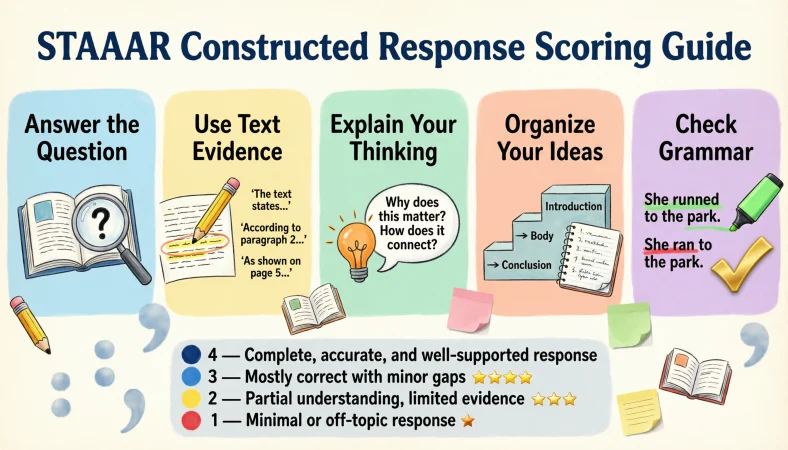
Quick Answer: The STAAR constructed response scoring guide helps students and educators understand how written responses are evaluated based on their accuracy, evidence, explanation, organization, and writing quality. A strong constructed response answers the question directly, supports ideas with relevant details, and explains its reasoning clearly.
5 Key Scoring Elements: Clear answers, relevant evidence, detailed explanations, logical organization, grammar and conventions.
Ever written an answer that seemed perfect in your head but somehow didn’t earn the points you expected? We’ve all been there! Constructed responses require more than simply knowing the correct answer. Students must explain their thinking, provide supporting evidence, and organize their ideas in a way that makes sense to the reader. That’s where the STAAR constructed response scoring guide becomes useful.
Whether you’re preparing for a standardized assessment, helping students improve their writing, or trying to understand how teachers assign points, knowing the scoring criteria can make a real difference. Think of the scoring guide as a roadmap that shows what a complete answer should include. Instead of guessing what graders want, students can focus on answering accurately, supporting their ideas, and explaining their reasoning with confidence.
Clear and Accurate Response Examples
A clear response directly answers the question without unnecessary information. Accuracy is important because even a beautifully written answer may lose credit if it misunderstands the task.
1. My answer directly addresses the question. Example: Useful when checking whether an answer responds to every part of the assessment question. Meaning: Shows that the student understands the main task.
2. I included the most important information. Example: Helpful when reviewing an answer that contains several details. Meaning: Emphasizes relevance and accuracy.
3. Every sentence supports my main idea. Example: Useful when removing unrelated information from a written response. Meaning: Keeps the answer focused.
4. I answered what was actually asked. Example: Helpful when a student tends to write about a related topic instead of the specific question. Meaning: Demonstrates understanding of the instructions.
5. My explanation stays on topic. Example: Useful when checking a response before submitting an assessment. Meaning: Shows consistency and focus.
6. I used accurate information throughout. Example: Helpful when responding to a reading comprehension question. Meaning: Highlights factual correctness.
7. I explained the central idea clearly. Example: Useful when describing the main message of a passage. Meaning: Shows understanding of the most important concept.
8. My response covers every required part. Example: Helpful for questions containing multiple instructions. Meaning: Demonstrates completeness.
9. I avoided unrelated details. Example: Useful when shortening an overly detailed answer. Meaning: Keeps the response relevant.
10. My answer reflects the passage accurately. Example: Helpful when answering questions based on a reading selection. Meaning: Shows that the student understands the source material.
11. I used precise words to explain my thinking. Example: Useful when replacing vague statements with specific explanations. Meaning: Improves clarity and accuracy.
12. My response gives a complete answer. Example: Helpful when checking whether the question has been fully addressed. Meaning: Emphasizes a complete and understandable response.
Evidence-Based Response Examples
Evidence helps students demonstrate that their answers are supported by information rather than guesses. Reading assessments often expect students to refer to specific details from the provided text.
1. I supported my answer with textual evidence. Example: Useful when answering a question about a character’s behavior. Meaning: Connects the answer to information in the passage.
2. The passage provides evidence for my idea. Example: Helpful when explaining an interpretation of a reading selection. Meaning: Shows that the response is grounded in the text.
3. I included a relevant quotation. Example: Useful when a question asks students to support an argument with exact words. Meaning: Adds direct evidence to the explanation.
4. This detail supports my main point. Example: Helpful when selecting a specific sentence from a passage. Meaning: Explains why the chosen evidence matters.
5. I used an example from the reading. Example: Useful when explaining a theme or central message. Meaning: Makes the answer more convincing.
6. My evidence matches the question. Example: Helpful when checking whether supporting details are relevant. Meaning: Demonstrates purposeful evidence selection.
7. I identified an important detail from the text. Example: Useful when answering a question about a character’s decisions. Meaning: Shows careful reading.
8. The author’s words support my explanation. Example: Helpful when interpreting an author’s message. Meaning: Connects the interpretation to the original writing.
9. I selected evidence that proves my point. Example: Useful when supporting an opinion about a passage. Meaning: Strengthens the response with relevant information.
10. My answer includes specific examples. Example: Helpful when a general explanation needs more support. Meaning: Makes ideas easier to understand.
11. I connected the evidence to the question. Example: Useful when explaining why a particular passage detail matters. Meaning: Demonstrates a clear relationship between evidence and the task.
12. I avoided unsupported statements. Example: Helpful when reviewing claims that lack proof. Meaning: Encourages evidence-based reasoning.
Explanation and Reasoning Examples
Providing evidence is only part of the task. Students also need to explain how their evidence supports their answers.
1. This evidence shows that my answer is correct. Example: Useful after including a quotation from a reading passage. Meaning: Connects supporting information to the main answer.
2. I explained why this detail matters. Example: Helpful when a response includes evidence without interpretation. Meaning: Adds reasoning to the answer.
3. My explanation connects the evidence to the main idea. Example: Useful when discussing a passage’s central message. Meaning: Demonstrates logical thinking.
4. I showed how the character’s actions reveal their feelings. Example: Helpful when analyzing character development. Meaning: Explains the significance of specific actions.
5. The evidence supports my conclusion. Example: Useful when answering an inference question. Meaning: Shows a logical connection between proof and conclusion.
6. I explained the reason behind my answer. Example: Helpful when a question asks students to justify their thinking. Meaning: Demonstrates understanding rather than simple guessing.
7. My reasoning makes the answer understandable. Example: Useful when reviewing a response that contains complicated ideas. Meaning: Improves the clarity of the explanation.
8. I connected each detail to my argument. Example: Helpful when using multiple examples in one response. Meaning: Creates a consistent explanation.
9. I explained what the evidence reveals. Example: Useful when interpreting a significant event in a passage. Meaning: Goes beyond simply repeating information.
10. My conclusion follows the evidence. Example: Helpful when checking an argumentative response. Meaning: Shows logical reasoning.
11. I explained the importance of the example. Example: Useful when discussing a specific event or quotation. Meaning: Shows why the evidence deserves attention.
12. My answer includes both proof and explanation. Example: Helpful when reviewing a complete constructed response. Meaning: Combines supporting details with meaningful reasoning.
Organization and Structure Examples
A well-organized response helps graders follow the student’s thinking. Clear sentences, logical sequencing, and appropriate paragraph structure make answers easier to evaluate.
1. My response follows a logical order. Example: Useful when explaining several events from a passage. Meaning: Keeps ideas organized.
2. I started with a clear answer. Example: Helpful when writing the opening sentence of a constructed response. Meaning: Establishes the main point immediately.
3. My supporting details appear in the right places. Example: Useful when organizing evidence and explanations. Meaning: Improves the flow of ideas.
4. Each sentence connects to the next. Example: Helpful when checking transitions between ideas. Meaning: Creates a smooth reading experience.
5. I used paragraphs to separate different ideas. Example: Useful when writing a longer assessment response. Meaning: Makes information easier to follow.
6. My introduction establishes the main point. Example: Helpful when writing a multi-paragraph response. Meaning: Gives readers a clear starting point.
7. I placed evidence near its explanation. Example: Useful when organizing quotations and supporting details. Meaning: Makes the connection between ideas obvious.
8. My conclusion reinforces my answer. Example: Helpful when finishing an extended response. Meaning: Brings the explanation together.
9. I avoided repeating the same point. Example: Useful when editing a response with repetitive sentences. Meaning: Makes writing more concise.
10. My ideas follow a clear sequence. Example: Helpful when describing cause and effect. Meaning: Improves logical organization.
11. I used transitions to connect ideas. Example: Useful when moving from evidence to explanation. Meaning: Helps the response flow naturally.
12. My response has a beginning, middle, and ending. Example: Helpful when reviewing a complete written answer. Meaning: Gives the response a recognizable structure.
Grammar and Writing Conventions Examples
Grammar, punctuation, spelling, and sentence structure help students communicate their ideas effectively. Writing conventions may be included in a scoring rubric, depending on the assessment.
1. I checked my spelling carefully. Example: Useful during the final review of an assessment response. Meaning: Reduces spelling mistakes.
2. My sentences are grammatically correct. Example: Helpful when reviewing sentence construction. Meaning: Improves readability.
3. I used punctuation correctly. Example: Useful when editing sentences with quotations or multiple clauses. Meaning: Makes meaning easier to understand.
4. My writing uses complete sentences. Example: Helpful when replacing incomplete thoughts with full explanations. Meaning: Creates clear communication.
5. I avoided unnecessary grammar mistakes. Example: Useful when proofreading a final answer. Meaning: Improves writing accuracy.
6. My word choices are appropriate. Example: Helpful when selecting precise vocabulary. Meaning: Makes explanations more effective.
7. I used consistent verb tense. Example: Useful when describing events in a reading passage. Meaning: Keeps the writing grammatically consistent.
8. My sentences are easy to understand. Example: Helpful when revising confusing explanations. Meaning: Prioritizes readability.
9. I avoided run-on sentences. Example: Useful when dividing lengthy sentences into shorter ones. Meaning: Improves sentence structure.
10. My capitalization is correct. Example: Helpful when proofreading names, places, and sentence beginnings. Meaning: Demonstrates attention to writing conventions.
11. I used vocabulary that fits the topic. Example: Useful when explaining academic concepts. Meaning: Makes the response more precise.
12. I proofread before submitting. Example: Helpful during the final minutes of an assessment. Meaning: Encourages careful editing.
Short and Direct Response Examples
Sometimes students believe longer answers automatically earn more points. However, a response should focus on answering the question completely rather than adding unnecessary words.
1. My answer is short but complete. Example: Useful when responding to a question requiring one clear explanation. Meaning: Prioritizes completeness over unnecessary length.
2. Every word serves a purpose. Example: Helpful when removing repetitive information. Meaning: Encourages concise writing.
3. I kept my response focused. Example: Useful when answering a specific comprehension question. Meaning: Prevents unrelated explanations.
4. My explanation gets straight to the point. Example: Helpful when time is limited during an assessment. Meaning: Communicates the main idea efficiently.
5. I included enough evidence without overexplaining. Example: Useful when balancing supporting details and explanation. Meaning: Encourages appropriate detail.
6. My sentences are simple and clear. Example: Helpful when explaining a difficult concept. Meaning: Makes ideas accessible.
7. I removed unnecessary repetition. Example: Useful during the editing process. Meaning: Makes the answer more efficient.
8. My response answers the question directly. Example: Helpful when checking the opening sentence. Meaning: Establishes relevance.
9. I included the details that matter most. Example: Useful when selecting evidence from a long passage. Meaning: Prioritizes important information.
10. My answer is complete without being lengthy. Example: Helpful when a short-answer task has limited space. Meaning: Balances clarity and completeness.
11. I explained my point in simple language. Example: Useful when describing an inference. Meaning: Makes reasoning understandable.
12. I avoided filling space with extra words. Example: Helpful when editing an overly long answer. Meaning: Encourages purposeful writing.
Detailed Response Examples
Some assessment questions require more than a short answer. Students may need to explain relationships, interpret evidence, or develop an argument using multiple details.
1. I explained my answer with enough detail. Example: Useful when responding to an extended comprehension question. Meaning: Shows a deeper understanding of the task.
2. My explanation includes relevant supporting information. Example: Helpful when discussing a passage’s central idea. Meaning: Strengthens the response.
3. I explored the meaning behind the evidence. Example: Useful when analyzing figurative language. Meaning: Demonstrates interpretation.
4. I explained both the idea and its significance. Example: Helpful when discussing an author’s message. Meaning: Shows why the main idea matters.
5. My answer develops the topic fully. Example: Useful when writing a multi-sentence explanation. Meaning: Encourages complete development.
6. I included more than one relevant detail. Example: Helpful when a question asks for multiple examples. Meaning: Provides broader support.
7. I explained the relationship between events. Example: Useful when analyzing cause and effect. Meaning: Demonstrates deeper comprehension.
8. My evidence and reasoning work together. Example: Helpful when reviewing an argumentative response. Meaning: Creates a connected explanation.
9. I explained how the details support my interpretation. Example: Useful when discussing a character’s motivation. Meaning: Shows analytical thinking.
10. My response addresses the deeper meaning. Example: Helpful when interpreting a theme or message. Meaning: Goes beyond surface-level understanding.
11. I developed my explanation step by step. Example: Useful when explaining a complex process or argument. Meaning: Makes reasoning easier to follow.
12. I provided enough information for a complete understanding. Example: Helpful when checking an extended written response. Meaning: Ensures the explanation is sufficiently developed.
Reading Comprehension Response Examples
Reading comprehension questions often require students to identify important details, make inferences, understand vocabulary, and explain the meaning of a passage.
1. I identified the central idea of the passage. Example: Useful when answering a main-idea question. Meaning: Demonstrates understanding of the text’s primary message.
2. I explained the author’s purpose. Example: Helpful when identifying why a passage was written. Meaning: Shows awareness of the author’s intention.
3. I identified important supporting details. Example: Useful when explaining a passage’s main point. Meaning: Connects smaller details to the central idea.
4. I made an inference using textual clues. Example: Helpful when a reading question requires information that is implied. Meaning: Demonstrates interpretation beyond directly stated facts.
5. I explained the character’s motivation. Example: Useful when analyzing why someone acts a certain way in a story. Meaning: Shows understanding of character behavior.
6. I identified the theme of the story. Example: Helpful when discussing the larger message of a narrative. Meaning: Demonstrates understanding of the story’s deeper meaning.
7. I explained how the setting affects events. Example: Useful when discussing the importance of time and place. Meaning: Connects the setting to the story.
8. I used context clues to understand vocabulary. Example: Helpful when interpreting unfamiliar words. Meaning: Shows vocabulary comprehension.
9. I explained the relationship between characters. Example: Useful when analyzing interactions in a story. Meaning: Demonstrates understanding of character relationships.
10. I identified the problem and its solution. Example: Helpful when summarizing a narrative. Meaning: Shows understanding of the story’s structure.
11. I supported my interpretation with details. Example: Useful when explaining a literary theme. Meaning: Makes the interpretation more convincing.
12. I explained how the passage develops its main idea. Example: Helpful when examining how information is presented. Meaning: Demonstrates an understanding of text organization.
Argumentative Response Examples
Argumentative constructed responses require students to make a clear claim, support it with evidence, and explain why the evidence supports their position.
1. My claim clearly states my position. Example: Useful when beginning an argumentative response. Meaning: Establishes the main argument.
2. I supported my claim with relevant evidence. Example: Helpful when discussing an issue using information from a passage. Meaning: Makes the argument evidence-based.
3. My reasons support my main argument. Example: Useful when developing supporting points. Meaning: Creates consistency throughout the response.
4. I explained why my evidence matters. Example: Helpful when including facts or quotations. Meaning: Connects proof to the argument.
5. I considered another point of view. Example: Useful when responding to a question about different perspectives. Meaning: Demonstrates awareness of alternative interpretations.
6. My argument follows a logical structure. Example: Helpful when organizing several supporting points. Meaning: Makes the argument easier to understand.
7. I used facts instead of unsupported opinions. Example: Useful when writing about an informational passage. Meaning: Encourages evidence-based writing.
8. I explained the connection between my reasons. Example: Helpful when developing a multi-part argument. Meaning: Strengthens the overall explanation.
9. My conclusion reinforces my claim. Example: Useful when completing an argumentative paragraph. Meaning: Brings the argument together.
10. I avoided irrelevant arguments. Example: Helpful when editing an argumentative response. Meaning: Keeps the discussion focused.
11. I used examples to clarify my position. Example: Useful when supporting an interpretation. Meaning: Makes abstract points easier to understand.
12. My response explains rather than simply states my opinion. Example: Helpful when revising an unsupported argument. Meaning: Encourages deeper reasoning.
Student-Friendly Scoring Guide Examples
A student-friendly scoring guide translates assessment expectations into simple language. It helps students recognize what they have accomplished and what they can improve.
1. I answered the question completely. Example: Useful as a self-checking statement before submission. Meaning: Focuses on answering the entire question.
2. I used details from the text. Example: Helpful when checking evidence requirements. Meaning: Encourages students to support their ideas.
3. I explained my thinking. Example: Useful when reviewing reasoning. Meaning: Shows how the student reached an answer.
4. My writing is easy to follow. Example: Helpful when checking organization. Meaning: Emphasizes readability.
5. I stayed focused on the topic. Example: Useful when reviewing relevance. Meaning: Prevents unnecessary information.
6. I used complete sentences. Example: Helpful when checking basic writing conventions. Meaning: Encourages clear communication.
7. I included enough information. Example: Useful when checking whether the response is developed. Meaning: Emphasizes completeness.
8. I checked my answer for mistakes. Example: Helpful before turning in an assessment. Meaning: Encourages proofreading.
9. I explained how my evidence supports my answer. Example: Useful when checking analytical thinking. Meaning: Connects evidence with reasoning.
10. I used my own words when appropriate. Example: Helpful when explaining information from a passage. Meaning: Demonstrates independent understanding.
11. I followed all the instructions. Example: Useful when reviewing a multi-part question. Meaning: Ensures the response meets the task requirements.
12. I made my answer understandable to the reader. Example: Helpful when reviewing the final draft. Meaning: Prioritizes effective communication.
Teacher Feedback Examples
Teacher feedback should explain what students did successfully and identify practical ways to improve their writing.
1. Your answer clearly addresses the question. Example: Useful when a student provides a direct and accurate response. Meaning: Recognizes strong task understanding.
2. Add more evidence from the passage. Example: Helpful when an answer contains an unsupported claim. Meaning: Encourages stronger evidence selection.
3. Explain how your evidence supports your answer. Example: Useful when a student includes a quotation without analysis. Meaning: Identifies a need for additional reasoning.
4. Your ideas are organized logically. Example: Helpful when a response follows a clear sequence. Meaning: Recognizes effective organization.
5. Include more specific details. Example: Useful when an explanation is too general. Meaning: Encourages a more developed response.
6. Check your sentence structure. Example: Helpful when a response contains confusing sentences. Meaning: Identifies an area for writing improvement.
7. Your evidence is relevant to the question. Example: Useful when a student selects appropriate textual details. Meaning: Recognizes effective evidence use.
8. Develop your explanation further. Example: Helpful when a response stops after stating an idea. Meaning: Encourages deeper reasoning.
9. Your response demonstrates careful reading. Example: Useful when a student identifies important details accurately. Meaning: Recognizes reading comprehension.
10. Avoid repeating the same information. Example: Helpful when a response contains redundant sentences. Meaning: Encourages concise writing.
11. Your conclusion connects to your main idea. Example: Useful when reviewing an organized response. Meaning: Recognizes consistency.
12. Proofread your response before submitting. Example: Helpful when minor writing mistakes affect clarity. Meaning: Encourages careful revision.
Assessment Preparation Response Examples
Preparing for an assessment becomes easier when students understand what a scoring rubric expects. Practicing with different question types can improve confidence and writing habits.
1. I will read the question carefully. Example: Useful before beginning a constructed response task. Meaning: Encourages understanding the instructions.
2. I will identify what the question requires. Example: Helpful when a prompt contains several tasks. Meaning: Establishes a clear response plan.
3. I will plan my answer before writing. Example: Useful when responding to an extended question. Meaning: Encourages organized thinking.
4. I will select relevant evidence. Example: Helpful when preparing to support a written claim. Meaning: Prioritizes appropriate textual information.
5. I will explain my reasoning clearly. Example: Useful when practicing inference questions. Meaning: Encourages meaningful explanations.
6. I will check that every part is answered. Example: Helpful when reviewing a multi-part prompt. Meaning: Reduces incomplete responses.
7. I will practice writing complete sentences. Example: Useful when improving written communication. Meaning: Develops sentence construction skills.
8. I will use the scoring criteria as a checklist. Example: Helpful when reviewing practice answers. Meaning: Makes expectations easier to remember.
9. I will improve one writing skill at a time. Example: Useful when working on grammar or evidence selection. Meaning: Encourages steady progress.
10. I will review my mistakes and learn from them. Example: Helpful after receiving assessment feedback. Meaning: Turns errors into learning opportunities.
11. I will manage my time carefully. Example: Useful during timed writing assessments. Meaning: Helps students complete and review their answers.
12. I will submit a complete and polished response. Example: Helpful during the final assessment review. Meaning: Encourages students to check their work.
Constructed Response Self-Assessment Examples
Self-assessment allows students to review their own writing before submitting it. It also helps teachers encourage reflection and independent learning.
1. Did I answer the question directly? Example: Useful as the first question on a writing checklist. Meaning: Checks whether the response addresses the task.
2. Did I include relevant evidence? Example: Helpful when reviewing a reading-based response. Meaning: Checks the quality of supporting details.
3. Did I explain my evidence? Example: Useful when checking analytical reasoning. Meaning: Ensures evidence is connected to the main answer.
4. Are my ideas easy to understand? Example: Helpful when reviewing sentence clarity. Meaning: Checks communication quality.
5. Did I organize my response logically? Example: Useful when reviewing paragraph structure. Meaning: Checks the sequence of ideas.
6. Did I use accurate information? Example: Helpful when answering factual questions. Meaning: Checks correctness.
7. Did I avoid unnecessary repetition? Example: Useful when editing a lengthy answer. Meaning: Checks conciseness.
8. Did I use complete sentences? Example: Helpful when checking writing conventions. Meaning: Checks sentence completeness.
9. Did I explain why my answer makes sense? Example: Useful when reviewing reasoning. Meaning: Checks depth of explanation.
10. Did I follow the assessment instructions? Example: Helpful when reviewing a multi-step assignment. Meaning: Checks task completion.
11. Did I proofread my final response? Example: Useful before submitting an answer. Meaning: Checks editing and accuracy.
12. What can I improve next time? Example: Helpful during post-assessment reflection. Meaning: Encourages continuous learning.
Scoring Rubric Interpretation Examples
A scoring rubric describes the characteristics of responses at different performance levels. The exact score descriptions and point values depend on the assessment and its official scoring criteria.
1. A complete response addresses every part of the question. Example: Useful when explaining what a fully developed answer should demonstrate. Meaning: Emphasizes task completion.
2. Strong evidence supports the central answer. Example: Helpful when reviewing a response with relevant textual details. Meaning: Highlights the importance of evidence.
3. Clear reasoning connects ideas together. Example: Useful when evaluating an explanation. Meaning: Emphasizes logical connections.
4. An incomplete answer may miss important information. Example: Helpful when explaining why a response needs revision. Meaning: Identifies missing content.
5. An unsupported claim needs additional evidence. Example: Useful when a student gives an opinion without proof. Meaning: Highlights evidence requirements.
6. Unclear explanations can make answers difficult to understand. Example: Helpful when reviewing confusing responses. Meaning: Emphasizes communication.
7. Relevant examples strengthen written explanations. Example: Useful when students need to develop an idea further. Meaning: Highlights specific support.
8. Accurate information improves response quality. Example: Helpful when reviewing factual answers. Meaning: Emphasizes correctness.
9. Logical organization makes reasoning easier to follow. Example: Useful when discussing paragraph structure. Meaning: Highlights the value of organization.
10. Writing conventions support clear communication. Example: Helpful when reviewing grammar and punctuation. Meaning: Explains the purpose of correct writing mechanics.
11. A focused answer avoids unrelated information. Example: Useful when revising an answer that moves away from the topic. Meaning: Encourages relevance.
12. A complete response combines an answer, evidence, and explanation. Example: Helpful when summarizing common constructed response expectations. Meaning: Brings the major writing elements together.
FAQs
What Does the STAAR Constructed Response Scoring Guide Mean?
The STAAR constructed response scoring guide refers to criteria used to evaluate students’ written answers. It helps explain expectations for answering questions, using evidence, developing explanations, and communicating ideas clearly.
Why Is Evidence Important in a Constructed Response?
Evidence supports a student’s answer with relevant information from a reading passage or another provided source. It helps demonstrate understanding and makes explanations more convincing.
Is the STAAR Constructed Response Scoring Guide Used for Professional or Formal Writing?
It is primarily relevant to educational assessment and student writing. However, its general principles, such as clarity, organization, accuracy, and supporting evidence, are also useful in professional and formal writing.
What Should I Say If I Do Not Have Enough Evidence for My Answer?
Be honest about what the available information supports. Revisit the passage, identify relevant details, and avoid making claims that cannot be supported by the source material.
Is Humor Appropriate in a Constructed Response?
Usually, academic constructed responses should maintain a clear and appropriate tone. Humor may be suitable in a creative assignment, but it should not distract from the question or weaken the explanation.
Conclusion
Understanding the STAAR constructed response scoring guide can make written assessments feel much less confusing. The secret isn’t writing the longest answer or filling every available line. It’s about answering the question, choosing relevant evidence, explaining your thinking, and presenting ideas clearly. Students who practice these skills can become more confident and better prepared for different types of writing assessments.
Teachers can also use these examples to explain expectations and provide meaningful feedback. Save this guide, revisit the checklist before your next assessment, and keep practicing. Every well-supported answer is another opportunity to improve. Happy writing, and remember that clear thinking deserves clear writing.