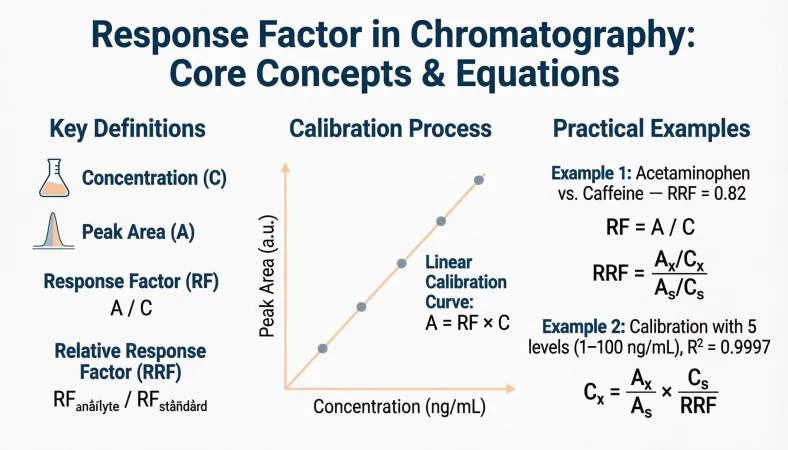
Quick Answer: The response factor formula depends on the field and calibration method. In chromatography, it commonly relates detector response, such as peak area, to the amount or concentration of an analyte. Some methods define RF as response divided by amount, while others use the reciprocal, so always check the convention used by the instrument or method.
Top alternatives: RF = Response ÷ Amount, RF = Amount ÷ Response, RRF = RF analyte ÷ RF reference, RRF = Analyte response ratio ÷ concentration ratio, Response Factor = Peak Area ÷ Concentration
Searching for the response factor formula can feel like opening a textbook and immediately being greeted by five different equations. The tricky part is that “response factor” does not have one universal formula. In analytical chemistry and chromatography, it generally connects an instrument response, such as peak area or peak height, with the amount or concentration of a compound.
Different software, laboratories, and methods can define the factor in opposite directions, so the convention matters. Whether you are checking HPLC results, interpreting GC data, preparing a calibration calculation, studying for an exam, or explaining the concept to a colleague, knowing what each symbol means is more useful than memorizing one equation. This guide breaks the topic into simple, technical, practical, and easy-to-remember explanations so you can quickly find the version that matches your calculation.
Simple Response Factor Formula Explanations
“RF = Response ÷ Amount.”
Use this when the method defines response factor as detector response relative to the amount analyzed.
Meaning: The equation tells you how much instrument signal is produced per unit amount.
“RF = Peak Area ÷ Concentration.”
Use this when chromatographic peak area is being compared with analyte concentration.
Meaning: The factor represents detector response per unit concentration.
“RF = Peak Height ÷ Amount.”
Use this when peak height rather than peak area is used as the detector response.
Meaning: It measures signal generated for a known amount.
“Response Factor = Signal ÷ Quantity.”
Use this when explaining the concept to someone unfamiliar with chromatography.
Meaning: It expresses instrument signal relative to the quantity that produced it.
“RF compares response with analyte amount.”
Use this when you need a plain-English definition.
Meaning: The factor connects what the detector sees with how much compound is present.
“Higher RF means more response per unit amount.”
Use this when interpreting response-factor values.
Meaning: A larger value can indicate stronger detector response under the chosen convention.
“Lower RF means less response per unit amount.”
Use this when comparing detector responses.
Meaning: A smaller value indicates less signal relative to the amount under that convention.
“The response is usually a peak area or peak height.”
Use this when explaining what goes into the numerator.
Meaning: Chromatographic detector response can be represented by measurable peak characteristics.
“Same units make calculations easier to verify.”
Use this when reviewing a laboratory calculation.
Meaning: Consistent units reduce avoidable calculation errors.
“Formula first, substitution second.”
Use this as a simple study reminder.
Meaning: Writing the equation before inserting numbers makes the calculation easier to follow.
Response Factor Formula For Chromatography
“RF = Peak Area ÷ Concentration.”
Use this when the laboratory defines RF as detector response divided by analyte concentration.
Meaning: The factor represents signal produced for a given concentration.
“RF = Area ÷ Amount.”
Use this when the method uses injected amount instead of concentration.
Meaning: The factor connects chromatographic area with the quantity injected.
“RF = Response ÷ Amount.”
Use this as a general chromatography explanation.
Meaning: Detector response is normalized against the amount of analyte.
“Peak area is the response.”
Use this when a chromatogram provides integrated peak areas.
Meaning: The measured area is being used as the detector signal.
“Concentration is the calibration quantity.”
Use this when preparing standards for calibration.
Meaning: Known concentration provides the reference needed to establish response.
“RF comes from a known standard.”
Use this when explaining calibration.
Meaning: A known analyte amount is paired with a measured detector response.
“Use the same response definition throughout.”
Use this when comparing several calibration runs.
Meaning: Switching between peak area and peak height can change the calculation.
“Use matching units for concentration.”
Use this when working with multiple standard solutions.
Meaning: Consistent concentration units make RF values comparable.
“Average repeated RF values when the method requires it.”
Use this when several calibration measurements are available.
Meaning: Multiple observations may be combined according to the laboratory procedure.
“Calibration establishes the detector response.”
Use this when describing why standards are analyzed.
Meaning: Known standards connect instrument signal with known analyte quantities.
“The RF can be used to estimate unknown amounts.”
Use this when explaining the purpose of calibration.
Meaning: A known response relationship can help quantify an unknown sample.
“Always follow the instrument method convention.”
Use this when software and textbooks appear to disagree.
Meaning: Some systems define RF as amount divided by response instead.
Relative Response Factor Formula
“RRF = RF analyte ÷ RF reference.”
Use this when calculating a relative response factor from individual RF values.
Meaning: The analyte response factor is normalized against a reference compound.
“RRF compares two response factors.”
Use this when explaining RRF in simple language.
Meaning: It shows how the detector responds to one compound relative to another.
“RRF = RFx ÷ RFis.”
Use this when x represents the analyte and is represents the internal standard.
Meaning: The analyte factor is compared with the internal-standard factor.
“RRF can correct response differences.”
Use this when explaining why relative response factors are useful.
Meaning: Different compounds may not generate identical detector responses.
“RRF greater than 1 indicates a larger numerator response factor.”
Use this when interpreting an RRF value.
Meaning: The analyte factor is larger than the reference factor under the selected convention.
“RRF below 1 indicates a smaller numerator response factor.”
Use this when interpreting a relative factor.
Meaning: The analyte factor is smaller than the reference factor under that convention.
“Use the reference compound consistently.”
Use this when building a calibration method.
Meaning: Changing the reference changes the resulting relative factor.
“Do not confuse RF with RRF.”
Use this when studying analytical chemistry.
Meaning: RF describes a response relationship, while RRF compares response factors.
“The exact RRF equation depends on the method.”
Use this when working with internal standards.
Meaning: Some procedures express RRF directly through response and concentration ratios.
“Check whether your source uses the reciprocal convention.”
Use this when two RRF values appear inverted.
Meaning: Different documentation can define correction factors in opposite directions.
Response Factor Formula With Peak Area
“RF = Area ÷ Concentration.”
Use this when peak area is the selected detector response.
Meaning: The formula expresses area generated per concentration unit.
“RF = A ÷ C.”
Use this as a compact mathematical form.
Meaning: A represents response area and C represents concentration.
“A is the measured peak area.”
Use this when explaining the symbols in the equation.
Meaning: A represents the integrated chromatographic signal.
“C is the known concentration.”
Use this when explaining calibration standards.
Meaning: C represents the concentration associated with the measured response.
“RF has units when response and amount have units.”
Use this when checking dimensional analysis.
Meaning: The units depend on whether the response is divided by concentration, mass, or another quantity.
“Peak area should come from the same analytical conditions.”
Use this when comparing standards.
Meaning: Instrument conditions can affect detector response.
“Use integrated areas consistently.”
Use this when processing a series of chromatograms.
Meaning: Consistent integration makes response-factor comparisons more meaningful.
“Do not mix area and height without a method reason.”
Use this when reviewing calibration data.
Meaning: Changing the response measurement changes the factor.
“Area response should be paired with its correct standard concentration.”
Use this when building a calibration table.
Meaning: Each response must correspond to the correct known concentration.
“Calculate RF for each calibration level when required.”
Use this when evaluating method performance.
Meaning: Multiple levels can show whether response remains consistent.
“Average RF values only when the procedure calls for it.”
Use this when several response factors are available.
Meaning: Averaging should follow the validated calculation procedure.
“Document the RF convention beside the equation.”
Use this when preparing laboratory notes.
Meaning: It prevents confusion between response-over-amount and amount-over-response definitions.
Response Factor Formula With Internal Standard
“RRF = (Ax ÷ Ais) ÷ (Cx ÷ Cis).”
Use this when comparing analyte and internal-standard response ratios.
Meaning: The equation compares signal ratio with concentration ratio.
“RRF = Ax × Cis ÷ Ais × Cx.”
Use this when rearranging the ratio into multiplication and division form.
Meaning: The equation expresses the same relative comparison using individual terms.
“Ax is the analyte response.”
Use this when explaining the symbols.
Meaning: Ax represents the measured analyte signal.
“Ais is the internal-standard response.”
Use this when explaining an internal-standard calculation.
Meaning: Ais represents the measured signal from the reference compound.
“Cx is analyte concentration.”
Use this when labeling the formula.
Meaning: Cx represents the known analyte concentration in the calibration solution.
“Cis is internal-standard concentration.”
Use this when identifying the final concentration term.
Meaning: Cis represents the known concentration of the internal standard.
“The internal standard provides a comparison point.”
Use this when explaining why it is included.
Meaning: The reference helps normalize analyte response.
“Response ratios can reduce some injection-related variation.”
Use this when explaining the practical purpose of internal standards.
Meaning: Comparing analyte and reference signals can provide a more controlled measurement.
“Keep internal-standard conditions consistent.”
Use this when preparing multiple calibration solutions.
Meaning: Consistent reference conditions support comparable calculations.
“RRF is calculated from both response and concentration ratios.”
Use this when teaching the concept.
Meaning: The factor accounts for differences in both detector signal and compound concentration.
“Check that concentration units match.”
Use this when troubleshooting an RRF calculation.
Meaning: Equivalent units are required for a meaningful ratio.
“Use the exact internal-standard formula in your method.”
Use this when laboratory documentation provides a specific equation.
Meaning: Regulatory and validated methods may specify the precise calculation convention.
Response Factor Formula In HPLC
“HPLC response factor links peak response with analyte quantity.”
Use this when introducing the concept in liquid chromatography.
Meaning: The factor connects detector output with the amount being measured.
“RF can be based on peak area.”
Use this when your HPLC method integrates chromatographic peaks.
Meaning: Integrated area serves as the detector response.
“RF can be based on peak height.”
Use this when the method specifically uses peak height.
Meaning: Maximum signal intensity becomes the response measurement.
“Use calibration standards to establish response.”
Use this when explaining HPLC calibration.
Meaning: Known standards provide the reference values.
“Keep detector settings consistent.”
Use this when comparing HPLC calibration runs.
Meaning: Detector conditions influence measured response.
“Keep injection conditions consistent.”
Use this when preparing calibration standards.
Meaning: Injection differences can affect measured peak response.
“RF should follow the validated HPLC method.”
Use this when a textbook equation differs from your laboratory procedure.
Meaning: The approved method takes priority over a generic formula.
“Check whether RF means response over amount.”
Use this when reading HPLC software documentation.
Meaning: Software can define the factor in more than one direction.
“Use the correct concentration units.”
Use this when calculating an HPLC response factor.
Meaning: Unit consistency keeps the resulting factor interpretable.
“Compare response factors across standards.”
Use this when evaluating calibration consistency.
Meaning: Large changes may indicate a calibration or analytical issue.
“RRF can be used when comparing compounds.”
Use this when an analyte is quantified relative to another compound.
Meaning: Relative response accounts for different detector sensitivities.
“Never copy an RF from another detector method without checking it.”
Use this when adapting a calculation.
Meaning: Response depends on analytical conditions and detector behavior.
Response Factor Formula In GC
“RF = Response ÷ Amount.”
Use this as a general starting point for a GC method that uses this convention.
Meaning: Detector response is normalized against the amount of analyte.
“RF can be expressed using peak area.”
Use this when GC peak areas are the selected response measurement.
Meaning: Integrated area represents detector signal.
“RRF compares analyte and reference responses.”
Use this when using an internal standard in GC.
Meaning: The relative factor normalizes the analyte against the reference.
“RRF = RF analyte ÷ RF internal standard.”
Use this when the method defines relative response using individual RF values.
Meaning: The analyte factor is compared directly with the internal-standard factor.
“Ax represents analyte peak area.”
Use this when labeling an RRF equation.
Meaning: Ax is the measured chromatographic response for the target compound.
“Ais represents internal-standard peak area.”
Use this when labeling a GC internal-standard formula.
Meaning: Ais is the reference signal used for normalization.
“Cx represents analyte concentration.”
Use this when explaining the concentration term.
Meaning: Cx identifies the amount or concentration of target compound.
“Cis represents internal-standard concentration.”
Use this when completing the variable definitions.
Meaning: Cis identifies the reference concentration.
“Same units are essential.”
Use this when checking a GC calculation.
Meaning: Concentration terms must be comparable.
“Use the method’s calibration convention.”
Use this when software reports a different RF definition.
Meaning: The direction of the ratio matters.
“Mean RRF can be calculated from multiple calibration levels.”
Use this when a method requires an average relative response factor.
Meaning: Several RRF measurements can be combined according to the prescribed procedure.
“Check %RSD when evaluating repeated RRF values.”
Use this when assessing calibration consistency.
Meaning: Relative standard deviation helps describe variation among response factors.
Response Factor Formula For Calibration
“Known amount first, measured response second.”
Use this when remembering how calibration establishes an RF.
Meaning: A known standard is measured to connect quantity with detector response.
“RF comes from calibration data.”
Use this when explaining where the number originates.
Meaning: It is derived from known standards rather than guessed.
“Response factor connects two measured quantities.”
Use this when introducing calibration to beginners.
Meaning: The factor links detector response with analyte quantity.
“Calibration levels should be prepared accurately.”
Use this when explaining why standard preparation matters.
Meaning: Incorrect standards can produce incorrect response factors.
“Record the response with its matching concentration.”
Use this when creating a calibration spreadsheet.
Meaning: Each response must remain connected to its correct standard.
“Use consistent units across calibration levels.”
Use this when preparing multiple standards.
Meaning: Consistent units make the factors comparable.
“Repeat measurements when the method requires replication.”
Use this when checking calibration precision.
Meaning: Replicates provide information about measurement variation.
“Average only according to the procedure.”
Use this when multiple RF values are available.
Meaning: The calculation method determines whether averaging is appropriate.
“Do not mix calibration conventions.”
Use this when combining data from different sources.
Meaning: Response-over-amount and amount-over-response are reciprocals, not interchangeable labels.
“Check the calibration curve when RF is inconsistent.”
Use this when response factors vary unexpectedly.
Meaning: The calibration relationship may not behave as assumed.
“Use the same detector conditions for comparable standards.”
Use this when performing repeated calibration.
Meaning: Detector settings influence response.
“Calibration converts instrument response into useful quantitative information.”
Use this when explaining the practical goal.
Meaning: Calibration allows measured signals to be related to known quantities.
Funny Ways To Remember The Response Factor Formula
“Peak area meets concentration, and math decides their relationship.”
Use this as a memorable study phrase.
Meaning: The formula connects detector signal with analyte quantity.
“RF is the detector’s way of saying, ‘How much signal did I get?’”
Use this when teaching beginners.
Meaning: The factor describes detector response relative to amount.
“Area goes in, answer comes out.”
Use this as a quick revision reminder.
Meaning: The measured response is processed through the chosen calibration relationship.
“Do not let RF become a formula mystery.”
Use this when studying before an exam.
Meaning: Understanding the variables is more useful than memorizing blindly.
“A divided by C is easier than a panic attack.”
Use this as a humorous study note.
Meaning: Writing the variables clearly makes the calculation manageable.
“Peak area is talking, concentration is listening.”
Use this as a memorable analogy.
Meaning: The equation relates the detector signal to known analyte quantity.
“Same units, fewer headaches.”
Use this when checking calculations.
Meaning: Consistent units prevent avoidable mistakes.
“RF loves consistency.”
Use this when reviewing calibration conditions.
Meaning: Comparable conditions make response-factor calculations meaningful.
“RRF is RF with a comparison buddy.”
Use this when explaining relative response factor.
Meaning: RRF compares an analyte with a reference.
“Never trust a mystery denominator.”
Use this when checking an unfamiliar formula.
Meaning: Always identify whether the method uses amount, concentration, or response.
“Formula before calculator.”
Use this as a study rule.
Meaning: Writing the equation first helps prevent substitution errors.
“Math looks friendlier when the symbols have names.”
Use this when teaching the formula.
Meaning: Defining every variable makes the equation easier to understand.
Clever Response Factor Formula Explanations
“Think of RF as a conversion relationship between signal and quantity.”
Use this when explaining the concept conceptually.
Meaning: The factor translates detector response into a quantitative relationship.
“RRF is the comparison layer.”
Use this when moving from RF to RRF.
Meaning: Relative response adds a reference compound to the calculation.
“Peak area tells you what the detector saw.”
Use this when introducing chromatographic response.
Meaning: Area is a measurable representation of detector signal.
“Concentration tells you what was present.”
Use this when explaining the denominator.
Meaning: Concentration represents the known quantity associated with the signal.
“RF tells you how those two relate.”
Use this as a simple conceptual definition.
Meaning: The response factor links signal with amount.
“The reciprocal convention changes the number, not the underlying relationship.”
Use this when two sources appear to disagree.
Meaning: Amount divided by response is the reciprocal of response divided by amount.
“Reference compounds make comparisons easier.”
Use this when explaining internal standards.
Meaning: A common reference provides a basis for relative response.
“A dimensionless RRF is a ratio of comparable response factors.”
Use this when interpreting units.
Meaning: Matching units cancel in the ratio.
“The detector does not treat every compound identically.”
Use this when explaining why RRF exists.
Meaning: Different compounds can generate different signal strengths.
“Calibration turns signal into quantity.”
Use this when summarizing the purpose of the calculation.
Meaning: Known standards establish the relationship needed for quantification.
“One equation can have different notation across methods.”
Use this when comparing textbooks and laboratory manuals.
Meaning: Symbols and conventions can vary even when the underlying concept is similar.
“The method definition is the final referee.”
Use this when resolving conflicting formulas.
Meaning: The validated procedure determines which convention should be applied.
Professional Response Factor Formula Statements
“The response factor was calculated from the measured detector response and known analyte amount.”
Use this in a laboratory report.
Meaning: The factor was derived from calibration information.
“The response factor was determined using the applicable calibration procedure.”
Use this when documenting analytical work.
Meaning: The calculation followed the specified method.
“The response factor was calculated using peak area and analyte concentration.”
Use this when the method uses area-based calibration.
Meaning: Peak area and concentration were the primary calculation variables.
“The relative response factor was calculated against the designated reference compound.”
Use this in formal analytical documentation.
Meaning: The analyte response was normalized against a specified reference.
“All concentration values were maintained in consistent units.”
Use this when documenting calculation controls.
Meaning: Unit consistency was maintained throughout the analysis.
“Response factors were evaluated across the calibration range.”
Use this when discussing method performance.
Meaning: The factor was examined at multiple calibration levels.
“Repeated calibration measurements were assessed for consistency.”
Use this when reporting quality-control checks.
Meaning: Replicate results were reviewed for variation.
“The response-factor convention was documented with the calculation.”
Use this when writing a technical report.
Meaning: The direction of the ratio was made explicit.
“The internal standard was used as the reference response.”
Use this when describing an internal-standard method.
Meaning: The reference compound provided the comparison signal.
“The RRF was calculated using the method-defined equation.”
Use this when multiple industry conventions exist.
Meaning: The calculation follows the specific approved procedure.
“Calibration response was used to estimate sample quantity.”
Use this when describing quantitation.
Meaning: Known standards provided the basis for interpreting unknown samples.
“The calculation should be interpreted within the validated analytical method.”
Use this when presenting results professionally.
Meaning: A response factor is meaningful only within its defined analytical context.
Common Response Factor Formula Mistakes
“Do not reverse RF without checking the convention.”
Use this when a result seems unexpectedly large or small.
Meaning: Response divided by amount and amount divided by response are reciprocal definitions.
“Do not mix peak area with peak height accidentally.”
Use this when checking chromatographic calculations.
Meaning: Different response measurements produce different factors.
“Do not mix concentration units.”
Use this when calculating RF from several standards.
Meaning: Unit inconsistencies can distort the resulting factor.
“Do not use the wrong internal standard.”
Use this when calculating RRF.
Meaning: The selected reference must match the analytical method.
“Do not assume every RF formula is universal.”
Use this when comparing sources.
Meaning: Different disciplines and software systems use different definitions.
“Do not ignore the method’s calculation section.”
Use this when working with regulated analytical procedures.
Meaning: The official procedure determines the accepted calculation.
“Do not substitute numbers before identifying variables.”
Use this when solving an exam problem.
Meaning: Variable identification reduces substitution errors.
“Do not forget units.”
Use this when reviewing a calculation.
Meaning: Units help reveal incorrect relationships.
“Do not compare RF values from unrelated conditions.”
Use this when reviewing historical data.
Meaning: Detector and analytical conditions can influence response.
“Do not assume RRF equals RF.”
Use this when studying chromatography.
Meaning: RRF is a relative comparison, not simply an individual response factor.
“Do not round too early.”
Use this when performing multi-step calculations.
Meaning: Early rounding can introduce avoidable numerical differences.
“Do not treat a formula without its definitions as complete.”
Use this when reading technical material.
Meaning: Every symbol and convention needs to be understood before using the equation.
Worked Response Factor Formula Examples
“Example: Area = 5,000 and concentration = 100, so RF = 50 under RF = Area ÷ Concentration.”
Use this when teaching the basic calculation with simple numbers.
Meaning: The detector produced 50 area units per concentration unit under the selected convention.
“Example: Area = 8,000 and concentration = 200, so RF = 40.”
Use this when practicing an area-based calculation.
Meaning: The response factor is 40 using the stated convention.
“Example: Area = 12,000 and concentration = 300, so RF = 40.”
Use this when showing another simple calibration point.
Meaning: The response-to-concentration ratio remains 40.
“Example: Area = 9,000 and concentration = 150, so RF = 60.”
Use this when practicing division.
Meaning: The response factor is 60 under the area-over-concentration convention.
“Example: RF = 30 and amount = 20, so response = 600.”
Use this when practicing the rearranged formula.
Meaning: The expected response is 600 under the selected definition.
“Example: RF analyte = 80 and RF reference = 40, so RRF = 2.”
Use this when demonstrating an RRF calculation.
Meaning: The analyte response factor is twice the reference factor.
“Example: RF analyte = 25 and RF reference = 50, so RRF = 0.5.”
Use this when practicing relative response.
Meaning: The analyte factor is half the reference factor.
“Example: Ax = 4,000, Ais = 2,000, Cx = 100, and Cis = 50, giving RRF = 1.”
Use this when demonstrating a response-ratio calculation.
Meaning: The analyte-to-reference response ratio matches the concentration ratio.
“Example: Area ÷ concentration = 6,000 ÷ 120 = 50.”
Use this when teaching fast mental checking.
Meaning: The response factor equals 50 under the selected convention.
“Example: Amount ÷ area = 100 ÷ 5,000 = 0.02.”
Use this when showing the reciprocal convention.
Meaning: The alternative definition produces the reciprocal of 50.
FAQs
What is the response factor formula? In chromatography, one common convention is RF = response ÷ amount, such as peak area divided by concentration. Some systems use the reciprocal, amount ÷ response, so the method definition must be checked.
What is the simplest response factor formula? A simple form is RF = Response ÷ Amount. If peak area is used as the response and concentration is the amount measure, this becomes RF = Peak Area ÷ Concentration.
What is the relative response factor formula? A common form is RRF = RF analyte ÷ RF reference. Other methods calculate RRF directly from analyte and internal-standard response and concentration ratios.
Is response factor the same as relative response factor? No. RF describes the response relationship for a compound, while RRF compares one response factor with another reference response factor.
What does a response factor tell you? It describes the relationship between detector signal and the amount or concentration that produced that signal.
Why are there different response factor formulas? Different analytical methods and software packages can define RF in different directions. Some use response divided by amount, while others use amount divided by response.
How do I calculate response factor from peak area? If your method defines RF as response divided by concentration, divide the measured peak area by the known concentration.
How is response factor used in HPLC? It can connect measured chromatographic response with known analyte concentration or amount during calibration and quantitation.
How is response factor used in GC? It can be used to relate detector response to analyte amount and, with an internal standard, to calculate relative response factors for quantitation.
Can response factor be greater than 1? Yes. The numerical value depends on the response measurement, amount units, and calculation convention.
Conclusion
The response factor formula becomes much easier once you stop treating it like a mystery equation and start identifying what each symbol represents. In chromatography, the key idea is the relationship between detector response and analyte amount, while relative response factors add a comparison with a reference compound. The biggest trap is assuming there is only one universal convention.
Different methods may define the factor as response divided by amount or use the reciprocal. Always check the method, define your variables, keep units consistent, and then calculate. Save this guide for revision, share it with your lab or study group, and use the examples whenever the formula starts looking intimidating.