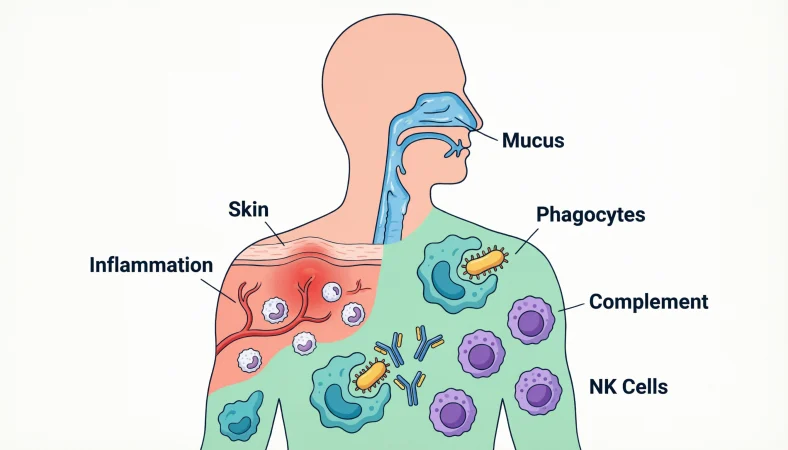
Quick Answer: The non specific immune response is the body’s general defense system that responds to harmful substances or invading microbes without targeting one specific pathogen. It includes barriers such as skin, inflammation, phagocytes, fever, and other rapid defenses.
Innate immune response, nonspecific immunity, first line of defense, innate immunity examples, body’s natural defenses
When biology throws around a phrase like non specific immune response, it can sound like something copied straight from a textbook at 2 a.m. But the idea is actually pretty straightforward. Your body has built-in defenses that respond quickly when potentially harmful microbes enter the picture. Unlike the adaptive immune response, these defenses do not need to recognize one particular pathogen before getting to work.
Skin, mucus, stomach acid, inflammation, fever, and immune cells such as neutrophils and macrophages all play roles in this broad defense system. Whether you are studying for an exam, revising your notes, explaining biology to a friend, or trying to finally understand what your teacher meant, knowing how the non specific immune response works makes the topic much easier. Think of it as your body’s general security team, always on patrol and ready to react.
1. Simple Non Specific Immune Response Explanations
“It is the body’s general defense system.”
Use this when you need a simple definition for revision.
Meaning: It describes immunity that responds broadly rather than targeting one specific pathogen.
“It acts quickly against potential threats.”
Use this when explaining why innate immunity matters.
Meaning: The response can begin rapidly after a threat is detected.
“It does not target just one pathogen.”
Use this when comparing innate and adaptive immunity.
Meaning: Nonspecific defenses work broadly against many types of threats.
“Skin is part of the first defense.”
Use this when discussing physical barriers.
Meaning: Intact skin helps prevent pathogens from entering the body.
“Mucus helps trap unwanted microbes.”
Use this when explaining another physical defense.
Meaning: Mucus can capture particles and microorganisms before they travel deeper.
“Inflammation is part of the response.”
Use this when describing what happens after tissue damage or infection.
Meaning: Inflammation helps coordinate local protective responses.
“Phagocytes can engulf pathogens.”
Use this when explaining immune cell activity.
Meaning: Certain immune cells can surround and digest foreign material.
“Fever can accompany infection.”
Use this when discussing whole-body responses.
Meaning: An elevated body temperature can occur as part of an immune response.
“The response is part of innate immunity.”
Use this when defining the broader category.
Meaning: Nonspecific immunity is another way of describing innate immune defenses.
“It works before specific immunity fully develops.”
Use this when comparing response timing.
Meaning: Innate defenses generally respond earlier than adaptive immune responses.
“It is not about remembering one specific germ.”
Use this when explaining the difference from immune memory.
Meaning: Innate immunity does not depend on pathogen-specific memory in the same way adaptive immunity does.
“Think fast defense, not custom-made defense.”
Use this as a memorable study phrase.
Meaning: It captures the rapid and broad nature of innate immunity.
2. Funny Non Specific Immune Response Responses
“Basically, the body’s security guard has clocked in.”
Use this as a memorable biology revision phrase.
Meaning: It compares innate defenses with constant security.
“Your immune system said, ‘Not today, microbes.’”
Use this when making revision notes more entertaining.
Meaning: It describes the body’s defensive reaction to invading organisms.
“Skin really said, ‘You shall not pass.’”
Use this when remembering the role of physical barriers.
Meaning: Skin helps stop pathogens from entering the body.
“Inflammation has entered the group chat.”
Use this when studying signs of an immune response.
Meaning: It humorously represents inflammation becoming active.
“Phagocytes are basically the cleanup crew.”
Use this when remembering engulfing immune cells.
Meaning: Phagocytes help remove pathogens and cellular debris.
“The immune system does not wait for an invitation.”
Use this when explaining rapid innate responses.
Meaning: Innate defenses can respond quickly to danger signals.
“Microbe detected, defense mode activated.”
Use this as a quick revision reminder.
Meaning: It summarizes the body’s immediate protective response.
“Your body has its own security department.”
Use this when explaining innate immunity to beginners.
Meaning: It compares immune defenses with security systems.
“Mucus deserves more credit than it gets.”
Use this when discussing protective secretions.
Meaning: Mucus contributes to the body’s physical defense against microbes.
“The immune system stays booked and busy.”
Use this as a playful revision phrase.
Meaning: Innate defenses constantly help protect the body.
“Pathogens picked the wrong address.”
Use this when making immune-system notes memorable.
Meaning: The body has multiple defenses against invading microbes.
“Biology really built a whole defense squad.”
Use this when summarizing innate defenses.
Meaning: Several barriers, cells, and chemical responses work together.
3. Clever Non Specific Immune Response Comparisons
“Innate immunity is the generalist.”
Use this when comparing it with adaptive immunity.
Meaning: It provides broad protection rather than highly specific recognition.
“Adaptive immunity is more specialized.”
Use this when explaining the major difference between immune systems.
Meaning: Adaptive responses target particular antigens more specifically.
“Innate comes first, adaptive gets more specific.”
Use this as a quick comparison in revision.
Meaning: Innate responses generally act earlier while adaptive responses develop targeted defenses.
“Think firewall, not fingerprint scanner.”
Use this analogy when explaining nonspecific protection.
Meaning: A firewall represents broad protection while a fingerprint scanner represents precise identification.
“Physical barriers are the body’s front gate.”
Use this when explaining skin and mucosal defenses.
Meaning: These barriers can stop threats before they enter deeper tissues.
“Inflammation is an alarm system.”
Use this analogy when learning immune responses.
Meaning: Inflammation helps signal and coordinate a response to damage or infection.
“Phagocytes are biological cleanup teams.”
Use this when remembering their function.
Meaning: They engulf and help break down pathogens and debris.
“Fever is a whole-body response.”
Use this when distinguishing local and systemic effects.
Meaning: Fever affects the body’s overall temperature regulation.
“Innate immunity is fast and broad.”
Use this as a two-word memory trick.
Meaning: It generally responds rapidly and across many different threats.
“Adaptive immunity is slower but highly targeted.”
Use this when comparing the two systems.
Meaning: Adaptive responses take time to develop but can recognize specific antigens.
“Barriers prevent entry; immune cells handle breaches.”
Use this when learning the sequence of defenses.
Meaning: Physical barriers act early while immune mechanisms respond when threats get through.
“Different defenses, one protective mission.”
Use this when summarizing innate immunity.
Meaning: Multiple mechanisms cooperate to protect the body.
4. Non Specific Immune Response Responses for Students
“Remember: nonspecific means broad.”
Use this as a simple exam memory trick.
Meaning: The response is not designed for one particular pathogen.
“Skin is a physical barrier.”
Use this when revising first-line defenses.
Meaning: Skin helps block pathogens from entering.
“Mucus traps particles and microbes.”
Use this when reviewing mucosal defenses.
Meaning: Mucus can help prevent microorganisms from reaching deeper tissues.
“Cilia help move trapped material.”
Use this when revising respiratory defenses.
Meaning: Tiny cilia can move mucus and trapped particles toward areas where they can be removed.
“Stomach acid creates a hostile environment.”
Use this when studying chemical defenses.
Meaning: Strong stomach acidity can destroy or inhibit many swallowed microorganisms.
“Inflammation helps recruit defenses.”
Use this when learning inflammatory responses.
Meaning: Inflammation helps coordinate immune activity at affected tissues.
“Neutrophils are important phagocytes.”
Use this when reviewing innate immune cells.
Meaning: Neutrophils can engulf and destroy microorganisms.
“Macrophages engulf foreign material.”
Use this when revising phagocytosis.
Meaning: Macrophages can ingest pathogens and cellular debris.
“Natural killer cells target abnormal cells.”
Use this when studying innate immune cells.
Meaning: Natural killer cells can destroy certain infected or abnormal cells.
“Complement helps defend against microbes.”
Use this when revising innate immune mechanisms.
Meaning: Complement proteins can support pathogen destruction and inflammation.
“Cytokines help immune cells communicate.”
Use this when learning immune signaling.
Meaning: Cytokines are signaling molecules that influence immune activity.
“Fast does not mean simple.”
Use this when preparing for an exam.
Meaning: Innate immunity is rapid but involves many coordinated mechanisms.
5. Non Specific Immune Response Responses for Exams
“Define it before explaining it.”
Use this when structuring an exam answer.
Meaning: Start by clearly identifying nonspecific immunity as innate, broad defense.
“Mention barriers first.”
Use this when explaining the first line of defense.
Meaning: Physical and chemical barriers are key components of innate protection.
“Then explain inflammation.”
Use this when building a longer biology response.
Meaning: Inflammation is an important part of innate defense after injury or infection.
“Include phagocytosis.”
Use this when discussing innate immune cells.
Meaning: Phagocytosis is a major mechanism used by certain immune cells.
“Compare it with adaptive immunity.”
Use this when an exam asks for differences.
Meaning: Comparison can demonstrate understanding of specificity and response timing.
“Use ‘rapid’ and ‘broad’ carefully.”
Use this when writing a concise answer.
Meaning: These words capture important features of innate immunity.
“Give a biological example.”
Use this when strengthening an explanation.
Meaning: Examples such as skin or phagocytes make abstract concepts easier to demonstrate.
“Explain the function, not just the name.”
Use this when writing about immune cells.
Meaning: Exam answers are stronger when they describe what cells actually do.
“Link the defense to the threat.”
Use this when explaining immune mechanisms.
Meaning: It shows how each defense contributes to protection.
“Avoid calling every response specific.”
Use this when checking your terminology.
Meaning: Innate and adaptive mechanisms have different degrees of specificity.
“Finish with the bigger picture.”
Use this when writing a longer response.
Meaning: Summarizing how multiple defenses work together creates a complete explanation.
“Clear biology beats complicated wording.”
Use this before submitting an answer.
Meaning: Accurate, understandable explanations are more useful than unnecessary jargon.
6. Non Specific Immune Response Responses for Beginners
“Your body has defenses built in.”
Use this when introducing innate immunity.
Meaning: The body has protective mechanisms that function without previous exposure to one specific pathogen.
“The skin is a protective wall.”
Use this when explaining physical barriers.
Meaning: Skin forms an important external defense.
“Mucus acts like a sticky trap.”
Use this when explaining mucosal protection.
Meaning: Mucus can trap microorganisms and particles.
“Cilia help move trapped material away.”
Use this when explaining respiratory defenses.
Meaning: Cilia move mucus and particles through coordinated movement.
“Inflammation signals that something is wrong.”
Use this when introducing inflammatory responses.
Meaning: Inflammation is part of the body’s response to injury or infection.
“Some immune cells eat invading microbes.”
Use this when introducing phagocytosis.
Meaning: Phagocytes engulf and digest microorganisms.
“Fever can be part of immune defense.”
Use this when explaining systemic responses.
Meaning: Infection can trigger changes in body temperature.
“Innate immunity acts quickly.”
Use this as a beginner-friendly summary.
Meaning: It can respond rapidly to threats.
“It is broader than adaptive immunity.”
Use this when comparing the two.
Meaning: Innate mechanisms are not directed at one specific antigen.
“Your body has several layers of defense.”
Use this when summarizing the system.
Meaning: Protection involves barriers, cells, proteins, and signaling responses.
“The first defense is not always an immune cell.”
Use this when discussing skin and mucus.
Meaning: Physical and chemical barriers are important parts of innate protection.
“Think layers, not one giant defense.”
Use this as a study analogy.
Meaning: Multiple mechanisms work together to protect the body.
7. Non Specific Immune Response Responses for Biology Notes
“Innate immunity = nonspecific defense.”
Use this as a compact revision note.
Meaning: Nonspecific immunity is commonly used to describe innate immune defenses.
“Physical barriers come first.”
Use this when outlining defenses.
Meaning: Skin and mucosal surfaces help prevent pathogen entry.
“Chemical barriers support protection.”
Use this when studying secretions and environmental conditions.
Meaning: Chemicals such as stomach acid contribute to defense.
“Cells provide internal defense.”
Use this when moving from barriers to immune cells.
Meaning: Immune cells can respond when pathogens enter tissues.
“Inflammation coordinates local responses.”
Use this when explaining tissue reactions.
Meaning: Inflammatory processes help organize immune activity.
“Phagocytosis removes foreign material.”
Use this when defining phagocyte function.
Meaning: Phagocytes engulf and digest pathogens and debris.
“Complement supports innate defense.”
Use this when summarizing immune proteins.
Meaning: Complement contributes to pathogen elimination and inflammatory processes.
“Natural killer cells provide cellular defense.”
Use this when describing innate immune cells.
Meaning: They can kill certain infected or abnormal cells.
“Cytokines coordinate communication.”
Use this when revising immune signaling.
Meaning: Cytokines help cells communicate and regulate immune activity.
“Innate responses can activate adaptive immunity.”
Use this when explaining cooperation between systems.
Meaning: Innate immune activity can help initiate and shape adaptive responses.
“Specificity is the key comparison.”
Use this when revising innate versus adaptive immunity.
Meaning: The degree of pathogen-specific recognition differs between the systems.
“Fast defense still involves complex biology.”
Use this as a final note in your revision page.
Meaning: Rapid innate responses depend on many interacting mechanisms.
8. Non Specific Immune Response Responses About Inflammation
“Inflammation is a protective response.”
Use this when defining inflammation in biology notes.
Meaning: It helps the body respond to injury or infection.
“Redness can result from increased blood flow.”
Use this when explaining visible inflammatory signs.
Meaning: Changes in local blood vessels can increase blood flow to affected tissue.
“Heat can accompany inflammation.”
Use this when reviewing classic signs.
Meaning: Increased blood flow and local processes can contribute to warmth.
“Swelling can occur when fluid moves into tissues.”
Use this when explaining another inflammatory sign.
Meaning: Increased vascular permeability can contribute to tissue swelling.
“Pain can accompany inflammatory signaling.”
Use this when discussing symptoms of inflammation.
Meaning: Chemical mediators can influence nerve endings and pain perception.
“Inflammation helps bring immune defenses to the area.”
Use this when explaining its purpose.
Meaning: It helps coordinate the movement and activity of immune components.
“Cytokines help coordinate inflammation.”
Use this when discussing immune communication.
Meaning: Cytokines can influence inflammatory and immune-cell activity.
“Inflammation is not automatically the enemy.”
Use this when correcting a common misconception.
Meaning: Inflammation is a normal protective process, although excessive or inappropriate inflammation can cause harm.
“Local inflammation can be easier to notice.”
Use this when discussing visible symptoms.
Meaning: Changes in affected tissue may produce noticeable signs.
“Inflammation connects detection with defense.”
Use this as a memorable study phrase.
Meaning: It helps translate recognition of danger into coordinated protective activity.
“The response can involve blood vessels and immune cells.”
Use this when writing a detailed explanation.
Meaning: Inflammation involves multiple systems working together.
“Inflammation is one piece of innate immunity.”
Use this when placing it in context.
Meaning: It is important but not the entire nonspecific immune response.
9. Non Specific Immune Response Responses About Phagocytes
“Phagocytes engulf foreign material.”
Use this when defining their main function.
Meaning: Phagocytosis involves surrounding and taking in particles.
“Neutrophils are rapid responders.”
Use this when studying innate immune cells.
Meaning: Neutrophils can quickly move toward sites of infection or inflammation.
“Macrophages are professional engulfers.”
Use this as a memorable revision phrase.
Meaning: Macrophages are capable of extensive phagocytosis.
“Phagocytosis helps remove pathogens.”
Use this when explaining why phagocytes matter.
Meaning: Engulfment contributes to pathogen elimination.
“Phagocytes can also remove cellular debris.”
Use this when expanding your notes.
Meaning: Their role is not limited to microorganisms.
“Chemotaxis helps guide immune cells.”
Use this when discussing movement toward affected tissues.
Meaning: Chemical signals can attract cells to areas where they are needed.
“Engulfment comes before intracellular breakdown.”
Use this when explaining phagocytosis stages.
Meaning: The particle must be taken into the cell before it can be processed internally.
“Phagocytes are part of innate immunity.”
Use this when categorizing these cells.
Meaning: They contribute to rapid, broad defense.
“Some phagocytes also communicate with other immune cells.”
Use this when discussing immune coordination.
Meaning: Their functions can extend beyond simply engulfing material.
“A phagocyte is more than a cleanup crew.”
Use this when explaining their broader roles.
Meaning: Phagocytes can participate in signaling and coordination as well as engulfment.
“Phagocytosis is a key innate defense mechanism.”
Use this in a revision summary.
Meaning: Engulfing pathogens is an important way innate immunity removes threats.
“Think detect, engulf, digest.”
Use this as a simple memory aid.
Meaning: It summarizes the basic concept of phagocytic defense.
10. Non Specific Immune Response Responses About Barriers
“Skin is the body’s outer barrier.”
Use this when introducing physical defenses.
Meaning: Skin forms a protective boundary between the body and its environment.
“Mucous membranes protect internal entry points.”
Use this when discussing respiratory and digestive surfaces.
Meaning: Mucosal surfaces help defend areas where the body meets the outside environment.
“Mucus can trap microorganisms.”
Use this when explaining secretions.
Meaning: Sticky mucus can capture microbes and particles.
“Cilia help clear trapped material.”
Use this when studying airway defenses.
Meaning: Cilia move mucus and trapped particles.
“Tears help protect the eyes.”
Use this when discussing protective secretions.
Meaning: Tears help wash the eye surface and contain antimicrobial components.
“Saliva contributes to oral defense.”
Use this when discussing protective secretions.
Meaning: Saliva helps physically clear material and contains antimicrobial factors.
“Stomach acid provides chemical defense.”
Use this when studying gastrointestinal protection.
Meaning: The acidic stomach environment can damage many microorganisms.
“Normal microbiota can provide protection.”
Use this when discussing biological defenses.
Meaning: Resident microorganisms can compete with potential pathogens.
“Barriers can stop infection before it starts.”
Use this when summarizing first-line defenses.
Meaning: Preventing entry is an important form of protection.
“A barrier is still part of immunity even if it is not a cell.”
Use this when correcting a common misunderstanding.
Meaning: Innate defense includes physical and chemical mechanisms.
“First line does not mean least important.”
Use this when explaining barrier defenses.
Meaning: Preventing pathogen entry is a major protective function.
“The best defense can be keeping the pathogen outside.”
Use this as a memorable study phrase.
Meaning: Physical and chemical barriers can prevent invasion altogether.
11. Non Specific Immune Response Responses for Quick Revision
“Innate = immediate-ish.”
Use this as a casual memory trick.
Meaning: Innate defenses generally act rapidly after a threat is detected.
“Nonspecific = broad.”
Use this when memorizing the definition.
Meaning: The response is not targeted to one particular pathogen.
“Skin = barrier.”
Use this for rapid revision.
Meaning: Skin helps prevent pathogen entry.
“Mucus = trap.”
Use this when remembering mucosal defenses.
Meaning: Mucus can capture microbes and particles.
“Cilia = move.”
Use this when revising respiratory defenses.
Meaning: Cilia move mucus and trapped material.
“Phagocytes = engulf.”
Use this as a cell-function reminder.
Meaning: Phagocytes take in and digest foreign material.
“Inflammation = coordinate.”
Use this when remembering inflammatory function.
Meaning: Inflammation helps organize local protective responses.
“Fever = systemic response.”
Use this when reviewing whole-body effects.
Meaning: Fever affects the body beyond one local tissue.
“Complement = support.”
Use this as a simple complement memory aid.
Meaning: Complement proteins support several innate immune functions.
“NK cells = abnormal-cell defense.”
Use this when reviewing natural killer cells.
Meaning: NK cells can destroy certain infected or abnormal cells.
“Adaptive = specific.”
Use this as a comparison point.
Meaning: Adaptive immunity develops targeted responses to particular antigens.
“Innate and adaptive work together.”
Use this when finishing a revision card.
Meaning: The two branches of immunity interact rather than operating as completely separate systems.
12. Confident Non Specific Immune Response Responses
“I know the difference: innate is broad, adaptive is specific.”
Use this when checking your understanding before an exam.
Meaning: It states a central distinction between the two immune branches.
“The first defense starts before the immune cells arrive.”
Use this when explaining barriers.
Meaning: Physical and chemical defenses can act before deeper immune responses are required.
“The body has backup after the barriers.”
Use this when explaining layered defense.
Meaning: Cellular and molecular mechanisms provide additional protection.
“Phagocytes are ready for cleanup.”
Use this when summarizing cellular innate defenses.
Meaning: Phagocytes help remove pathogens and debris.
“Inflammation is part of the response, not the whole response.”
Use this when avoiding oversimplification.
Meaning: Inflammation is one component of innate immunity.
“Speed is one of innate immunity’s strengths.”
Use this when comparing response timing.
Meaning: Innate defenses can act rapidly.
“Specificity is where adaptive immunity stands out.”
Use this when explaining the major contrast.
Meaning: Adaptive immunity is characterized by highly specific recognition.
“The immune system uses layers.”
Use this when explaining overall defense.
Meaning: Multiple protective mechanisms operate at different stages.
“One pathogen does not require one single defense.”
Use this when explaining broad immunity.
Meaning: Several innate mechanisms can contribute to protection against the same threat.
“The response starts before you know there is a problem.”
Use this when discussing early defense.
Meaning: Innate mechanisms can react before the person notices symptoms.
“Fast does not mean random.”
Use this when explaining innate recognition.
Meaning: Innate immunity uses organized biological mechanisms to detect signs of danger.
“Biology has more than one security layer.”
Use this when summarizing the system.
Meaning: The body combines barriers, cells, proteins, and signaling.
13. Non Specific Immune Response Responses for Comparing Immunity
“Innate immunity is broad; adaptive immunity is targeted.”
Use this when making a comparison table.
Meaning: The systems differ in the specificity of their responses.
“Innate responses are generally faster.”
Use this when comparing timing.
Meaning: Innate mechanisms can act rapidly after exposure to danger signals.
“Adaptive responses take time to develop.”
Use this when explaining first exposure.
Meaning: Building a targeted adaptive response requires immune activation and expansion.
“Adaptive immunity can create immune memory.”
Use this when explaining long-term specificity.
Meaning: Some adaptive cells persist and support faster responses to later exposure.
“Innate immunity relies on broad recognition patterns.”
Use this when discussing pathogen detection.
Meaning: Innate cells recognize common molecular patterns associated with microbes or damage.
“Adaptive immunity recognizes specific antigens.”
Use this when explaining specificity.
Meaning: Adaptive receptors can target particular antigen structures.
“Skin belongs to innate defense.”
Use this when categorizing physical barriers.
Meaning: Skin provides broad protection without antigen-specific recognition.
“Antibodies belong to adaptive immunity.”
Use this when making a basic comparison.
Meaning: Antibodies are produced by the adaptive immune system.
“Phagocytosis can be part of innate defense.”
Use this when discussing immune cells.
Meaning: Innate phagocytes help engulf and eliminate foreign material.
“Memory is a major adaptive feature.”
Use this when comparing long-term responses.
Meaning: Adaptive immunity can retain pathogen-specific memory.
“The two systems cooperate.”
Use this when avoiding an either-or explanation.
Meaning: Innate and adaptive immunity interact during immune responses.
“Think broad first, specific later.”
Use this as a revision shortcut.
Meaning: It captures the typical sequence of early innate defense followed by targeted adaptive responses.
14. Non Specific Immune Response Responses for Study Guides
“Definition: broad innate defense.”
Use this at the top of a study card.
Meaning: It provides the core concept in a few words.
“First line: physical and chemical barriers.”
Use this when outlining the topic.
Meaning: Barriers help prevent pathogen entry.
“Second line: internal innate defenses.”
Use this when organizing revision notes.
Meaning: Cellular and molecular defenses act after barriers are breached.
“Key cells: neutrophils and macrophages.”
Use this when listing important phagocytes.
Meaning: These cells are major contributors to innate cellular defense.
“Key process: phagocytosis.”
Use this when identifying an important mechanism.
Meaning: Phagocytosis involves engulfing and processing foreign material.
“Key response: inflammation.”
Use this when summarizing local defense.
Meaning: Inflammation coordinates protective activity at affected tissues.
“Key proteins: complement.”
Use this when listing innate immune components.
Meaning: Complement proteins support pathogen destruction and inflammatory responses.
“Key cells: natural killer cells.”
Use this when reviewing innate cellular immunity.
Meaning: NK cells can kill certain infected or abnormal cells.
“Key signals: cytokines.”
Use this when reviewing immune communication.
Meaning: Cytokines help coordinate immune-cell behavior.
“Main feature: rapid response.”
Use this when writing a short definition.
Meaning: Innate immunity can react quickly.
“Main difference: limited pathogen specificity.”
Use this when comparing innate and adaptive immunity.
Meaning: Innate recognition is broader than adaptive antigen-specific recognition.
“Big idea: multiple defenses work together.”
Use this when finishing a study guide.
Meaning: Nonspecific immunity is a coordinated network rather than one single mechanism.
15. Smart Non Specific Immune Response Responses
“The body does not wait for a pathogen-specific memory response to begin defending itself.”
Use this when explaining why innate immunity is important.
Meaning: Innate defenses provide early protection before adaptive immunity is fully activated.
“Nonspecific does not mean ineffective.”
Use this when correcting a common misconception.
Meaning: Broad defenses can provide powerful protection despite lacking pathogen-specific targeting.
“Innate recognition detects common danger patterns.”
Use this when discussing how innate immunity identifies threats.
Meaning: Innate immune receptors recognize patterns associated with microbes or cellular damage.
“Barriers prevent entry before deeper defenses are needed.”
Use this when explaining layered protection.
Meaning: Physical and chemical defenses reduce exposure to internal tissues.
“Inflammation coordinates a local defense response.”
Use this when explaining tissue-level protection.
Meaning: Inflammatory signaling helps organize immune activity.
“Phagocytes remove foreign material through engulfment.”
Use this when defining phagocytosis.
Meaning: Certain immune cells take in and digest pathogens and debris.
“Complement adds another layer of innate defense.”
Use this when explaining immune proteins.
Meaning: Complement can support pathogen destruction and inflammatory processes.
“Natural killer cells help control infected and abnormal cells.”
Use this when discussing innate cellular defenses.
Meaning: NK cells can recognize and kill certain abnormal cells without the same antigen-specific mechanism used by adaptive cytotoxic T cells.
“Cytokines make immune communication possible.”
Use this when explaining immune signaling.
Meaning: Cytokines allow cells to influence one another during immune responses.
“Innate immunity can help activate adaptive immunity.”
Use this when explaining cooperation between immune branches.
Meaning: Innate signals and antigen-presenting cells can help initiate adaptive responses.
“A fast response can buy time for a more specific response.”
Use this when comparing innate and adaptive immunity.
Meaning: Early innate defenses can help control threats while adaptive immunity develops.
“The immune system works as a network, not a single switch.”
Use this when summarizing the entire topic.
Meaning: Multiple cells, barriers, proteins, and signals interact to protect the body.
FAQs
What does non specific immune response mean?
A non specific immune response is a broad defensive response that does not target one particular pathogen with the precision associated with adaptive immunity. It is commonly associated with innate immunity.
Is non specific immune response the same as innate immunity?
The terms are closely connected. Nonspecific immunity generally refers to the broad defenses of innate immunity, including physical barriers, inflammatory responses, phagocytes, complement, and natural killer cells.
What is an example of a non specific immune response?
Examples include inflammation, phagocytosis by neutrophils or macrophages, activation of complement, and physical barriers such as skin and mucous membranes.
Is the non specific immune response fast?
Yes. Innate immune defenses generally respond more rapidly than adaptive immune responses, which need time to develop highly specific responses.
Is inflammation a non specific immune response?
Inflammation is an important component of innate immunity and can occur as part of a broad response to infection or tissue damage.
Are antibodies part of the non specific immune response?
Antibodies are generally associated with adaptive immunity because they recognize specific antigens. Some innate mechanisms can interact with antibodies, but antibodies themselves are not usually classified as nonspecific defenses.
What cells are involved in the non specific immune response?
Important cells include neutrophils, macrophages, dendritic cells, natural killer cells, and other innate immune cells. Their exact roles differ, but they contribute to detecting, controlling, or coordinating responses to threats.
Is the non specific immune response important?
Yes. It provides early and broad protection and also interacts with adaptive immunity. It helps the body respond rapidly while more specific immune responses develop.
Can the non specific immune response cause inflammation?
Yes. Inflammation is one of the major processes associated with innate immune defense. It can help recruit immune cells and coordinate protective activity at affected tissues.
Does nonspecific immunity have memory?
Classical immune memory is primarily associated with adaptive immunity. However, research has identified forms of trained or altered innate immune responses, so the traditional simple distinction between innate and adaptive memory has some modern nuance.
How can you remember non specific immune response?
A useful shortcut is “fast and broad.” Think of barriers, inflammation, phagocytes, complement, and natural killer cells as major examples of innate defense.
What is the difference between specific and nonspecific immunity?
Nonspecific immunity provides broad, rapid defense, while specific immunity, mainly adaptive immunity, uses highly targeted recognition of particular antigens and can develop long-lasting immune memory.
Conclusion
Understanding the non specific immune response does not have to feel like decoding a biology textbook written in another language. The easiest way to remember it is to think fast, broad, and built in. Your body uses barriers, inflammation, phagocytes, complement, natural killer cells, and other mechanisms to respond to potential threats before highly targeted adaptive immunity gets fully involved.
Once you understand what each defense does, the whole topic becomes much easier to connect. Use these explanations as revision notes, turn the short phrases into flashcards, or share them with someone who is also trying to survive biology revision. Save this guide for later, and keep those immune-system facts locked in.