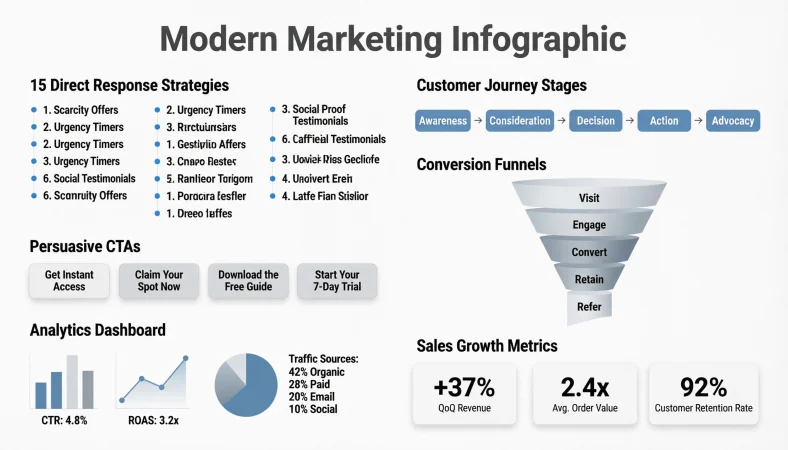
Quick Answer: Direct response marketing strategies are designed to encourage an immediate, measurable action such as clicking, signing up, calling, booking, downloading, or buying. The strongest strategies combine a clear offer, compelling message, specific audience, persuasive CTA, and measurable results.
Clear call-to-action, Irresistible offer, Problem-solution messaging, Urgency and scarcity, Social proof
Ever stare at an ad and think, “Okay, but what exactly do you want me to do?” That tiny moment of confusion can cost a business a click, lead, booking, or sale. That is exactly why direct response marketing strategies matter. Unlike marketing that mainly builds awareness, direct response marketing is built around measurable action. Whether you are writing an Instagram ad, sending an email, creating a landing page, texting a customer, or pitching an offer at work, the message needs a destination.
The reader should quickly understand the problem, see the value, believe the offer, and know what to do next. No mysterious marketing fog. No giant paragraph that says absolutely nothing. Just a clear path from “Hmm, interesting” to “Yep, I’m clicking.” Below are practical, ready-to-use strategies for making your campaigns clearer, more persuasive, and easier to measure.
Problem-Focused Direct Response Marketing Strategies
“Still struggling with [specific problem]?”
Use this opening when your audience already recognizes the problem you solve.
Meaning: It immediately creates relevance by addressing a familiar frustration.
“Tired of wasting time on [problem]?”
Use this when your offer saves customers time.
Meaning: It connects your product with a costly inconvenience.
“If [problem] keeps happening, there is a simpler way.”
Use this for ads targeting people who have tried several solutions.
Meaning: It introduces your offer as an alternative.
“You should not have to [painful task] just to get [desired result].”
Use this when your product removes unnecessary effort.
Meaning: It contrasts frustration with a better outcome.
“What if [desired result] did not have to feel so difficult?”
Use this for softer social media or email messaging.
Meaning: It creates curiosity around an easier solution.
“The real reason [problem] keeps happening may surprise you.”
Use this as a curiosity-driven headline.
Meaning: It encourages the reader to discover the underlying issue.
“You know that annoying [problem]? We built a simpler solution.”
Use this for conversational social ads.
Meaning: It makes the brand feel relatable and solution-focused.
“One common mistake could be making [problem] worse.”
Use this for educational lead-generation campaigns.
Meaning: It creates curiosity while positioning your content as useful.
“Fix the problem before it becomes the bigger problem.”
Use this for preventive services.
Meaning: It connects early action with avoiding future complications.
Benefit-Driven Direct Response Marketing Strategies
“Get [specific benefit] without [common frustration].”
Use this when your offer removes a major objection.
Meaning: It combines the desired result with reduced friction.
“More [benefit], less [pain point].”
Use this as a short ad headline.
Meaning: It communicates the value proposition quickly.
“Turn [current situation] into [desired outcome].”
Use this for transformation-focused campaigns.
Meaning: It shows the before-and-after value.
“Everything you need to [desired result] in one place.”
Use this for bundles, platforms, or comprehensive services.
Meaning: It emphasizes convenience.
“Get the result you want without starting from scratch.”
Use this for templates, courses, tools, or done-for-you services.
Meaning: It highlights saved effort.
“Spend less time on [task] and more time on [benefit].”
Use this for productivity products.
Meaning: It frames the offer around better use of time.
“Make [desired result] easier, faster, and more manageable.”
Use this for practical solutions.
Meaning: It communicates multiple benefits without overcomplicating the message.
“A simpler way to achieve [specific result].”
Use this for concise landing page headlines.
Meaning: It positions the product as an easier alternative.
“Built to help you [benefit] with less guesswork.”
Use this for tools or educational products.
Meaning: It reduces uncertainty.
“Get more from every [resource, hour, campaign, or customer].”
Use this for business audiences.
Meaning: It focuses attention on efficiency and value.
“From [pain point] to [positive outcome].”
Use this for transformation-based creative.
Meaning: It gives the customer a simple journey to visualize.
“The easier way to [desired action].”
Use this for direct, benefit-focused advertising.
Meaning: It promises simplicity rather than unnecessary complexity.
Urgency-Based Direct Response Marketing Strategies
“Start today and stop putting it off.”
Use this when your offer benefits from immediate action.
Meaning: It gives procrastination a clear alternative.
“Your next step can happen today.”
Use this for low-friction calls to action.
Meaning: It makes action feel immediate and achievable.
“Do not wait until [negative consequence] becomes unavoidable.”
Use this when delay has a genuine cost.
Meaning: It encourages timely action.
“Ready to make a move? Start here.”
Use this for landing pages and social ads.
Meaning: It turns interest into a simple next step.
“The sooner you start, the sooner you can [benefit].”
Use this for services with a clear time-to-result.
Meaning: It connects immediate action with earlier benefits.
“Your future self will thank you for starting now.”
Use this for lifestyle, education, or productivity offers.
Meaning: It uses future-oriented motivation.
“Do not let another month pass with the same problem.”
Use this for recurring customer pain points.
Meaning: It creates urgency around continued inaction.
“Take the first step today.”
Use this when the desired action is simple.
Meaning: It makes a larger goal feel manageable.
“Now is a good time to make the change.”
Use this for softer urgency.
Meaning: It encourages action without sounding overly aggressive.
“Why wait for the perfect moment?”
Use this for motivational campaigns.
Meaning: It challenges hesitation.
“Make today the day you finally [desired result].”
Use this for emotional direct response copy.
Meaning: It gives the reader a memorable reason to act.
“Start before another opportunity passes.”
Use this when timing genuinely matters.
Meaning: It encourages prompt action without making unsupported claims.
Social Proof Direct Response Marketing Strategies
“Join thousands of customers already using [product].”
Use this when you have verified customer numbers.
Meaning: It uses adoption as credibility.
“See why customers keep coming back.”
Use this when repeat purchases are a genuine strength.
Meaning: It creates curiosity around customer satisfaction.
“Rated highly by customers who wanted [specific result].”
Use this when relevant review data supports the claim.
Meaning: It connects positive feedback with the reader’s goal.
“Loved by people who were tired of [problem].”
Use this for relatable testimonial-driven advertising.
Meaning: It creates identification with existing customers.
“See what customers are saying about [product].”
Use this as a CTA leading to reviews or testimonials.
Meaning: It invites prospects to investigate social proof.
“Customers are talking, and here is why.”
Use this as a testimonial campaign headline.
Meaning: It creates curiosity around customer experiences.
“From first click to happy customer.”
Use this for case-study-focused campaigns.
Meaning: It frames the customer journey positively.
“Trusted by [specific audience].”
Use this only when the claim is accurate.
Meaning: It creates relevance through peer credibility.
“Discover why [specific customer group] chooses [brand].”
Use this when targeting a defined niche.
Meaning: It uses group identification to build interest.
“See the results for yourself.”
Use this when supporting evidence is available.
Meaning: It invites the reader to evaluate proof directly.
“Do not just take our word for it.”
Use this before genuine reviews or case studies.
Meaning: It shifts credibility from the brand to customers.
Offer-Focused Direct Response Marketing Strategies
“Get [product] today for [specific price or offer].”
Use this when the pricing is clear and current.
Meaning: It gives the reader a concrete purchasing opportunity.
“Everything you need, packaged into one simple offer.”
Use this for bundles.
Meaning: It emphasizes convenience and perceived value.
“Get [main product] plus [bonus] when you sign up.”
Use this when the bonus genuinely applies.
Meaning: It increases perceived value.
“Your complete [solution] starts here.”
Use this for comprehensive products or services.
Meaning: It positions the offer as a starting point.
“One purchase. Multiple useful benefits.”
Use this when one product delivers several advantages.
Meaning: It reinforces value.
“Get more value without adding more complexity.”
Use this for bundles or upgraded packages.
Meaning: It addresses the fear of unnecessary complexity.
“Everything is ready. You just need to take the first step.”
Use this for prepared services or digital products.
Meaning: It reduces perceived effort.
“A practical solution without the unnecessary extras.”
Use this for streamlined products.
Meaning: It appeals to customers who dislike complicated offers.
“Built for people who want results, not another complicated system.”
Use this for straightforward services.
Meaning: It contrasts your offer with overly complex alternatives.
“Choose the option that fits your goal.”
Use this when offering multiple packages.
Meaning: It gives customers control.
“Start with the option that makes the most sense for you.”
Use this when customers need flexibility.
Meaning: It reduces pressure while encouraging selection.
“Get started with everything you need in one place.”
Use this for complete solutions.
Meaning: It reinforces convenience and readiness.
Curiosity-Driven Direct Response Marketing Strategies
“Most people approach [problem] the wrong way.”
Use this as a content or ad hook.
Meaning: It creates curiosity about a better approach.
“Here is what nobody tells you about [topic].”
Use this for educational marketing content.
Meaning: It promises a less obvious insight.
“The simple change that can improve [result].”
Use this when you have a specific useful tactic.
Meaning: It makes the solution feel accessible.
“Before you spend another pound on [solution], read this.”
Use this when educating buyers about a common mistake.
Meaning: It creates a reason to pause and engage.
“What if the problem is not what you think?”
Use this for curiosity-based campaigns.
Meaning: It challenges the audience’s current assumption.
“The overlooked step behind [desired result].”
Use this for educational offers.
Meaning: It creates interest in a hidden or underused tactic.
“One thing successful [audience] do differently.”
Use this when you can substantiate the observation.
Meaning: It encourages readers to discover a specific behavior.
“The reason your current approach may not be working.”
Use this for diagnostic content.
Meaning: It promises an explanation rather than a generic sales pitch.
“Before you buy another [product], check this.”
Use this for comparison or educational content.
Meaning: It creates curiosity while reducing impulsive purchasing.
“There is a better way to think about [problem].”
Use this for thought-leadership marketing.
Meaning: It invites a change in perspective.
“This tiny detail could change how you approach [task].”
Use this for educational hooks.
Meaning: It makes the information feel immediately useful.
“Want to know what actually moves the needle?”
Use this for performance-focused marketing content.
Meaning: It promises practical insight instead of fluff.
Email Direct Response Marketing Strategies
“Ready to finally fix [problem]?”
Use this as a concise promotional email subject line.
Meaning: It connects directly with an existing customer pain point.
“Your next step is waiting.”
Use this for follow-up emails after a customer shows interest.
Meaning: It encourages action without overexplaining.
“Still thinking about [product]?”
Use this for abandoned-cart or consideration campaigns.
Meaning: It reopens the purchasing conversation.
“Here is what you get when you start today.”
Use this when emphasizing offer benefits.
Meaning: It focuses attention on value.
“A simpler way to [desired result].”
Use this as an email headline.
Meaning: It quickly communicates the core benefit.
“You asked. We made it easier.”
Use this when launching an improved product or feature.
Meaning: It connects customer feedback with the solution.
“Three reasons customers choose [product].”
Use this for educational sales emails.
Meaning: It provides structured reasons to consider the offer.
“Do this before you [common mistake].”
Use this for helpful pre-purchase emails.
Meaning: It provides value while creating engagement.
“Want the shortcut to [result]?”
Use this for digital products or educational offers.
Meaning: It positions the product as a way to reduce effort.
“Your guide to getting started with [solution].”
Use this for onboarding or lead nurturing.
Meaning: It makes the next action feel simple.
“One small step can change your approach.”
Use this for motivational email campaigns.
Meaning: It encourages low-friction action.
“Ready when you are.”
Use this as a friendly final CTA.
Meaning: It creates a relaxed invitation to act.
Social Media Direct Response Marketing Strategies
“Comment ‘INFO’ and we will send you the details.”
Use this when your platform and workflow support comment-based lead generation.
Meaning: It gives followers a simple action.
“Save this for the next time you need [solution].”
Use this for educational carousel posts.
Meaning: It encourages engagement while creating future utility.
“Tap the link in our profile to get started.”
Use this when the platform supports profile-based navigation.
Meaning: It provides a direct path to the offer.
“Send us a message with ‘START’ to learn more.”
Use this for DM-based lead generation.
Meaning: It creates a simple conversation trigger.
“Which one would you choose?”
Use this when presenting multiple options.
Meaning: It encourages comments and participation.
“Share this with someone who needs it.”
Use this for highly relatable educational content.
Meaning: It turns the audience into potential distributors.
“Follow for more practical tips on [topic].”
Use this for content designed to build an audience.
Meaning: It gives viewers a clear reason to follow.
“Want the full checklist? Grab it here.”
Use this when promoting a lead magnet.
Meaning: It connects useful content with a measurable action.
“Comment your biggest challenge below.”
Use this for market research and engagement.
Meaning: It encourages prospects to reveal their needs.
“Ready to try it? Start here.”
Use this under product-focused social content.
Meaning: It moves interested viewers toward action.
“Do not just like this. Save it for later.”
Use this for practical posts.
Meaning: It encourages a stronger form of engagement.
“If this sounds like you, you know what to do.”
Use this for relatable promotional content.
Meaning: It creates a playful transition toward the CTA.
Landing Page Direct Response Marketing Strategies
“Get [desired result] without [major obstacle].”
Use this as the main landing page headline.
Meaning: It communicates value immediately.
“Everything you need to [result] starts here.”
Use this above a signup or purchase button.
Meaning: It creates a clear beginning point.
“See how it works in three simple steps.”
Use this before a process explanation.
Meaning: It makes the product feel manageable.
“Here is exactly what you get.”
Use this before a feature or package breakdown.
Meaning: It increases transparency.
“No complicated setup. Just [desired benefit].”
Use this when your product is genuinely easy to start.
Meaning: It reduces friction.
“Built for [specific audience] who want [specific result].”
Use this when targeting a niche.
Meaning: It creates immediate audience relevance.
“Ready to move from [problem] to [result]?”
Use this above a CTA.
Meaning: It frames the purchase as a transformation.
“See what is included before you decide.”
Use this near pricing or package details.
Meaning: It reduces uncertainty.
“Your next step takes less than a minute.”
Use this only when the claim is accurate.
Meaning: It reduces perceived effort.
“Start with the plan that fits your needs.”
Use this for multiple pricing tiers.
Meaning: It makes selection easier.
“Have questions? Get the answers before you start.”
Use this near an FAQ section.
Meaning: It addresses hesitation before the CTA.
“Ready to get started?”
Use this as a simple final CTA.
Meaning: It converts interest into a direct invitation.
Testimonial-Focused Direct Response Marketing Strategies
“I finally stopped struggling with [problem].”
Use this as a genuine customer testimonial headline.
Meaning: It communicates a personal transformation.
“I wish I had found this sooner.”
Use this only when it is an authentic customer statement.
Meaning: It communicates strong satisfaction.
“It made [task] much easier for me.”
Use this when a customer genuinely experienced increased convenience.
Meaning: It highlights practical value.
“The biggest difference was [specific benefit].”
Use this above a detailed testimonial.
Meaning: It draws attention to a concrete result.
“I went from [before] to [after].”
Use this when the customer can substantiate the transformation.
Meaning: It creates a clear before-and-after story.
“Here is what happened after I started.”
Use this for case-study content.
Meaning: It creates curiosity around the customer journey.
“Real experience, not another sales pitch.”
Use this before genuine testimonials.
Meaning: It positions customer feedback as independent evidence.
“See how [customer type] used [product] to [result].”
Use this for case-study headlines.
Meaning: It creates relevance through a specific example.
“The result surprised me.”
Use this only when it reflects a genuine testimonial.
Meaning: It creates curiosity about the outcome.
“This solved the problem I kept putting off.”
Use this when a customer genuinely reports that experience.
Meaning: It connects the product with delayed action.
“I would recommend it to anyone dealing with [problem].”
Use this when quoting a genuine customer.
Meaning: It uses direct peer endorsement.
“Here is why I kept using it.”
Use this for repeat-customer testimonials.
Meaning: It highlights sustained value.
Mobile And Short-Form Direct Response Marketing Strategies
“Stop scrolling for two seconds.”
Use this as a playful short-form video hook.
Meaning: It creates an immediate interruption.
“This is for anyone who wants [result].”
Use this at the beginning of a short video.
Meaning: It quickly identifies the target audience.
“Here is the easiest way to [task].”
Use this for short educational content.
Meaning: It promises immediate usefulness.
“Three things you need to know about [topic].”
Use this for short-form educational videos.
Meaning: It creates a clear content structure.
“If you are doing [task], watch this first.”
Use this when preventing a common mistake.
Meaning: It gives the viewer a reason to continue watching.
“You are probably making this mistake.”
Use this when discussing a common and verifiable issue.
Meaning: It creates curiosity around improvement.
“Here is what I would do instead.”
Use this for practical advice content.
Meaning: It provides an alternative approach.
“Want the full version? Get it here.”
Use this when short-form content leads to a longer resource.
Meaning: It creates a natural next step.
“Save this before you forget.”
Use this for highly practical content.
Meaning: It encourages future engagement.
“Try this before you spend another pound.”
Use this for money-saving educational content.
Meaning: It positions the advice as immediately valuable.
“One change. Better process.”
Use this for concise business content.
Meaning: It communicates a simple improvement.
“Ready for the next step?”
Use this at the end of short-form content.
Meaning: It transitions naturally into a CTA.
Retargeting Direct Response Marketing Strategies
“Still thinking about it?”
Use this for people who previously viewed an offer.
Meaning: It reopens the decision without excessive pressure.
“You were interested, so here is another look.”
Use this for warm audiences.
Meaning: It acknowledges previous engagement.
“Still looking for a way to [result]?”
Use this when the prospect previously showed interest in the problem.
Meaning: It reconnects the product with their original goal.
“Your next step is still available.”
Use this when a prospect started but did not complete an action.
Meaning: It encourages them to return.
“Not ready before? No problem.”
Use this for gentle retargeting.
Meaning: It removes pressure and invites reconsideration.
“Here is what you may have missed.”
Use this when highlighting a previously overlooked benefit.
Meaning: It gives the prospect a new reason to reconsider.
“Take another look at what is included.”
Use this when product details may have been overlooked.
Meaning: It redirects attention toward value.
“Still comparing your options?”
Use this for buyers in the research stage.
Meaning: It acknowledges the decision process.
“Before you decide, see what customers experienced.”
Use this when genuine testimonials are available.
Meaning: It provides social proof before purchase.
“Your cart is waiting.”
Use this for appropriate abandoned-cart campaigns.
Meaning: It reminds the shopper about an incomplete purchase.
“You were one step away.”
Use this for unfinished signup or checkout processes.
Meaning: It highlights how close the prospect was to completing the action.
“Ready to pick up where you left off?”
Use this for returning prospects.
Meaning: It makes resuming the journey feel effortless.
Data-Driven Direct Response Marketing Strategies
“Test the headline before changing everything else.”
Use this when optimizing an underperforming campaign.
Meaning: It encourages focused experimentation.
“Track the action, not just the attention.”
Use this when evaluating marketing performance.
Meaning: It prioritizes measurable outcomes.
“Measure clicks, leads, conversions, and revenue.”
Use this when creating campaign reporting.
Meaning: It focuses measurement on business outcomes.
“Compare one major variable at a time.”
Use this for structured A/B testing.
Meaning: It makes test results easier to interpret.
“Let customer behavior guide your next campaign.”
Use this after collecting meaningful performance data.
Meaning: It turns results into future strategy.
“A high click-through rate means little if conversions stay low.”
Use this when reviewing campaign performance.
Meaning: It encourages marketers to look beyond surface-level metrics.
“Test the offer, not just the color of the button.”
Use this when prioritizing meaningful optimization.
Meaning: It focuses attention on factors that can materially affect response.
“Track where prospects drop off.”
Use this when analyzing a sales funnel.
Meaning: It identifies possible friction points.
“Your best-performing message deserves another test.”
Use this when scaling proven creative.
Meaning: It encourages systematic iteration.
“Do not guess what customers want when you can measure behavior.”
Use this for data-led marketing planning.
Meaning: It encourages evidence-based decisions.
“Every campaign should teach you something.”
Use this after launching a test campaign.
Meaning: It frames marketing as continuous learning.
“Turn campaign data into the next campaign idea.”
Use this during strategy planning.
Meaning: It connects measurement with creative improvement.
Conversion-Focused Direct Response Marketing Strategies
“Make the next step obvious.”
Use this when improving a landing page or advertisement.
Meaning: It encourages a clear customer journey.
“One page, one primary action.”
Use this when simplifying a conversion-focused landing page.
Meaning: It reduces competing choices.
“Tell people what happens after they click.”
Use this near important CTAs.
Meaning: It reduces uncertainty about the next step.
“Remove anything that distracts from the offer.”
Use this during conversion optimization.
Meaning: It prioritizes the primary action.
“Answer the biggest objection before asking for the sale.”
Use this in sales copy.
Meaning: It addresses hesitation proactively.
“Make the benefit visible before the features.”
Use this when rewriting product pages.
Meaning: It leads with customer value.
“Use specific language instead of vague promises.”
Use this when improving generic marketing copy.
Meaning: It makes the offer easier to understand.
“Give customers a reason to act now.”
Use this when genuine urgency exists.
Meaning: It creates motivation for timely action.
“Make the CTA sound like a benefit.”
Use this when generic buttons are underperforming.
Meaning: It connects the action with the desired outcome.
“Reduce unnecessary form fields.”
Use this when optimizing lead-generation forms.
Meaning: It can make the action feel easier.
“Show proof close to the decision point.”
Use this when using testimonials or reviews.
Meaning: It provides reassurance when customers are deciding.
“Make buying feel like the logical next step.”
Use this when structuring persuasive landing pages.
Meaning: It creates a natural progression from problem to solution to action.
FAQs
What Are Direct Response Marketing Strategies?
Direct response marketing strategies are methods designed to encourage a measurable action from an audience. That action might be purchasing, clicking, calling, subscribing, booking, downloading, requesting information, or submitting a form.
What Are the Main Elements of Direct Response Marketing?
Strong direct response campaigns commonly include a specific audience, relevant problem, compelling offer, clear benefit, persuasive message, social proof, urgency when appropriate, and a straightforward call to action.
Are Direct Response Marketing Strategies Good for Social Media?
Yes. Social media can support direct response campaigns through clickable ads, lead forms, DMs, comments, profile visits, purchases, signups, and other measurable actions. The CTA should match the platform and campaign objective.
Can Direct Response Marketing Be Used in Email?
Absolutely. Email is particularly useful for direct response because marketers can track actions such as clicks, registrations, purchases, downloads, and replies. Strong emails usually combine a relevant subject line, useful or persuasive content, and one clear next step.
What Is the Difference Between Direct Response and Brand Marketing?
Direct response marketing focuses heavily on encouraging and measuring immediate or trackable action. Brand marketing often focuses more broadly on awareness, perception, recognition, and long-term customer relationships. Many businesses use both approaches together.
Should Direct Response Marketing Always Create Urgency?
No. Urgency should be genuine and appropriate to the offer. Artificial pressure can damage trust. A campaign can encourage action through value, clarity, convenience, relevance, proof, or a strong offer without relying on aggressive urgency.
What Is a Good Direct Response Call to Action?
A good CTA clearly tells people what to do next. Examples include “Start Your Free Trial,” “Get the Guide,” “Book Your Consultation,” “Shop Now,” “Request a Quote,” and “Download the Checklist.”
How Do You Measure Direct Response Marketing?
Common measurements include click-through rate, conversion rate, cost per lead, cost per acquisition, revenue, return on advertising spend, average order value, and customer lifetime value. The appropriate metric depends on the campaign objective.
Conclusion
Direct response marketing strategies work best when they make the customer journey feel obvious. Show people that you understand their problem, explain the benefit, provide a believable reason to trust the offer, and make the next step ridiculously clear. Whether you are writing an email, launching a social campaign, building a landing page, or creating a short video, remember that every word has a job.
You do not need louder marketing. You need clearer marketing that gives people a reason to care and an easy way to act. Save this list, test the strategies that fit your audience, track what happens, and keep improving. Your next better-performing campaign could be one experiment away.