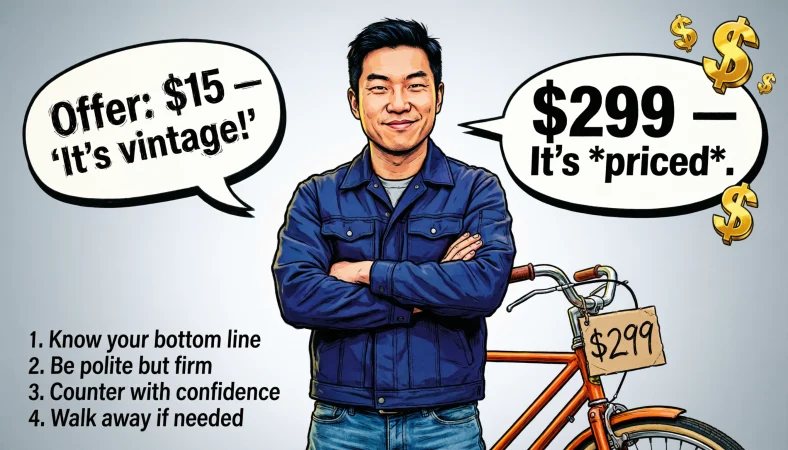
Quick Answer: The best responses to a lowball offer on Craigslist are confident, polite, and clear without sounding desperate. You can reject the offer, counter it, or leave the door open for a serious buyer.
Top alternatives: Thanks, but I’ll pass, I can do $X, That’s lower than I can accept, I’m firm at $X, Meet me at $X
You list something on Craigslist at a fair price, wait for interested buyers, and then someone appears with an offer that makes you wonder if they accidentally deleted a zero. Yep, the classic lowball offer. Whether you’re selling furniture, electronics, collectibles, tools, a vehicle, or basically anything else, knowing how to respond can save you time and keep the negotiation under control. The trick is not getting annoyed and firing off a message you’ll regret five minutes later. Instead, use confident, clever, or even funny responses depending on the situation. This guide has plenty of ready-to-send responses to lowball offers on Craigslist, from polite counteroffers to clever one-liners. Whether you want to negotiate, stay firm, or simply move on, there’s a response here for your selling style.
Funny Responses
Sometimes a little humor is the easiest way to reject a wildly unrealistic Craigslist offer without turning the exchange into a fight.
That offer needs a little more seasoning.
Use this when the buyer’s price is dramatically below your asking price.
Meaning: You’re jokingly saying the offer needs improvement.
My calculator just laughed.
Use this when someone sends an surprisingly low number.
Meaning: The offer is far below what you consider reasonable.
I think a digit went missing somewhere.
Use this when the buyer’s offer is much lower than your listed price.
Meaning: You’re suggesting they accidentally offered too little.
That price is doing some serious parkour.
Use this when the offer jumps far below your asking price.
Meaning: You’re playfully pointing out the huge price difference.
I appreciate the creativity, but no.
Use this when the buyer makes an unusually aggressive offer.
Meaning: You acknowledge the attempt while firmly declining.
My item deserves better than that plot twist.
Use this when the offer is unexpectedly low.
Meaning: You’re humorously rejecting the price.
That’s a bold number.
Use this when you want to tease a buyer about an extreme offer.
Meaning: You’re acknowledging the confidence behind the lowball.
Nice try, Craigslist warrior.
Use this with buyers who seem to negotiate everything aggressively.
Meaning: You’re jokingly calling out their negotiating style.
My price just filed an appeal.
Use this when someone offers far less than your asking price.
Meaning: You’re humorously defending your original price.
That’s not quite the bargain you’re imagining.
Use this when you want to keep the tone light but reject the offer.
Meaning: You’re politely saying their expectations are unrealistic.
I respect the hustle, but my answer is still no.
Use this when you appreciate the buyer trying to negotiate.
Meaning: You reject the offer without being hostile.
You miss 100% of the dollars you don’t offer.
Use this when you want a playful spin on a very low offer.
Meaning: You’re joking while encouraging a better offer.
Brutal Responses
When a buyer is being especially unreasonable, a direct response can shut down the negotiation quickly.
That’s nowhere near the asking price.
Use this when the offer is dramatically below your listing.
Meaning: You’re clearly rejecting the proposed amount.
I’ll pass on that offer.
Use this when you don’t want to negotiate further.
Meaning: You’re ending the discussion politely but firmly.
That’s too low for me to consider.
Use this when the buyer offers substantially less than you’re willing to accept.
Meaning: The offer does not meet your minimum price.
I’m not giving it away.
Use this when the buyer makes an extremely low offer.
Meaning: You’re emphasizing that the item still has meaningful value.
That’s not a serious offer.
Use this when the proposed price feels unrealistic.
Meaning: You’re asking the buyer to return with a credible number.
You’ll need to come up quite a bit.
Use this when you’re open to negotiating but not near their current offer.
Meaning: Their offer is below your negotiation range.
That’s an easy no.
Use this when you want to end the negotiation immediately.
Meaning: You have no interest in accepting the offer.
Not at that price.
Use this when you want a short and firm response.
Meaning: The price is unacceptable.
I’m not interested in selling at that number.
Use this when you want to remain professional while being firm.
Meaning: You are declining without inviting unnecessary debate.
That’s far below market value.
Use this when comparable listings support your asking price.
Meaning: You’re explaining why the offer is unreasonable.
I won’t be able to accept that.
Use this when you want a firm but respectful refusal.
Meaning: You are closing the door on the proposed amount.
If that’s your budget, this probably isn’t the right listing.
Use this when the buyer cannot approach your asking price.
Meaning: You’re suggesting they look elsewhere.
Flirty Responses
A lowball offer can sometimes become playful banter, especially when the buyer’s tone is clearly joking.
You’re cute, but that’s a no.
Use this when you’re comfortable being playful with the buyer.
Meaning: You’re keeping the rejection light and teasing.
Nice attempt, bargain hunter.
Use this when someone makes a cheeky low offer.
Meaning: You’re playfully acknowledging their negotiation attempt.
You really thought I’d say yes to that?
Use this when the buyer’s offer is dramatically low.
Meaning: You’re teasing them while rejecting the amount.
You can do better than that.
Use this when you want a playful counteroffer.
Meaning: You’re challenging the buyer to increase the offer.
I like the confidence. Not the number.
Use this when the buyer makes an extremely bold offer.
Meaning: You appreciate their confidence but reject the price.
Try again, superstar.
Use this when you want a playful response rather than a serious argument.
Meaning: You’re inviting a better offer.
That offer needs a glow-up.
Use this when the proposed price is much too low.
Meaning: You’re playfully asking for a higher number.
Almost impressive. Almost.
Use this when the buyer’s offer is close but still too low.
Meaning: You’re teasing while leaving room for negotiation.
I’ll accept a better offer and maybe a compliment.
Use this when you want to add humor to the negotiation.
Meaning: You’re joking while encouraging a higher offer.
You’re negotiating like you want the friends-and-family discount.
Use this when the buyer is pushing for an unusually low price.
Meaning: You’re playfully pointing out how aggressive the discount request is.
Make me a serious offer and we’ll talk.
Use this when you want playful confidence without encouraging nonsense.
Meaning: You’re leaving the negotiation open.
The item is available, but that price isn’t.
Use this when you want a memorable but clear response.
Meaning: The item remains for sale, but not at their proposed amount.
Polite Responses
Politeness goes a long way on Craigslist, especially when you want to keep potential buyers interested.
Thanks for the offer, but I can’t accept that amount.
Use this when you want to reject a low offer respectfully.
Meaning: You’re declining without creating tension.
Thanks for reaching out. I’m looking for closer to my asking price.
Use this when you’re open to negotiating.
Meaning: You’re encouraging the buyer to increase the offer.
I appreciate the offer, but I’ll have to pass.
Use this when the proposed price is too low.
Meaning: You’re politely ending that negotiation.
Thanks, but I’m firm at $X.
Use this when you have a fixed minimum price.
Meaning: You’re clearly communicating your bottom line.
I can consider reasonable offers, but that’s lower than I’d accept.
Use this when you’re willing to negotiate within limits.
Meaning: You’re setting a boundary while keeping the conversation open.
I understand you’re trying to stay within budget. Unfortunately, I can’t go that low.
Use this when you want to acknowledge the buyer’s position.
Meaning: You’re showing understanding while protecting your price.
Thanks for the interest. Would you be able to come up to $X?
Use this when you’re interested in making a deal.
Meaning: You’re turning the rejection into a counteroffer.
I appreciate the offer, but I’ll wait for a buyer closer to my asking price.
Use this when you’re not in a hurry to sell.
Meaning: You’re signaling that you can wait for a better offer.
That’s a little lower than I had in mind.
Use this when the offer is somewhat low but not insulting.
Meaning: You’re inviting the buyer to improve it.
I can’t meet that price, but I could do $X.
Use this when you have some flexibility.
Meaning: You’re giving a specific alternative.
Thanks for checking with me. I’m not able to accept that offer.
Use this when you want to close the discussion gracefully.
Meaning: You’re politely declining.
If you can meet me at $X, we can make it work.
Use this when you’re ready to negotiate toward a specific number.
Meaning: You’re presenting a clear deal point.
Professional Responses
If you’re selling frequently or want every interaction to sound businesslike, these responses keep emotions out of the negotiation.
Thank you for the offer. My current asking price is $X.
Use this when you want to restate your price professionally.
Meaning: You’re reinforcing the listed value.
I appreciate your interest, but I cannot accept $X.
Use this when you want a formal rejection.
Meaning: You’re declining the offer without unnecessary explanation.
I’m willing to consider reasonable offers above $X.
Use this when you’re open to negotiation.
Meaning: You’re establishing a lower boundary.
My lowest price is $X.
Use this when you’ve decided on a firm minimum.
Meaning: You’re clearly communicating your bottom line.
I can offer a small adjustment to $X.
Use this when you’re willing to make a limited concession.
Meaning: You’re showing flexibility without dropping too far.
The item is priced based on its condition and current value.
Use this when a buyer questions your price.
Meaning: You’re giving a concise justification.
I don’t think we’re close enough on price to make a deal.
Use this when the buyer’s offer is far below yours.
Meaning: You’re ending the negotiation professionally.
If your budget changes, feel free to reach out.
Use this when you want to leave the door open.
Meaning: You’re ending the exchange without burning the bridge.
I’m currently holding at $X.
Use this when you’re not ready to lower the price.
Meaning: You’re maintaining your current position.
I can negotiate within reason, but I can’t match that offer.
Use this when you want to emphasize limited flexibility.
Meaning: You’re rejecting the specific number while remaining open.
The asking price reflects the item’s condition and included accessories.
Use this when the buyer is undervaluing what you’re selling.
Meaning: You’re explaining why your price is justified.
If $X works for you, we can arrange pickup.
Use this when you want to move directly toward closing.
Meaning: You’re offering a clear path to a sale.
Creative Responses
A creative reply can make your listing interaction more memorable without becoming rude.
My asking price and your offer are currently living in different time zones.
Use this when there’s a huge gap between both numbers.
Meaning: You’re humorously highlighting the difference.
That offer took the scenic route below my price.
Use this when the buyer comes in much lower than expected.
Meaning: You’re joking about the size of the discount.
Let’s bring that number back to Earth.
Use this when you want the buyer to increase their offer.
Meaning: You’re suggesting their offer needs adjustment.
The negotiation has entered hard mode.
Use this when the buyer makes an extremely low offer.
Meaning: You’re playfully acknowledging the difficult starting point.
We’re going to need a bigger number.
Use this when the offer is much too low.
Meaning: You’re encouraging a higher bid.
That number missed the target by a mile.
Use this when the offer is far below your expectations.
Meaning: You’re clearly rejecting the proposed amount.
My price isn’t feeling very compatible with that offer.
Use this when you want a softer rejection.
Meaning: You’re saying the numbers do not work together.
The calculator says we’re not quite there yet.
Use this when you want a humorous counterpoint.
Meaning: You’re indicating that the offer needs to increase.
Let’s meet somewhere closer to reality.
Use this when the buyer’s offer is especially unrealistic.
Meaning: You’re asking for a more reasonable proposal.
That number needs a serious upgrade.
Use this when the offer is too low.
Meaning: You’re encouraging the buyer to improve it.
The price gap is currently doing the most.
Use this when there’s a dramatic difference between both numbers.
Meaning: You’re joking about the negotiation gap.
I think our numbers need couples therapy.
Use this when you want a playful response to a major price mismatch.
Meaning: You’re saying the two offers need to get closer.
Sarcastic Responses
Sarcasm can work when the buyer is clearly joking, but use it carefully with strangers.
Wow, you really went for it.
Use this when the buyer makes an unusually low offer.
Meaning: You’re sarcastically acknowledging their confidence.
That’s certainly one number.
Use this when the offer is far below your expectations.
Meaning: You’re humorously questioning the amount.
Bold strategy.
Use this when someone offers dramatically less than your asking price.
Meaning: You’re teasing their negotiation approach.
I admire the optimism.
Use this when the buyer seems to expect an extreme discount.
Meaning: You’re sarcastically rejecting their expectations.
Interesting choice.
Use this when the proposed price is surprisingly low.
Meaning: You’re signaling that the offer is unreasonable.
You miss every bargain you don’t shoot for, I guess.
Use this when a buyer makes an aggressively low offer.
Meaning: You’re joking about their negotiation strategy.
That offer has confidence. I’ll give it that.
Use this when the price is absurdly low.
Meaning: You’re complimenting their boldness while rejecting the number.
I see we’re negotiating from another universe.
Use this when the buyer’s price is nowhere near yours.
Meaning: You’re emphasizing the huge difference.
That’s impressively ambitious.
Use this when the buyer asks for a very large discount.
Meaning: You’re sarcastically acknowledging their request.
You definitely didn’t start with the asking price.
Use this when the offer is substantially lower.
Meaning: You’re pointing out how aggressively they negotiated.
I needed a laugh today, so thanks.
Use this only when the offer is obviously unserious.
Meaning: You’re jokingly dismissing the price.
I’ll let you know if I suddenly change my mind about reality.
Use this when someone refuses to make a reasonable offer.
Meaning: You’re firmly rejecting their expectations.
Cute Responses
These are useful when you want to stay friendly, especially with buyers who seem genuinely interested but have a limited budget.
I appreciate you trying. Can you come up a little?
Use this when the buyer seems sincere.
Meaning: You’re inviting them to improve their offer.
You’re close, but not quite there.
Use this when their offer is slightly below your target.
Meaning: You’re encouraging a better number.
Nice offer, but I need a little more.
Use this when you’re willing to negotiate.
Meaning: You’re rejecting the price gently.
Let’s meet in the middle.
Use this when both sides are reasonably close.
Meaning: You’re suggesting a compromise.
I wish I could do that price.
Use this when you genuinely cannot accept their offer.
Meaning: You’re expressing understanding while holding your boundary.
You’re making this tempting, but I have to stay at $X.
Use this when the offer is attractive but still too low.
Meaning: You’re staying firm in a friendly way.
Almost! Add a little more and we have a deal.
Use this when the buyer is close to your acceptable price.
Meaning: You’re encouraging them to close the gap.
I can give you a little wiggle room.
Use this when you have some flexibility.
Meaning: You’re offering a small discount.
Let’s find a number we’re both happy with.
Use this when you want a collaborative negotiation.
Meaning: You’re encouraging compromise.
I don’t want to scare you with my counteroffer, but how about $X?
Use this when you want to make a counteroffer playfully.
Meaning: You’re presenting your preferred price with humor.
You’re definitely on the right track.
Use this when the buyer’s offer is close.
Meaning: You’re encouraging them to improve it slightly.
Meet me at $X and I’ll call it a win.
Use this when you’re ready to settle.
Meaning: You’re giving a clear final number.
Dramatic Responses
For friends, playful buyers, or situations where the lowball is truly spectacular, dramatic replies can be entertaining.
My wallet just gasped.
Use this when the buyer’s offer is hilariously low.
Meaning: You’re joking about the absurd price.
The negotiation has officially entered its villain era.
Use this when the buyer is aggressively lowballing you.
Meaning: You’re humorously describing the situation as dramatic.
I was not emotionally prepared for that number.
Use this when the offer catches you off guard.
Meaning: You’re playfully expressing surprise.
That offer just broke my heart a little.
Use this when the proposed price is much too low.
Meaning: You’re jokingly showing disappointment.
My asking price is currently fighting for its life.
Use this when the buyer keeps pushing the price down.
Meaning: You’re humorously emphasizing the negotiation pressure.
And suddenly, the plot thickens.
Use this when a buyer makes a surprisingly low offer.
Meaning: You’re adding playful drama to the situation.
This negotiation has taken a dark turn.
Use this when the offer is dramatically below your expectations.
Meaning: You’re joking about the situation.
I fear we have lost the plot.
Use this when the buyer’s price is wildly unrealistic.
Meaning: You’re humorously saying the negotiation has gone off track.
My price is crying in the corner right now.
Use this when the offer is extremely low.
Meaning: You’re playfully rejecting the number.
That number arrived with absolutely no warning.
Use this when you’re surprised by the offer.
Meaning: You’re joking about how unexpected it was.
I need a moment to process that masterpiece.
Use this when the offer is unusually bold.
Meaning: You’re teasing the buyer about their price.
Somewhere, a calculator just fainted.
Use this when you want an exaggerated response to a lowball.
Meaning: You’re humorously calling the offer unreasonable.
Chill And Casual Responses
Sometimes the best response is simple, relaxed, and free from unnecessary drama.
Nah, I can’t do that price.
Use this when you want a casual rejection.
Meaning: You’re keeping things straightforward.
I’m looking for closer to $X.
Use this when you’re open to negotiation.
Meaning: You’re showing the buyer where you’d like the price to land.
I can do $X, but that’s about it.
Use this when you have a clear minimum.
Meaning: You’re offering limited flexibility.
That’s a little too low for me.
Use this when the offer isn’t completely unreasonable but still misses your target.
Meaning: You’re encouraging a higher offer.
I might be able to meet you around $X.
Use this when you want to negotiate casually.
Meaning: You’re presenting a possible compromise.
I’m good at $X.
Use this when you’ve settled on your minimum.
Meaning: You’re confidently stating your acceptable price.
Not quite, but thanks.
Use this when you want to keep the reply short.
Meaning: You’re politely rejecting the offer.
I can’t go that low.
Use this when you don’t want a long negotiation.
Meaning: You’re establishing a firm boundary.
Maybe somewhere around $X?
Use this when you’re willing to negotiate.
Meaning: You’re suggesting a more realistic price.
If you can do $X, it’s yours.
Use this when you’re ready to sell at a specific amount.
Meaning: You’re giving the buyer a clear opportunity.
I’ll hold at my current price for now.
Use this when you’re not in a hurry.
Meaning: You’re choosing not to negotiate yet.
Feel free to send another offer.
Use this when you want to keep the conversation open.
Meaning: You’re inviting a more reasonable proposal.
Confident Responses
Confidence helps you negotiate without sounding defensive or desperate.
I’m confident in the value, so I’ll stay at $X.
Use this when the buyer challenges your asking price.
Meaning: You’re standing behind your valuation.
I’m firm at $X.
Use this when you have a nonnegotiable minimum.
Meaning: You’re clearly stating your bottom line.
I know what it’s worth, so I won’t take that offer.
Use this when the buyer significantly undervalues the item.
Meaning: You’re confidently rejecting the lowball.
I’m comfortable waiting for the right buyer.
Use this when you don’t need to sell immediately.
Meaning: You’re showing that you’re not desperate.
The price is fair, so I’ll pass on that offer.
Use this when you believe your listing is already reasonably priced.
Meaning: You’re maintaining your position.
I’m open to offers, but not that far below asking.
Use this when you want some negotiation.
Meaning: You’re setting a realistic range.
I’ll hold my price for now.
Use this when you’re willing to wait.
Meaning: You’re refusing to lower the listing immediately.
If someone can meet $X, I’ll sell it.
Use this when you have a clear target.
Meaning: You’re making your terms transparent.
I’m not competing with bargain-basement pricing.
Use this when another buyer references extremely low prices.
Meaning: You’re emphasizing that your item has value.
My price reflects what I’m willing to accept.
Use this when you don’t want to justify yourself further.
Meaning: You’re firmly defending your asking price.
I don’t need to rush the sale.
Use this when you have time to wait for a better offer.
Meaning: You’re signaling that low offers won’t pressure you.
Come back with something closer to $X.
Use this when you want to continue negotiating.
Meaning: You’re giving the buyer a clear target.
Emotional Responses
These responses work when you want to communicate that the offer genuinely disappointed you without becoming hostile.
Honestly, that’s much lower than I expected.
Use this when you were surprised by the buyer’s number.
Meaning: You’re expressing genuine disappointment.
I put a fair price on it, so that offer is tough for me.
Use this when you’ve priced the item carefully.
Meaning: You’re explaining why the offer doesn’t work.
I’d rather wait than sell it for that amount.
Use this when you’re not desperate to sell.
Meaning: You’re choosing patience over a bad deal.
I understand wanting a good deal, but that’s too low.
Use this when you want to acknowledge the buyer’s perspective.
Meaning: You’re being empathetic while maintaining your boundary.
I was hoping for something closer to asking.
Use this when you want a softer rejection.
Meaning: You’re signaling that a higher offer is needed.
That doesn’t really work for me.
Use this when you want to avoid confrontation.
Meaning: You’re declining without criticizing the buyer.
I’d feel like I was giving it away at that price.
Use this when the offer is far below the item’s value.
Meaning: You’re explaining why you cannot accept.
I appreciate the offer, but I’d regret selling it that low.
Use this when you genuinely value the item.
Meaning: You’re choosing not to accept an unfavorable deal.
That’s quite a bit below what I had in mind.
Use this when you want to encourage a better offer.
Meaning: You’re opening the door to negotiation.
I’d rather keep it than accept that amount.
Use this when you’re firm about the item’s value.
Meaning: You’re making it clear that you won’t sell cheaply.
I hope you understand where I’m coming from.
Use this when the negotiation becomes personal or emotional.
Meaning: You’re asking for mutual understanding.
Let’s see if we can find a price that feels fair to both of us.
Use this when you want to save the negotiation.
Meaning: You’re encouraging a balanced compromise.
Sweet Responses
A warm reply can keep the buyer interested while still protecting your price.
Thanks for the offer! I just can’t get quite that low.
Use this when you want to decline warmly.
Meaning: You’re rejecting the number without sounding harsh.
I appreciate you reaching out. How about $X?
Use this when you’re open to making a deal.
Meaning: You’re responding positively with a counteroffer.
Thanks! We’re a little far apart, but I’m willing to work with you.
Use this when the buyer is genuine.
Meaning: You’re keeping the negotiation friendly.
I’d love to make a deal if we can get closer to $X.
Use this when you’re motivated to sell.
Meaning: You’re showing enthusiasm while maintaining your price.
You’re welcome to make another offer.
Use this when you don’t want to close the conversation.
Meaning: You’re inviting a more reasonable bid.
I understand wanting to save a little.
Use this when you want to acknowledge the buyer’s motivation.
Meaning: You’re showing empathy before stating your boundary.
I can come down a little, but not that much.
Use this when you’re willing to discount slightly.
Meaning: You’re offering limited flexibility.
Let’s find a number that works for both of us.
Use this when you want a friendly negotiation.
Meaning: You’re encouraging compromise.
Thanks for being interested in it!
Use this when you want to stay positive.
Meaning: You’re appreciating the buyer regardless of the offer.
I think we’re close enough to work something out.
Use this when the offer is not far from your target.
Meaning: You’re optimistic about reaching an agreement.
If you can do $X, I’d be happy to let it go.
Use this when you have a preferred final price.
Meaning: You’re making a friendly closing offer.
Hope we can make the numbers work.
Use this when you want to keep negotiations pleasant.
Meaning: You’re showing openness to a deal.
Clever Responses
A clever reply can make your point without sounding aggressive.
Your offer is asking my asking price to do a disappearing act.
Use this when the proposed price is dramatically low.
Meaning: You’re joking about the size of the discount.
We’re not negotiating yet, we’re introducing ourselves to different numbers.
Use this when the gap is huge.
Meaning: You’re humorously pointing out that the offers are far apart.
Let’s narrow the gap before we start celebrating.
Use this when the buyer seems eager to close at a low number.
Meaning: You’re reminding them that a deal isn’t close yet.
You’re starting at the basement, and I’m on the second floor.
Use this when there is a large price gap.
Meaning: You’re saying the two positions are far apart.
That number needs to move north.
Use this when the offer is too low.
Meaning: You’re asking for an increase.
We’re looking at two very different versions of fair.
Use this when you and the buyer disagree about value.
Meaning: You’re highlighting the valuation difference.
Let’s negotiate, not perform financial gymnastics.
Use this when the buyer makes an unrealistic offer.
Meaning: You’re asking for a more reasonable negotiation.
That’s a starting point, not a selling price.
Use this when the offer is extremely low.
Meaning: You’re indicating that the buyer needs to raise it substantially.
The offer is brave, but the math isn’t cooperating.
Use this when you want to reject an aggressive offer humorously.
Meaning: You’re saying the numbers don’t work.
I think your budget and my price need an introduction.
Use this when the buyer’s budget is much lower.
Meaning: You’re pointing out the gap in a playful way.
Let’s get the numbers into the same neighborhood.
Use this when the offers are far apart.
Meaning: You’re suggesting a more realistic counteroffer.
That’s below my comfort zone.
Use this when you want a clever but simple boundary.
Meaning: You’re saying you won’t accept that amount.
Firm And Final Responses
When you’ve had enough negotiating, these replies make your position unmistakable.
I’m firm at $X.
Use this when you’ve decided not to negotiate further.
Meaning: Your minimum price is $X.
I won’t be lowering the price.
Use this when you’ve already received multiple low offers.
Meaning: You’re ending further price negotiations.
That’s my final price.
Use this when you’re ready to stop discussing the amount.
Meaning: There is no additional discount available.
I can’t accept anything below $X.
Use this when you want to communicate a hard minimum.
Meaning: Offers below $X will not work.
No thanks, I’ll wait for another buyer.
Use this when you aren’t in a hurry.
Meaning: You’re ending the negotiation and moving on.
I’m going to pass. Best of luck with your search.
Use this when you want a polite final response.
Meaning: You’re closing the conversation respectfully.
The price stays at $X.
Use this when you want maximum clarity.
Meaning: The listing price is not changing.
I’m not interested in negotiating below $X.
Use this when buyers repeatedly push your price down.
Meaning: You’re establishing a firm negotiation floor.
If $X doesn’t work, I completely understand.
Use this when you want to remain respectful.
Meaning: You’re allowing the buyer to walk away without pressure.
I’ll keep the listing active at the current price.
Use this when you don’t need to make a quick sale.
Meaning: You’re choosing to wait for a better offer.
I appreciate the offer, but my answer is no.
Use this when you want to be direct and courteous.
Meaning: You’re clearly rejecting the proposal.
If you change your mind and can meet $X, let me know.
Use this when you want to leave one final opportunity.
Meaning: You’re offering a clear condition for continuing.
Negotiation-Friendly Responses
If your goal is to sell rather than simply reject the buyer, these responses keep the conversation moving.
I can’t do $X, but I can meet you at $Y.
Use this when you’re willing to compromise.
Meaning: You’re offering a specific counteroffer.
How about we split the difference?
Use this when both offers are relatively close.
Meaning: You’re suggesting an equal compromise.
I could come down to $X if you can pick it up today.
Use this when convenience matters to you.
Meaning: You’re trading a discount for a quick transaction.
If you can meet me at $X, we have a deal.
Use this when you’re ready to close.
Meaning: You’re setting a clear final condition.
I can move a little, but not all the way to $X.
Use this when the buyer asks for too much discount.
Meaning: You’re showing flexibility with a limit.
What’s the highest you can do?
Use this when you want the buyer’s best number.
Meaning: You’re inviting them to improve their offer.
I have some flexibility if you’re serious.
Use this when you want to distinguish serious buyers from bargain hunters.
Meaning: You’re willing to negotiate with genuine interest.
I’m asking $X, but I might consider $Y for a quick sale.
Use this when timing matters.
Meaning: You’re offering a conditional discount.
If we can settle at $X, I’ll mark it sold.
Use this when you’re ready to close quickly.
Meaning: You’re presenting a concrete final deal.
I’d consider $X if you’re able to pick it up this week.
Use this when pickup timing matters.
Meaning: You’re linking your discount to convenience.
I don’t want to waste your time or mine, so $X is the lowest I’d go.
Use this when you want to establish a firm boundary.
Meaning: You’re clearly communicating your minimum.
If that works for you, we can arrange the details.
Use this after you’ve reached an acceptable price.
Meaning: You’re moving the negotiation toward completion.
Short One-Liner Responses
Sometimes you don’t need a paragraph. A clean one-liner can save time and keep your inbox sane.
Thanks, but I’ll pass.
Use this when you want a quick rejection.
Meaning: You’re declining without further discussion.
I can do $X.
Use this when you want to counter immediately.
Meaning: You’re offering your acceptable price.
Too low, sorry.
Use this when the offer is far below your minimum.
Meaning: You’re quickly rejecting the proposal.
I’m firm at $X.
Use this when you have a fixed price.
Meaning: Your minimum is clear.
Can you do $X?
Use this when you want to counter.
Meaning: You’re asking the buyer to increase their offer.
Not at that price.
Use this when you want to keep things brief.
Meaning: You’re rejecting the amount.
I’m looking for $X.
Use this when you want to guide the negotiation.
Meaning: You’re giving the buyer a target.
I’ll wait for a better offer.
Use this when you’re not in a rush.
Meaning: You’re choosing patience.
I can’t go that low.
Use this when the offer falls below your minimum.
Meaning: You’re establishing a boundary.
Meet me at $X.
Use this when you’re ready to negotiate.
Meaning: You’re presenting a specific number.
No thanks.
Use this when you don’t want to continue.
Meaning: You’re ending the interaction politely.
Feel free to send a better offer.
Use this when you’re still open to selling.
Meaning: You’re inviting a higher proposal.
Friendly But Assertive Responses
These responses strike the sweet spot between being approachable and protecting your price.
I appreciate the offer, but I need to stay closer to $X.
Use this when you want to negotiate without giving in too much.
Meaning: You’re setting a realistic target.
I understand the offer, but I can’t make the numbers work.
Use this when you want to avoid sounding confrontational.
Meaning: You’re rejecting the price based on practicality.
I’m happy to negotiate, just not that far.
Use this when you’re willing to move somewhat.
Meaning: You’re setting a reasonable negotiation boundary.
That’s below what I’d be comfortable accepting.
Use this when you want a calm refusal.
Meaning: You’re communicating your personal minimum.
Let’s see if we can get a little closer.
Use this when the buyer’s offer is not too far away.
Meaning: You’re inviting compromise.
I’d need at least $X to make the sale worthwhile.
Use this when you have a specific minimum.
Meaning: You’re giving a reason for your counteroffer.
I’m willing to work with you if we can get closer to asking.
Use this when you want to encourage a better offer.
Meaning: You’re keeping the negotiation alive.
That’s a little outside my range, but I can offer $X.
Use this when you’re countering.
Meaning: You’re rejecting their amount while giving an alternative.
I don’t think we’re too far apart if you can increase your offer.
Use this when the negotiation is salvageable.
Meaning: You’re encouraging the buyer to keep negotiating.
I’d rather be upfront about my minimum.
Use this when you want to avoid back-and-forth messages.
Meaning: You’re clearly stating your boundary.
If $X works, I’m happy to make it easy.
Use this when you want to close efficiently.
Meaning: You’re offering a straightforward deal.
Thanks for understanding.
Use this after rejecting a low offer politely.
Meaning: You’re ending on a positive note.
Responses To Extremely Low Offers
Some offers are so low that a normal counteroffer doesn’t make much sense.
That’s less than half my asking price, so I’ll have to decline.
Use this when the offer is dramatically below your listing.
Meaning: You’re explaining the size of the gap.
I don’t think we’re close enough to negotiate.
Use this when there is a huge difference in expectations.
Meaning: You’re ending an impractical negotiation.
That’s far outside my acceptable range.
Use this when the offer is extremely low.
Meaning: You’re clearly rejecting it.
I’d rather keep the item than sell it for that.
Use this when you’re comfortable waiting.
Meaning: You’re emphasizing your minimum value.
That’s not a number I can work with.
Use this when the offer is unrealistic.
Meaning: You’re rejecting it without insulting the buyer.
We’d need to move the offer up significantly.
Use this when you’re willing to continue negotiating.
Meaning: You’re asking for a major increase.
I think we’re too far apart on price.
Use this when both sides have very different expectations.
Meaning: You’re acknowledging that a deal may not be possible.
I’ll pass, but thanks for the interest.
Use this when you want to end the conversation courteously.
Meaning: You’re declining while staying polite.
That’s not close to what I’m willing to accept.
Use this when the offer misses your minimum by a lot.
Meaning: You’re setting a firm boundary.
If you can come much closer to $X, we can continue.
Use this when you want to leave a negotiation option.
Meaning: You’re establishing a target.
I’m going to stick with my asking price for now.
Use this when you want to wait for other buyers.
Meaning: You’re refusing the lowball without drama.
No deal at that number.
Use this when you need a decisive response.
Meaning: You’re closing the negotiation.
Responses When The Buyer Says “That’s All I Have”
A buyer may claim that their low offer is their maximum budget. You can be sympathetic without giving away your item.
I understand, but unfortunately that’s below what I can accept.
Use this when the buyer says their budget is limited.
Meaning: You’re acknowledging their situation while staying firm.
I understand your budget, but I have to stick with $X.
Use this when you’re not willing to reduce the price further.
Meaning: You’re respecting their limit without changing yours.
No worries, but I can’t meet that budget.
Use this when you want to keep the exchange friendly.
Meaning: You’re ending the negotiation without blame.
If your budget changes, feel free to message me.
Use this when you want to leave the door open.
Meaning: You’re inviting them back if they can increase their offer.
I completely understand. I just can’t sell it for that amount.
Use this when you want to show empathy.
Meaning: You’re separating their budget from your selling price.
That’s okay, but I’ll wait for another buyer.
Use this when you’re comfortable holding out.
Meaning: You’re choosing not to discount.
Maybe another listing would fit your budget better.
Use this when the gap is too large.
Meaning: You’re suggesting they continue shopping elsewhere.
I wish I could make that work, but I can’t.
Use this when you want a warm refusal.
Meaning: You’re politely standing firm.
If you can get closer to $X, let me know.
Use this when you’re still open to negotiation.
Meaning: You’re giving them a clear target.
I understand, but the item is already priced fairly.
Use this when you believe your listing is competitive.
Meaning: You’re defending your asking price.
No hard feelings if it doesn’t fit your budget.
Use this when you want to end things positively.
Meaning: You’re making the rejection feel friendly.
Best of luck finding one within your range.
Use this when the buyer cannot meet your price.
Meaning: You’re politely sending them on their way.
Responses When You Want To Explain Your Price
Sometimes buyers aren’t lowballing maliciously. They may simply not understand why your item costs what it does.
I priced it based on its condition and current market value.
Use this when the buyer asks why you’re firm.
Meaning: You’re explaining the basis of your price.
The price includes everything shown in the listing.
Use this when accessories or extras add value.
Meaning: You’re clarifying what the buyer receives.
Similar items are selling around this range.
Use this when comparable listings support your price.
Meaning: You’re showing that your number is market-based.
It’s already priced below what I originally paid.
Use this when you want to explain your asking price.
Meaning: You’re pointing out that the listing already reflects a reduction.
The condition is reflected in the price.
Use this when the buyer compares your item to cheaper alternatives.
Meaning: You’re explaining why your listing may cost more.
I’ve priced it competitively based on similar listings.
Use this when you want a professional explanation.
Meaning: You’re emphasizing that the price isn’t random.
I took the item’s age and condition into account.
Use this when the buyer questions your valuation.
Meaning: You’re explaining how you reached the price.
The asking price is based on what comparable items are going for.
Use this when you have market evidence.
Meaning: You’re giving a reasonable justification.
I’m not looking to maximize the price, just get a fair one.
Use this when you want to sound reasonable.
Meaning: You’re showing that your goal is a fair transaction.
The current price is already a discount from retail.
Use this when selling something that is significantly cheaper than new.
Meaning: You’re explaining the existing discount.
I’ve already accounted for the wear and age in the price.
Use this when the buyer points out imperfections.
Meaning: You’re saying those factors were already considered.
I think the listing price reflects the value fairly.
Use this when you want a calm explanation.
Meaning: You’re standing behind your valuation.
Funny Comebacks For Persistent Lowballers
When someone keeps returning with lower offers, humor can help you make your position clear.
At this rate, you’re going to owe me money.
Use this when the buyer repeatedly lowers their offer.
Meaning: You’re joking about how extreme the negotiation has become.
Every message somehow makes the number smaller.
Use this when the buyer keeps dropping their offer.
Meaning: You’re humorously calling out the pattern.
We’re moving in the wrong financial direction.
Use this when the buyer continues lowering the price.
Meaning: You’re telling them to increase the offer.
I think your calculator is broken.
Use this when the offers become increasingly unrealistic.
Meaning: You’re joking that their numbers don’t make sense.
Please stop making my listing feel like a clearance sale.
Use this when the buyer repeatedly asks for huge discounts.
Meaning: You’re humorously defending your price.
You’re negotiating like the price offended you personally.
Use this when the buyer aggressively pushes down the number.
Meaning: You’re teasing their approach.
We’re getting farther apart with every message.
Use this when the buyer keeps lowering the offer.
Meaning: You’re highlighting the lack of progress.
At this point, the item might owe you money.
Use this when the offer is ridiculously low.
Meaning: You’re making fun of the extreme discount request.
I admire your commitment to the low number.
Use this when someone refuses to raise their offer.
Meaning: You’re playfully acknowledging their persistence.
You’ve officially unlocked the budget boss level.
Use this when the buyer is extremely aggressive about price.
Meaning: You’re humorously describing their negotiation style.
I think we’ve squeezed enough pennies out of this conversation.
Use this when negotiations become repetitive.
Meaning: You’re signaling that further bargaining isn’t productive.
My price is still alive and well at $X.
Use this when you want to remind them of your firm price.
Meaning: You’re saying your listing price hasn’t changed.
Responses For Sellers Who Want To Move On
Not every buyer deserves ten rounds of negotiation. Sometimes the smartest response is simply to end the exchange.
Thanks for your offer, but I’ll wait for someone closer to my asking price.
Use this when you don’t want further negotiation.
Meaning: You’re politely ending the discussion.
I don’t think we’re going to reach an agreement.
Use this when both sides are too far apart.
Meaning: You’re recognizing that the negotiation isn’t working.
I’ll pass for now. Take care.
Use this when you want a clean ending.
Meaning: You’re closing the interaction politely.
Looks like we’re too far apart. Best of luck.
Use this when the buyer cannot meet your price.
Meaning: You’re ending the exchange on good terms.
I’ll keep the listing up and see what happens.
Use this when you prefer to wait.
Meaning: You’re choosing other potential buyers.
I don’t think this one is going to work for either of us.
Use this when the negotiation isn’t productive.
Meaning: You’re ending things without assigning blame.
Thanks anyway, and good luck with your search.
Use this when you want a friendly goodbye.
Meaning: You’re ending the conversation respectfully.
I’ll stick with my current price.
Use this when you’re not interested in negotiating.
Meaning: You’re maintaining your position.
No worries if we’re not on the same page.
Use this when you want to avoid conflict.
Meaning: You’re acknowledging the disagreement calmly.
I’ll let another buyer take a shot at it.
Use this when you expect better offers.
Meaning: You’re moving on from the current buyer.
I think we’ll leave it there.
Use this when the conversation has gone on too long.
Meaning: You’re ending the negotiation.
If things change on your end, you know where to find the listing.
Use this when you want to leave the possibility open.
Meaning: You’re ending the exchange without completely closing the door.
FAQs
What Does A Lowball Offer Mean On Craigslist?
A lowball offer is a price significantly below the seller’s asking price or reasonable market value. It can be a genuine budget limitation or simply a negotiation tactic.
How Should I Respond To A Lowball Offer On Craigslist?
Stay calm and keep it simple. You can reject the offer, give your lowest acceptable price, or make a counteroffer.
Should I Ignore A Lowball Offer?
You can, especially if the offer is obviously unserious or the buyer becomes rude. However, a short response such as “Thanks, but I’ll pass” can save time and keep things professional.
Is It Okay To Be Funny When Responding To A Lowball Offer?
Yes, if the situation seems lighthearted. Humor works best when the buyer is joking or friendly. Avoid sarcasm if the buyer seems aggressive or difficult.
What Is A Good Response To A Very Low Craigslist Offer?
Try, “Thanks for the offer, but that’s too low for me. I can do $X.” It’s direct, polite, and gives the buyer a clear path forward.
Should I Tell A Buyer My Lowest Price?
If you’re comfortable doing so, yes. Giving a firm minimum can reduce endless back-and-forth messages.
What If The Buyer Says They Can’t Pay More?
Respect their budget, but don’t feel pressured to lower your price. You can say, “I understand, but I can’t go that low. If your budget changes, feel free to reach out.”
Can I Counter A Lowball Offer?
Absolutely. A counteroffer is often the best response when you still want to sell. Give a specific number rather than simply saying the offer is too low.
What If The Buyer Is Rude?
Keep your response short and professional. You don’t need to match their attitude. If the interaction becomes uncomfortable, ending the conversation is perfectly reasonable.
Is “Firm Price” A Good Way To Prevent Lowball Offers?
It can help set expectations, but some buyers will still negotiate. A clear listing description and realistic price can also reduce unnecessary bargaining.
What Should I Say If I Don’t Actually Want To Negotiate?
Say, “Thanks for the offer, but I’m firm at $X.” This makes your position clear without inviting a long discussion.
Is It Better To Be Polite Or Brutal?
Polite is usually the better choice, especially on a marketplace. A confident response can be firm without insulting the buyer.
Conclusion
Lowball offers are practically part of the Craigslist experience, but they don’t have to ruin your mood. The best response depends on your goal. If you want the sale, make a clear counteroffer and if you’re firm, state your minimum and move on and if the buyer is joking around, a funny comeback can keep things entertaining. Most importantly, don’t let a ridiculous offer pressure you into accepting less than you’re comfortable with. Your response sets the tone for the entire negotiation, so keep it confident, clear, and calm. Save these replies for the next bargain hunter who slides into your messages, share the list with another seller, and go negotiate like you know your item’s worth.