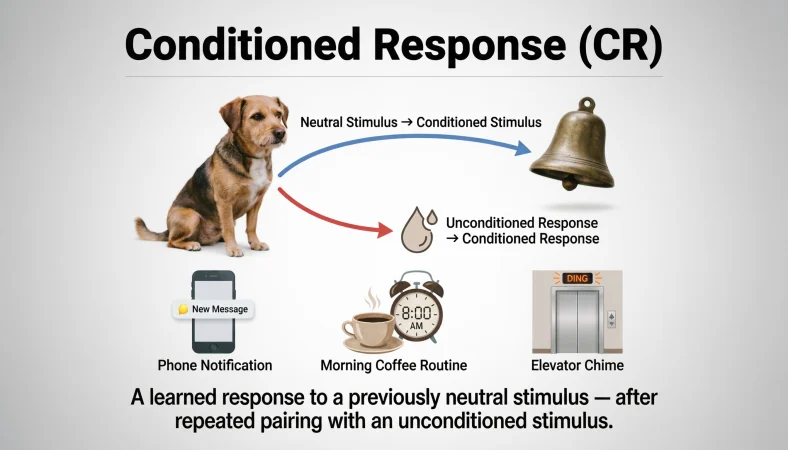
Quick Answer: A conditioned response (CR) is a learned reaction that happens after a previously neutral stimulus becomes associated with another stimulus that naturally produces a response. In simple terms, your brain learns the connection, then reacts automatically when the cue appears.
Top alternatives: learned response, acquired response, Pavlovian response, learned reaction, classical conditioning response
Ever heard a particular notification sound and instantly reached for your phone, even when you knew nobody important had texted? Yep, your brain may be doing its little learned-response thing. A conditioned response (CR) is a learned reaction that develops when a previously neutral cue becomes associated with something that naturally triggers a response.
You can spot examples in everyday routines, classroom learning, workplace habits, friendships, texting, DMs, and even crush situations. The phrase matters because it helps explain why people and animals sometimes react automatically to familiar cues. Understanding a conditioned response can make psychology terms feel much less like textbook soup and much more like real life. From Pavlov’s famous dogs to your own reaction when your alarm rings on Monday morning, learned associations are happening everywhere.
Funny Conditioned Response (CR) Examples
“My phone buzzes and suddenly I become a professional notification inspector.”
Use this when joking about checking your phone automatically.
Meaning: The repeated notification sound has become associated with checking for messages.
“Alarm rings, happiness leaves the building.”
Use this when describing your automatic reaction to a morning alarm.
Meaning: The alarm has become a cue associated with waking up.
“I hear the microwave beep and appear like magic.”
Use this when joking about food-related habits.
Meaning: The sound has become associated with food being ready.
“The email notification sounds and my blood pressure writes a novel.”
Use this for workplace humor.
Meaning: A familiar work cue can trigger an learned emotional reaction.
“One classroom bell and my brain says, ‘Pack it up.’”
Use this when remembering school routines.
Meaning: The bell became associated with ending class.
“My favorite song starts and suddenly I’m the main character.”
Use this for a playful social-media caption.
Meaning: A familiar song can trigger learned emotions and memories.
“Coffee smell detected. Productivity protocol activated.”
Use this when joking about morning routines.
Meaning: The smell of coffee has become associated with beginning a familiar routine.
“The doorbell rings and my dog becomes head of security.”
Use this when describing a pet’s reaction.
Meaning: The sound has become a cue for an expected event.
“Monday arrives and my conditioned response is emotional buffering.”
Use this as a workplace joke.
Meaning: Repeated Monday experiences can create an automatic emotional association.
“My favorite snack wrapper makes my brain clock in early.”
Use this when discussing food-related habits.
Meaning: The wrapper sound has become associated with getting a treat.
“The notification light flashes and my curiosity gets promoted.”
Use this for texting humor.
Meaning: A familiar visual cue can trigger an automatic checking behavior.
“Pavlov had dogs. I have delivery notifications.”
Use this as a modern psychology joke.
Meaning: Modern notifications can create learned reactions similar in principle to classical conditioning.
Simple Conditioned Response (CR) Examples
“A bell makes you expect food after repeated pairings.”
Use this when explaining classical conditioning to a beginner.
Meaning: The bell becomes a conditioned stimulus that produces a learned response.
“A school bell can make students start packing automatically.”
Use this when giving an everyday example.
Meaning: Repeated pairing of the bell with dismissal can create a learned reaction.
“A notification sound can make you check your phone.”
Use this when explaining conditioning through technology.
Meaning: Repeated notifications can turn a sound into a cue for checking messages.
“A particular song can trigger a familiar emotion.”
Use this when discussing learned associations.
Meaning: The song may become connected with an emotionally meaningful experience.
“A smell can bring back a learned feeling.”
Use this when discussing sensory associations.
Meaning: Repeated experiences can connect smells with emotional reactions.
“A dentist’s office can create nervousness before treatment begins.”
Use this when explaining learned fear.
Meaning: Environmental cues may become associated with an unpleasant experience.
“A traffic light can make drivers prepare to stop.”
Use this when discussing learned behavior in daily life.
Meaning: Repeated practice creates an automatic response to a familiar cue.
“A ringtone can make you expect a particular person.”
Use this when explaining association through communication.
Meaning: Repeatedly hearing the ringtone before messages from someone can create an expectation.
“A classroom routine can make students respond without thinking.”
Use this when discussing learned habits.
Meaning: Repetition strengthens associations between cues and actions.
“A pet may react to the sound of a food container opening.”
Use this when giving an animal example.
Meaning: The sound can become associated with receiving food.
“A familiar place can trigger memories automatically.”
Use this when explaining environmental cues.
Meaning: Context can become linked with previous emotional experiences.
“Repeated associations can turn ordinary cues into meaningful signals.”
Use this when summarizing conditioning.
Meaning: Learning gives a previously neutral stimulus the ability to trigger a response.
Pavlovian Conditioned Response (CR) Examples
“Pavlov’s dogs learned to respond to a bell-associated cue.”
Use this when introducing classical conditioning.
Meaning: The dogs learned an association between a previously neutral stimulus and food.
“The bell became meaningful through repeated association.”
Use this when explaining Pavlov’s experiment.
Meaning: Repeated pairing changed the dog’s response to the bell.
“Food naturally caused salivation.”
Use this when explaining the original conditioning setup.
Meaning: Food is an unconditioned stimulus that naturally produces salivation.
“The bell eventually triggered salivation.”
Use this when identifying the conditioned response.
Meaning: Salivation after the bell became a learned response.
“The learned reaction is the conditioned response.”
Use this when defining CR in simple terms.
Meaning: CR refers to a response acquired through conditioning.
“The original natural reaction is not learned.”
Use this when contrasting conditioned and unconditioned responses.
Meaning: An unconditioned response happens naturally without prior learning.
“A neutral cue can gain meaning through repetition.”
Use this when explaining how conditioning develops.
Meaning: Association can transform a neutral stimulus into a conditioned stimulus.
“Pavlov’s experiment became a classic psychology example.”
Use this when discussing the history of classical conditioning.
Meaning: His research became a foundational illustration of learned associations.
“The brain learns, ‘This cue predicts that event.’”
Use this when simplifying the conditioning process.
Meaning: Conditioning involves learning predictive relationships between stimuli.
“The response can become automatic after repeated pairings.”
Use this when explaining learned reactions.
Meaning: Repetition can strengthen the association.
“Pavlovian conditioning is also called classical conditioning.”
Use this when introducing terminology.
Meaning: The two terms describe the same basic learning process.
“The bell was not magical. The association was.”
Use this as a memorable teaching line.
Meaning: The learned connection, rather than the sound itself, produced the new response.
Everyday Conditioned Response (CR) Examples
“Your alarm makes you reach for the snooze button.”
Use this when discussing morning habits.
Meaning: Repeated alarm experiences can create an automatic behavioral reaction.
“Your phone buzz makes you look at the screen.”
Use this when discussing digital habits.
Meaning: Repeated notifications can condition checking behavior.
“A favorite restaurant smell makes you hungry.”
Use this when explaining sensory associations.
Meaning: The smell may become associated with eating and enjoyment.
“A specific ringtone makes you expect a certain caller.”
Use this when explaining learned cues.
Meaning: Repeated pairings can make the ringtone predictive.
“A classroom bell makes you expect a schedule change.”
Use this when explaining school routines.
Meaning: Repetition connects the bell with a particular event.
“The smell of sunscreen can make you think of summer.”
Use this when discussing memory-linked associations.
Meaning: Sensory cues can become connected with repeated experiences.
“A work notification can instantly shift your attention.”
Use this when discussing workplace habits.
Meaning: The notification becomes associated with work-related action.
“A familiar song can instantly change your mood.”
Use this when discussing emotional associations.
Meaning: Music can become linked with particular experiences or emotions.
“A specific road can make you anticipate traffic.”
Use this when discussing driving experiences.
Meaning: Repeated experiences can create expectations around environmental cues.
“A school hallway can bring back old feelings.”
Use this when discussing contextual learning.
Meaning: Places can become associated with previous experiences.
“A pet may run when it hears a treat bag.”
Use this when explaining conditioning with animals.
Meaning: The sound can become a learned predictor of food.
“A notification badge can trigger an automatic check.”
Use this when describing digital behavior.
Meaning: Visual cues can become associated with incoming information.
Emotional Conditioned Response (CR) Examples
“That song still makes me emotional.”
Use this when describing a strong music-related association.
Meaning: The song has become linked with an emotional experience.
“That smell instantly reminds me of home.”
Use this when discussing nostalgic reactions.
Meaning: The sensory cue has become associated with familiar memories.
“Walking into that room makes me nervous.”
Use this when describing a learned anxiety response.
Meaning: The environment may have become associated with an unpleasant experience.
“That ringtone makes me excited.”
Use this when describing anticipation around communication.
Meaning: The ringtone has become associated with positive messages or events.
“The sound of rain makes me feel relaxed.”
Use this when describing a repeated calming association.
Meaning: The sound may have become connected with restful experiences.
“That place instantly brings back memories.”
Use this when discussing contextual associations.
Meaning: The environment has become connected with meaningful past experiences.
“The smell of fresh bread makes me hungry.”
Use this when explaining appetite-related conditioning.
Meaning: The smell can become associated with eating.
“That notification sound makes me anxious.”
Use this when discussing a learned emotional reaction.
Meaning: Repeated negative experiences may create an association with the sound.
“Hearing that name changes my mood instantly.”
Use this when describing an emotionally loaded cue.
Meaning: Previous experiences can attach emotional significance to a word or name.
“The old ringtone brings back a whole era.”
Use this as a nostalgic expression.
Meaning: The ringtone has become associated with a specific period of life.
“That hallway still gives me school-day feelings.”
Use this when discussing contextual memory.
Meaning: A familiar environment can trigger learned emotional associations.
“One familiar scent and my brain opens the memory folder.”
Use this as a playful explanation.
Meaning: Sensory cues can become strongly connected with past experiences.
Conditioned Response (CR) In Psychology Class
“CR means conditioned response.”
Use this as a basic definition for a study note.
Meaning: CR is the learned response produced by a conditioned stimulus.
“A CR is acquired through learning.”
Use this when distinguishing learned reactions from natural ones.
Meaning: Conditioning creates the response through experience.
“The conditioned stimulus triggers the CR.”
Use this when reviewing key terminology.
Meaning: A previously neutral cue becomes capable of producing a learned response.
“CR and UR are not the same thing.”
Use this when preparing for a psychology quiz.
Meaning: A conditioned response is learned, while an unconditioned response is naturally occurring.
“Classical conditioning creates stimulus-response associations.”
Use this when summarizing the concept.
Meaning: Learning connects one stimulus with a predictable response.
“The CR depends on prior learning.”
Use this when explaining why conditioning matters.
Meaning: Without the learned association, the conditioned response would not occur in the same way.
“The conditioned response can weaken without reinforcement.”
Use this when discussing extinction.
Meaning: Removing the expected association can gradually reduce the learned response.
“Spontaneous recovery can bring a response back temporarily.”
Use this when reviewing conditioning concepts.
Meaning: An extinguished conditioned response can sometimes reappear after a rest period.
“Generalization can spread the response to similar cues.”
Use this when studying classical conditioning.
Meaning: A learned response may occur when stimuli resemble the original conditioned stimulus.
“Discrimination helps distinguish between different cues.”
Use this when reviewing another conditioning concept.
Meaning: Learning can make an organism respond differently to similar stimuli.
“Acquisition is when the association develops.”
Use this when studying the conditioning process.
Meaning: Acquisition refers to the stage in which the conditioned relationship is learned.
“CR is one of the key terms in classical conditioning.”
Use this when creating a quick revision note.
Meaning: Understanding CR helps connect the major components of classical conditioning.
Conditioned Response (CR) And Classical Conditioning
“Classical conditioning is built around learned associations.”
Use this when explaining the basic theory.
Meaning: A stimulus becomes associated with another stimulus through repeated pairing.
“The CR is the learned reaction.”
Use this when defining the role of CR.
Meaning: The response is acquired through conditioning.
“The CS comes before the CR.”
Use this when reviewing terminology.
Meaning: The conditioned stimulus serves as the cue that produces the learned response.
“A neutral stimulus can become a CS.”
Use this when describing acquisition.
Meaning: Association can give a previously neutral stimulus the ability to trigger a response.
“The US naturally produces a UR.”
Use this when reviewing the basic conditioning model.
Meaning: The unconditioned stimulus naturally causes an unconditioned response.
“Pairing creates the learned connection.”
Use this when simplifying classical conditioning.
Meaning: Repeated relationships between stimuli produce learning.
“Extinction weakens the learned association.”
Use this when studying what happens when reinforcement stops.
Meaning: The conditioned response can decrease when the conditioned stimulus is repeatedly presented without the expected outcome.
“Generalization makes similar cues trigger similar reactions.”
Use this when explaining stimulus generalization.
Meaning: The learned response can spread beyond the original cue.
“Discrimination makes the response more specific.”
Use this when explaining stimulus discrimination.
Meaning: The learner distinguishes the conditioned stimulus from similar stimuli.
“Acquisition is where the learning happens.”
Use this as a simple study phrase.
Meaning: Acquisition is the development of the conditioned association.
“Classical conditioning can explain many learned reactions.”
Use this when connecting textbook theory to real life.
Meaning: Learned associations can influence emotional and behavioral responses.
“The brain learns patterns from repeated experiences.”
Use this as a simple summary.
Meaning: Repeated associations can shape future responses to familiar cues.
Conditioned Response (CR) In Relationships And Social Life
“A familiar message notification can trigger instant anticipation.”
Use this when discussing texting habits.
Meaning: Repeated communication experiences can create a learned reaction to a notification.
“Seeing a certain name pop up can change your mood.”
Use this when discussing emotional associations.
Meaning: Previous experiences can attach emotional meaning to a person’s name.
“A familiar place can bring back relationship memories.”
Use this when discussing nostalgia.
Meaning: Context can become associated with emotionally significant events.
“A particular song can remind you of someone instantly.”
Use this when discussing romantic associations.
Meaning: The song may have become connected with shared experiences.
“A specific emoji can make you expect a familiar tone.”
Use this when discussing digital communication.
Meaning: Repeated use can make symbols carry learned social meaning.
“A certain notification can trigger excitement before you even check it.”
Use this when discussing anticipation.
Meaning: The cue has become associated with positive communication.
“A familiar silence can feel different after repeated experiences.”
Use this when discussing emotional expectations.
Meaning: Past experiences can influence how people react to similar situations.
“A date location can bring back old feelings.”
Use this when discussing contextual associations.
Meaning: Places can become linked with emotionally meaningful experiences.
“A person’s ringtone can become an instant attention signal.”
Use this when discussing phone habits.
Meaning: Repeated pairing makes the sound meaningful.
“A certain phrase can trigger an emotional reaction.”
Use this when discussing learned social associations.
Meaning: Words can become connected with previous positive or negative experiences.
“A crush’s notification can suddenly make your screen very interesting.”
Use this as a playful example.
Meaning: Previous positive interactions can make a familiar cue exciting.
“Your brain remembers patterns even when you are not trying.”
Use this when explaining automatic social reactions.
Meaning: Learned associations can influence behavior without conscious planning.
Conditioned Response (CR) In Education And Work
“A school bell can signal the end of class.”
Use this when explaining conditioned cues in education.
Meaning: Repeated exposure can make the bell produce an automatic expectation.
“A work notification can signal that attention is needed.”
Use this when discussing workplace habits.
Meaning: Repeated notifications can create a learned attentional response.
“A calendar reminder can trigger task preparation.”
Use this when discussing productivity routines.
Meaning: The reminder becomes associated with beginning a particular task.
“A teacher’s familiar phrase can signal a quiz.”
Use this when describing classroom conditioning.
Meaning: Repeated pairings can make a phrase predict an upcoming event.
“The sound of a printer can signal paperwork time.”
Use this when discussing office routines.
Meaning: Workplace sounds can become associated with familiar tasks.
“A meeting notification can create an automatic preparation routine.”
Use this when explaining workplace learning.
Meaning: Repeated reminders can trigger preparation behaviors.
“A classroom entrance can trigger study mode.”
Use this when discussing environmental cues.
Meaning: Repeated studying in the same place can create an association with learning.
“A specific ringtone can signal an important work call.”
Use this when discussing communication habits.
Meaning: The ringtone becomes associated with a particular type of event.
“A deadline reminder can instantly change your priorities.”
Use this when describing learned work routines.
Meaning: The reminder becomes a cue for urgent task behavior.
“A familiar desk setup can signal the beginning of work.”
Use this when discussing routine formation.
Meaning: Environmental cues can become associated with particular activities.
“A teacher’s countdown can signal that time is almost over.”
Use this when describing classroom behavior.
Meaning: Repeated countdowns can create an expectation of an upcoming transition.
“Repeated routines can make workplace reactions feel automatic.”
Use this when explaining learned behavior.
Meaning: Consistent cues and outcomes can strengthen associations.
Conditioned Response (CR) And Learned Fear
“A loud sound can become associated with danger.”
Use this when explaining learned fear in simple terms.
Meaning: A previously neutral cue can acquire an emotional response through association.
“A particular location can trigger nervousness after a bad experience.”
Use this when discussing contextual conditioning.
Meaning: The location may become associated with the unpleasant event.
“A medical environment can become linked with anxiety.”
Use this when explaining learned emotional responses.
Meaning: Repeated unpleasant experiences can make environmental cues emotionally meaningful.
“A barking sound can make someone tense after a frightening encounter.”
Use this when discussing learned fear.
Meaning: The sound may become associated with a previous threatening experience.
“A certain smell can bring back an unpleasant memory.”
Use this when discussing sensory conditioning.
Meaning: The smell can become connected with an emotionally difficult event.
“A particular road can trigger nervousness after an accident.”
Use this when explaining learned associations.
Meaning: The environment may become associated with the previous negative experience.
“Fear can sometimes be learned through association.”
Use this as a simple psychology explanation.
Meaning: A neutral cue can become capable of triggering fear after being paired with something unpleasant.
“Avoidance can reinforce learned fear in some situations.”
Use this when discussing behavioral patterns.
Meaning: Avoiding a cue can prevent new experiences that might weaken the learned association.
“Generalization can make similar cues feel threatening.”
Use this when explaining stimulus generalization.
Meaning: A learned fear response can spread to stimuli resembling the original cue.
“Discrimination can help separate safe cues from threatening ones.”
Use this when explaining stimulus discrimination.
Meaning: Learning can make responses more specific to the relevant stimulus.
“Extinction can reduce a conditioned fear response.”
Use this when discussing classical conditioning concepts.
Meaning: Repeated exposure without the expected unpleasant outcome can weaken the association.
“Learned fear shows how powerful associations can become.”
Use this as a concise study summary.
Meaning: Emotional reactions can be shaped by previous experiences.
Conditioned Response (CR) And Positive Associations
“A favorite song can make you feel instantly upbeat.”
Use this when explaining positive conditioning.
Meaning: The song may have become associated with enjoyable experiences.
“The smell of cookies can create instant anticipation.”
Use this when discussing food-related associations.
Meaning: The smell has become connected with receiving or eating cookies.
“A familiar vacation song can bring back happy memories.”
Use this when discussing positive emotional cues.
Meaning: The song has become associated with enjoyable experiences.
“A notification from a favorite person can trigger excitement.”
Use this when discussing social conditioning.
Meaning: Previous positive interactions can give the notification emotional significance.
“A particular café can feel comforting before you even sit down.”
Use this when discussing environmental associations.
Meaning: The location has become connected with pleasant experiences.
“A favorite perfume can remind you of someone special.”
Use this when discussing sensory memory.
Meaning: The scent has become associated with a meaningful person or experience.
“A team jersey can trigger excitement before a game.”
Use this when discussing learned emotional cues.
Meaning: The symbol can become associated with enjoyable sporting experiences.
“A celebration song can make you want to dance.”
Use this when discussing repeated positive experiences.
Meaning: The song has become associated with celebration.
“A familiar greeting can instantly make you feel welcome.”
Use this when discussing social associations.
Meaning: Repeated positive interactions can give the greeting emotional meaning.
“The sound of a coffee machine can signal a comforting routine.”
Use this when describing everyday conditioning.
Meaning: The sound becomes associated with a familiar positive experience.
“A favorite movie opening can bring back the whole mood.”
Use this when discussing media-related associations.
Meaning: The opening becomes connected with the emotions of watching the movie.
“Positive associations can make ordinary cues feel special.”
Use this as a summary statement.
Meaning: Learning can give everyday stimuli emotional significance.
Clever Conditioned Response (CR) Explanations
“The stimulus changed meaning because the experience changed the association.”
Use this when explaining conditioning beyond memorization.
Meaning: Learning gives a formerly neutral cue a new predictive role.
“CR is learned, not simply automatic from birth.”
Use this when distinguishing conditioned from unconditioned reactions.
Meaning: A conditioned response develops through experience.
“The cue becomes powerful because it predicts something.”
Use this when explaining why conditioned stimuli matter.
Meaning: Predictive association is central to classical conditioning.
“Your brain is basically a pattern detective.”
Use this when making psychology easier to understand.
Meaning: Learning involves detecting and responding to repeated relationships.
“Repeated pairing turns coincidence into expectation.”
Use this as a memorable explanation.
Meaning: Consistent associations can create predictions about what comes next.
“CR is the response after the learning has happened.”
Use this when reviewing terminology.
Meaning: The conditioned response is produced by the learned association.
“A neutral cue can become psychologically meaningful.”
Use this when explaining acquisition.
Meaning: Conditioning can give an initially neutral stimulus a learned significance.
“Extinction changes the expectation, not the original history.”
Use this when discussing extinction.
Meaning: A learned response may weaken when the expected outcome stops occurring.
“Generalization spreads the learned reaction.”
Use this when explaining stimulus generalization.
Meaning: Similar stimuli can sometimes produce the conditioned response.
“Discrimination narrows the reaction.”
Use this when explaining stimulus discrimination.
Meaning: Learning can make the response specific to one cue rather than similar ones.
“The interesting part is the association, not just the reaction.”
Use this when explaining the deeper idea.
Meaning: Conditioning is fundamentally about relationships between stimuli and outcomes.
“Everyday habits can make psychology feel surprisingly familiar.”
Use this when connecting textbook concepts to daily life.
Meaning: Learned associations appear in ordinary routines.
Chill And Casual Conditioned Response (CR) Examples
“Basically, your brain learned the cue.”
Use this when giving a relaxed explanation.
Meaning: The response developed through association and experience.
“You see the signal and your brain already knows the routine.”
Use this when describing automatic learned behavior.
Meaning: Repetition has created a predictable response.
“It is basically learned reaction mode.”
Use this for a casual psychology explanation.
Meaning: A conditioned response is a reaction acquired through learning.
“The cue shows up and your brain goes, ‘Oh, I know this.’”
Use this when simplifying conditioning.
Meaning: The stimulus has become familiar through repeated association.
“Same cue, same learned reaction.”
Use this when explaining repetition.
Meaning: Consistent associations can make responses more automatic.
“Your brain connected the dots.”
Use this as a simple metaphor.
Meaning: Learning created an association between stimuli.
“The reaction was learned over time.”
Use this when distinguishing conditioning from instinct.
Meaning: Experience created the response.
“It is psychology hiding in your daily routine.”
Use this as a social-media-friendly explanation.
Meaning: Conditioning can appear in ordinary habits.
“The cue is doing more work than you think.”
Use this when discussing conditioned stimuli.
Meaning: A familiar signal can trigger a learned reaction.
“Your brain loves predictable patterns.”
Use this when explaining repeated associations.
Meaning: Consistent relationships can shape future responses.
“One little sound can carry a whole history.”
Use this when discussing emotionally meaningful cues.
Meaning: A sound can become connected with repeated experiences.
“Welcome to classical conditioning in everyday life.”
Use this as a casual summary.
Meaning: Learned stimulus-response associations are common outside the laboratory.
Confident Conditioned Response (CR) Study Answers
“A conditioned response is a learned reaction to a conditioned stimulus.”
Use this as a concise exam-preparation definition.
Meaning: The CR is produced because learning created an association with the cue.
“CR is different from UR because CR is learned.”
Use this when preparing for a psychology test.
Meaning: The conditioned response requires prior conditioning.
“The conditioned stimulus produces the learned response.”
Use this when reviewing the basic sequence.
Meaning: The CS becomes capable of triggering the CR after conditioning.
“Classical conditioning explains how associations develop.”
Use this when writing a study summary.
Meaning: The process connects stimuli through repeated pairing.
“Pavlov’s experiment demonstrates classical conditioning.”
Use this when answering a history-of-psychology question.
Meaning: Pavlov’s work is a classic example of stimulus association.
“Acquisition establishes the conditioned association.”
Use this when reviewing stages of conditioning.
Meaning: Acquisition is the period in which the association is learned.
“Extinction weakens a conditioned response.”
Use this when studying what happens when reinforcement stops.
Meaning: The learned reaction can decrease when the expected outcome no longer follows the cue.
“Generalization allows similar stimuli to trigger the response.”
Use this when reviewing stimulus generalization.
Meaning: The learned reaction may extend to cues resembling the original stimulus.
“Discrimination makes the response more selective.”
Use this when reviewing stimulus discrimination.
Meaning: The learner distinguishes the conditioned cue from similar stimuli.
“Spontaneous recovery is the temporary return of an extinguished response.”
Use this when reviewing key terminology.
Meaning: A conditioned response can sometimes reappear after a pause.
“The key word in CR is learned.”
Use this as a memorable exam tip.
Meaning: The defining feature of a conditioned response is that it results from experience.
“If you remember the association, CR becomes easier to understand.”
Use this when helping someone study.
Meaning: Focusing on the learned connection makes the terminology more intuitive.
Creative Conditioned Response (CR) Captions
“My brain saw the cue and already knew the assignment.”
Use this as a playful psychology caption.
Meaning: The learned association produces an automatic response.
“Tiny stimulus, surprisingly big reaction.”
Use this for an educational social post.
Meaning: A small cue can trigger a learned response.
“Brain connected. Response activated.”
Use this as a short infographic caption.
Meaning: Learning created a stimulus-response association.
“Pavlov walked so notification sounds could run.”
Use this as a modern psychology joke.
Meaning: Everyday digital cues can illustrate the basic idea of learned associations.
“Your brain is collecting associations like receipts.”
Use this as a playful educational caption.
Meaning: Experiences can accumulate learned connections.
“One sound. One memory. Instant reaction.”
Use this for a sensory-conditioning post.
Meaning: A familiar cue can trigger a learned emotional response.
“Conditioning: when ordinary things become meaningful.”
Use this for an educational graphic.
Meaning: Learning can give neutral stimuli new significance.
“The cue is innocent. The association is doing the work.”
Use this when explaining conditioned stimuli.
Meaning: The stimulus becomes powerful because of what it has been associated with.
“Brain science, but make it relatable.”
Use this as a psychology social caption.
Meaning: Everyday examples can make conditioning easier to understand.
“Learned it once, reacted to it forever.”
Use this as a dramatic but playful caption.
Meaning: Strong associations can create long-lasting reactions.
“That was not random. Your brain remembers patterns.”
Use this when explaining automatic reactions.
Meaning: Previous experiences can influence present responses.
“Classical conditioning just entered the group chat.”
Use this for a Gen Z-style psychology post.
Meaning: The concept can be seen in modern digital habits too.
FAQs
What Does Conditioned Response (CR) Mean?
A conditioned response is a learned reaction to a stimulus that became meaningful through association with another stimulus.
What Is A Simple Example Of A Conditioned Response?
A classic example is salivating when hearing a bell after the bell has repeatedly been paired with food.
Is A Conditioned Response Learned?
Yes. Learning and repeated association are what distinguish a conditioned response from a naturally occurring unconditioned response.
What Is The Difference Between CR And UR?
CR means conditioned response and is learned, while UR means unconditioned response and occurs naturally without prior conditioning.
What Is The Difference Between CR And CS?
CR is the learned response, while CS means conditioned stimulus, which is the learned cue that triggers the response.
Is A Conditioned Response Emotional?
It can be. Learned responses may involve emotions such as excitement, fear, anticipation, comfort, or nervousness.
Can A Conditioned Response Be Positive?
Yes. A stimulus can become associated with pleasant experiences and produce a positive learned reaction.
Can A Conditioned Response Be Negative?
Yes. Unpleasant experiences can create learned associations that produce discomfort, fear, anxiety, or avoidance.
Can Conditioned Responses Happen In Everyday Life?
Absolutely. Notifications, sounds, smells, places, songs, routines, and social cues can all become associated with particular experiences.
Is Pavlov’s Experiment An Example Of CR?
Yes. Pavlov’s dogs are the classic example of classical conditioning, in which a learned response developed to a previously neutral cue.
Is Humor Appropriate When Explaining Conditioned Response (CR)?
Definitely. Everyday jokes about phones, alarms, food, school bells, and work notifications can make the concept easier to remember.
What Is The Easiest Way To Remember CR?
Remember this: CR means the learned response. The word “conditioned” points to a response created through association and experience.
Conclusion
A conditioned response (CR) sounds like a textbook phrase, but the idea is actually hiding all around you. Your phone notification, favorite song, morning alarm, classroom bell, food smell, or familiar place can become a cue connected to a learned reaction. Once you understand the difference between conditioned and unconditioned responses, classical conditioning becomes much easier to recognize.
The next time your brain reacts before you even think about it, you may have spotted a little psychology in action. Try using different examples to study, teach, or explain the concept, and save this guide whenever you need a quick refresher. Share it with a psychology student or anyone who loves learning why our brains do what they do.