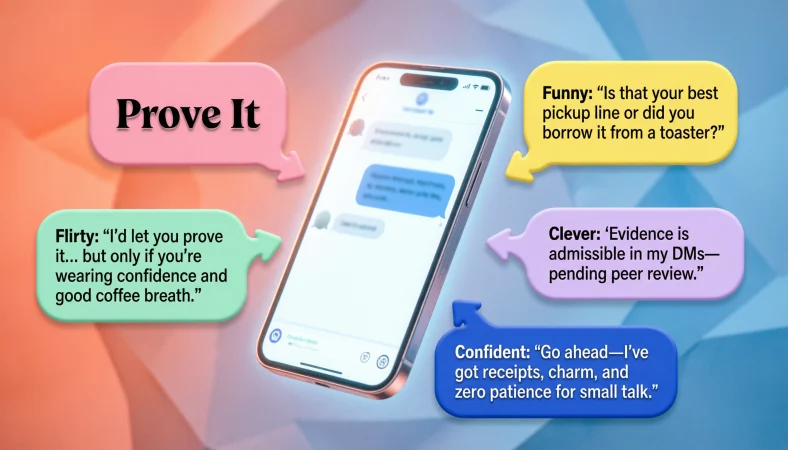
Quick Answer: When someone says “prove it,” your reply can be funny, confident, flirty, sarcastic, or completely chill depending on the situation. The best response keeps the energy going without trying too hard.
Top alternatives: “Challenge accepted,” “Watch me,” “Bet,” “Just wait,” “I’ll let my actions speak.”
Ever said something confidently over text, only to get hit with the two-word challenge: “Prove it”? Suddenly, your perfectly reasonable statement has turned into a courtroom drama, a flirting opportunity, or an unexpected competition. Whether it happens in DMs, a group chat, at work, between friends, or with a crush, knowing how to Respond to prove it can completely change the vibe. “Prove it” usually means someone wants evidence, action, or simply a little playful energy. Sometimes they are genuinely skeptical. Other times, they are basically handing you an opening for a clever comeback. The trick is matching your response to the mood. You can keep things funny, turn up the charm, stay confident, or shut down the challenge without making things awkward. Here are plenty of ready-to-send responses for practically every situation.
Funny Responses To “Prove It”
“Challenge accepted.”
Use this when you want to turn their skepticism into a playful competition.
Meaning: You are confidently accepting the challenge.
“Do I get a trophy afterward?”
Use this when you want to make their challenge unnecessarily dramatic and funny.
Meaning: You are joking about how seriously they are taking things.
“Please form an orderly line for the evidence.”
Use this with friends who love exaggerating everything.
Meaning: You are playfully acting like you have overwhelming proof.
“My lawyer advised me not to answer.”
Use this when you want a silly courtroom-style comeback.
Meaning: You are jokingly refusing to provide evidence.
“Fine, but prepare to be impressed.”
Use this when you are feeling playful and confident.
Meaning: You believe you can back up your claim.
“I was hoping you wouldn’t ask.”
Use this when you want to create funny suspense.
Meaning: You are pretending your proof is hilariously complicated.
“Let me activate my presentation mode.”
Use this when someone wants proof of something obvious.
Meaning: You are exaggerating the situation for comedic effect.
“Evidence is loading…”
Use this in a casual text or DM when you want a meme-style response.
Meaning: You are playfully pretending proof is on the way.
“One moment while I gather my receipts.”
Use this when you want to sound dramatically prepared.
Meaning: You are joking that you have evidence ready.
“You really want to open this file?”
Use this when your claim has plenty of funny evidence behind it.
Meaning: You are teasing them about what they are about to discover.
“Say less. I love a challenge.”
Use this when you want a confident but humorous answer.
Meaning: You are excited to prove your point.
“I could, but then what would we argue about?”
Use this when playful arguing is part of your friendship.
Meaning: You are joking that the debate is more fun than the proof.
Flirty Responses To “Prove It”
“Come closer and find out.”
Use this when a crush challenges your claim and the chemistry is already obvious.
Meaning: You are turning the challenge into flirtation.
“I’d rather show you than tell you.”
Use this when you want to sound smooth and confident.
Meaning: You prefer actions over words.
“Careful what you ask for.”
Use this when the conversation has a teasing romantic vibe.
Meaning: You are playfully suggesting they might get more than expected.
“Maybe I should prove it over dinner.”
Use this when you want to turn the challenge into a date opportunity.
Meaning: You are flirting while suggesting time together.
“You’re really giving me an excuse to impress you.”
Use this when you want to make their skepticism part of the flirting.
Meaning: You are happily accepting the opportunity to charm them.
“I think you just wanted an excuse to see me.”
Use this when you suspect their challenge is secretly flirtatious.
Meaning: You are teasing them about their hidden intentions.
“Watch closely, cutie.”
Use this with someone you already have playful chemistry with.
Meaning: You are confidently flirting while accepting the challenge.
“I could prove it, but I like keeping you curious.”
Use this when you want to create playful suspense.
Meaning: You are deliberately keeping the flirtation going.
“You’re adorable when you’re skeptical.”
Use this when you want to turn their challenge into a compliment.
Meaning: You are responding with affectionate teasing.
“Guess you’ll have to stick around.”
Use this when you want a subtle, charming response.
Meaning: You are suggesting they stay close enough to find out.
“I have a feeling you’ll believe me soon.”
Use this when you want to sound quietly confident.
Meaning: You expect your actions to convince them.
“Is this your way of asking for more attention?”
Use this when someone is clearly enjoying the playful exchange.
Meaning: You are teasing them while keeping the flirtation alive.
Clever Responses To “Prove It”
“Proof is better than promises, right?”
Use this when you want to answer confidently without overexplaining.
Meaning: You are ready to let your actions support your words.
“Give me one good reason to start.”
Use this when you want to put the challenge back on them.
Meaning: You are playfully making them earn the proof.
“Interesting. What would convince you?”
Use this when you want to understand exactly what they mean.
Meaning: You are asking them to define their standard of proof.
“The evidence speaks for itself.”
Use this when the facts are already obvious.
Meaning: You believe no additional explanation is necessary.
“I prefer demonstrations over explanations.”
Use this when you want to sound composed and intelligent.
Meaning: You trust actions more than words.
“Proof requires observation. Pay attention.”
Use this when you want a confident, slightly theatrical comeback.
Meaning: You are telling them to watch what happens next.
“You asked for proof, not a PowerPoint.”
Use this when someone is making your simple claim unnecessarily complicated.
Meaning: You are joking about overexplaining.
“Consider this your official warning.”
Use this when you want to make the response playful and mysterious.
Meaning: You are hinting that proof is coming.
“I could prove it, but where’s the fun in that?”
Use this when you want to keep some mystery alive.
Meaning: You enjoy the playful challenge more than immediately ending it.
“You doubt me? Bold strategy.”
Use this when someone is teasing you about your confidence.
Meaning: You are amused that they chose to challenge you.
“Let the results do the talking.”
Use this when you want to sound mature and self-assured.
Meaning: You believe results are stronger than arguments.
“Noted. I’ll let reality handle the rest.”
Use this when you want a calm, clever response.
Meaning: You are confident that the facts will prove your point.
Sarcastic Responses To “Prove It”
“Absolutely, Your Honor.”
Use this when someone is acting like a judge during a casual argument.
Meaning: You are sarcastically exaggerating their demand.
“Should I bring witnesses too?”
Use this when their request for proof feels hilariously excessive.
Meaning: You are mocking how serious the situation has become.
“Would you like the extended edition?”
Use this when someone keeps asking for more evidence.
Meaning: You are sarcastically offering unnecessary extra proof.
“I’ll notify the investigation team.”
Use this when a friend is treating your statement like a major mystery.
Meaning: You are joking about their skepticism.
“Breaking news: you remain unconvinced.”
Use this when someone refuses to believe you.
Meaning: You are poking fun at their continued doubt.
“Hold on while I contact the experts.”
Use this when you want to make their challenge sound ridiculous.
Meaning: You are exaggerating the amount of proof supposedly required.
“I’m sorry, this evidence is classified.”
Use this when you want a playful sarcastic refusal.
Meaning: You are jokingly pretending the information is top secret.
“You want citations too?”
Use this when a casual conversation suddenly feels academic.
Meaning: You are teasing them for demanding too much evidence.
“I’ll submit the paperwork immediately.”
Use this when their challenge is clearly playful.
Meaning: You are pretending the situation requires official documentation.
“Of course. Let me schedule the presentation.”
Use this when you want to exaggerate the effort involved.
Meaning: You are sarcastically treating the challenge like a business meeting.
“I didn’t realize we were under oath.”
Use this during a playful argument with someone you know well.
Meaning: You are joking about how seriously they are questioning you.
“Your skepticism has been noted.”
Use this when you want a dry, understated comeback.
Meaning: You acknowledge their doubt while refusing to be bothered by it.
Confident Responses To “Prove It”
“Watch me.”
Use this when you want a short response with maximum confidence.
Meaning: You are certain you can back up your words.
“I don’t make claims I can’t back up.”
Use this when someone seriously doubts you.
Meaning: You are emphasizing your reliability.
“Give me the opportunity.”
Use this when you are ready to demonstrate your point.
Meaning: You are confidently asking for a chance to prove yourself.
“Actions are coming.”
Use this when you want to keep your response short and direct.
Meaning: You plan to let what you do speak for you.
“You’ll see.”
Use this when you want a calm, mysterious response.
Meaning: You are confident that proof will arrive soon.
“I have nothing to prove, but I’ll entertain you.”
Use this when you want confidence without sounding defensive.
Meaning: You are choosing to prove yourself because you want to, not because you must.
“Bet.”
Use this when you want a modern, concise challenge accepted.
Meaning: You are fully accepting their dare.
“Consider it handled.”
Use this when you want to sound composed and capable.
Meaning: You are confident you can deliver.
“Just wait.”
Use this when you want to create anticipation.
Meaning: You expect your actions to settle the matter.
“I’ll make my point.”
Use this when you want a firm but controlled response.
Meaning: You intend to demonstrate that you are right.
“You’re about to find out.”
Use this when the situation is playful and competitive.
Meaning: You are confidently promising proof.
“Doubt me now. Thank me later.”
Use this when you want a bold, memorable comeback.
Meaning: You are confident your actions will change their mind.
Cute Responses To “Prove It”
“Okay, but don’t act surprised when I do.”
Use this when you want to keep the challenge adorable rather than intense.
Meaning: You are playfully confident about proving your point.
“Aww, you want proof?”
Use this when the other person is teasing you.
Meaning: You are responding with affectionate amusement.
“Fine, I’ll show you.”
Use this when you want a sweet and simple response.
Meaning: You are willing to prove yourself without making it dramatic.
“You’re so suspicious.”
Use this when someone playfully doubts your statement.
Meaning: You are teasing them for being skeptical.
“Okay, detective.”
Use this when you want a cute, playful comeback.
Meaning: You are joking about their need for evidence.
“I’ll convince you eventually.”
Use this when you want to sound patient and charming.
Meaning: You are confident they will eventually believe you.
“You really don’t trust me, huh?”
Use this when you want to turn their challenge into playful teasing.
Meaning: You are pretending to be dramatically offended.
“Fine, but I expect applause.”
Use this when you want to make the proof funny and cute.
Meaning: You are jokingly demanding recognition afterward.
“Only because it’s you.”
Use this when you want to add a little affection.
Meaning: You are suggesting they are special enough to get proof.
“Okay, I’ll make it convincing.”
Use this when you want a sweet but confident response.
Meaning: You are promising to make your point clear.
“Your wish is my command.”
Use this when playful exaggeration fits the relationship.
Meaning: You are jokingly agreeing to their request.
“Fine, you win. I’ll prove it.”
Use this when you want to keep things light and affectionate.
Meaning: You are playfully surrendering while accepting the challenge.
Chill And Casual Responses To “Prove It”
“Sure.”
Use this when you want to keep things simple and low-key.
Meaning: You are casually agreeing.
“Bet.”
Use this when you want a quick, confident modern response.
Meaning: You accept the challenge.
“Give me a sec.”
Use this when proof genuinely requires a moment.
Meaning: You are saying you will provide evidence shortly.
“Fair enough.”
Use this when their request for proof is reasonable.
Meaning: You acknowledge their point without taking offense.
“You’ll see soon.”
Use this when you want to keep the response relaxed.
Meaning: You expect your actions to make things clear.
“No problem.”
Use this when you are completely comfortable backing up your claim.
Meaning: You have no issue proving what you said.
“Easy.”
Use this when you want to sound casually confident.
Meaning: You believe proving your point will be simple.
“Say less.”
Use this when you want to accept the challenge without overexplaining.
Meaning: You understand and are ready to act.
“Alright, watch this.”
Use this when you are about to demonstrate something.
Meaning: You are inviting them to see the proof.
“I got you.”
Use this when you want a friendly, reassuring answer.
Meaning: You are confident you can deliver.
“Give it time.”
Use this when the proof cannot happen immediately.
Meaning: You are asking them to wait for the results.
“We’ll see.”
Use this when you want to stay relaxed and avoid overpromising.
Meaning: You are open to letting the situation unfold.
Dramatic Responses To “Prove It”
“Very well. The demonstration begins.”
Use this when you want to turn a tiny challenge into a full production.
Meaning: You are humorously embracing the drama.
“You have activated my final form.”
Use this with friends who appreciate exaggerated internet humor.
Meaning: You are joking that their challenge unlocked your competitive side.
“Prepare yourself.”
Use this when you want a theatrical response.
Meaning: You are playfully warning them that proof is coming.
“The moment has arrived.”
Use this when you want to make a simple situation sound legendary.
Meaning: You are exaggerating the importance of proving your point.
“History will remember this day.”
Use this when the challenge is completely ordinary but you want maximum drama.
Meaning: You are jokingly presenting the moment as historic.
“You have made a grave mistake.”
Use this when someone playfully challenges your abilities.
Meaning: You are pretending their doubt will have hilarious consequences.
“Roll the cameras.”
Use this when you want to make your proof feel like a movie scene.
Meaning: You are dramatically preparing for your big moment.
“The evidence shall be revealed.”
Use this when you want a theatrical but harmless comeback.
Meaning: You are promising to unveil proof dramatically.
“And so it begins.”
Use this when a playful argument is about to escalate.
Meaning: You are humorously announcing the start of the challenge.
“Tell everyone to gather around.”
Use this when you want to exaggerate the importance of your proof.
Meaning: You are joking that your demonstration deserves an audience.
“You wanted proof. You got a whole production.”
Use this when you are deliberately going overboard.
Meaning: You are turning their simple request into entertainment.
“Cue the dramatic music.”
Use this when you want a funny cinematic response.
Meaning: You are making the moment sound far more important than it is.
Polite Responses To “Prove It”
“Of course, I can show you.”
Use this when someone genuinely needs reassurance or evidence.
Meaning: You are responding helpfully and respectfully.
“Sure, what would you like to see?”
Use this when you want to clarify what proof they need.
Meaning: You are inviting them to explain their concern.
“I understand why you’d want confirmation.”
Use this when the other person has a reasonable reason to be skeptical.
Meaning: You are acknowledging their perspective.
“Absolutely, I can provide evidence.”
Use this in a serious conversation where proof actually matters.
Meaning: You are willing to support your statement with facts.
“Let me find that for you.”
Use this when you genuinely need to locate supporting information.
Meaning: You are offering practical help.
“That’s fair. I’ll show you.”
Use this when you want to remain calm and cooperative.
Meaning: You accept their request without taking it personally.
“I’d be happy to clarify.”
Use this when someone misunderstands what you meant.
Meaning: You are offering a respectful explanation.
“Give me a moment to pull it up.”
Use this when you need time to find documentation.
Meaning: You are preparing to provide concrete evidence.
“I can understand the hesitation.”
Use this when their skepticism comes from uncertainty.
Meaning: You are validating their concern.
“Let me back that up with the facts.”
Use this when you want to move the conversation toward evidence.
Meaning: You intend to support your statement objectively.
“Certainly. I’ll show you what I mean.”
Use this when you want a polished response without sounding defensive.
Meaning: You are calmly offering clarification.
“No worries, I can explain.”
Use this when someone needs more context before believing you.
Meaning: You are keeping the conversation friendly and open.
Creative Responses To “Prove It”
“I’ll let the receipts tell the story.”
Use this when you have screenshots, facts, or other evidence ready.
Meaning: You are letting proof speak instead of arguing.
“Plot twist: I actually can.”
Use this when someone expects you to struggle to prove your point.
Meaning: You are playfully surprising them.
“Welcome to the evidence department.”
Use this when you want a quirky response in a group chat.
Meaning: You are humorously presenting yourself as the proof provider.
“Let’s turn theory into evidence.”
Use this when you want a smart but creative answer.
Meaning: You are ready to move from words to action.
“I’ll bring the receipts and the confidence.”
Use this when you want a bold social-media-style comeback.
Meaning: You are confident you can support your claim.
“Proof incoming. Please remain seated.”
Use this when you want to create playful suspense.
Meaning: You are making the upcoming evidence sound like an event.
“Time to turn my words into facts.”
Use this when you want to sound motivated and confident.
Meaning: You intend to support your statement through action.
“Let’s make this scientifically undeniable.”
Use this when friends are jokingly debating something.
Meaning: You are exaggerating your commitment to proving your point.
“I have receipts with your name on them.”
Use this when you already have evidence and want a teasing edge.
Meaning: You are confidently hinting that proof is ready.
“The proof is about to have a plot twist.”
Use this when you want to make the reveal more entertaining.
Meaning: You are promising an unexpected result.
“I’ll make the evidence aesthetically pleasing.”
Use this when chatting with someone who loves social-media humor.
Meaning: You are jokingly treating proof like content.
“Consider this my evidence era.”
Use this when you want a trendy, playful response.
Meaning: You are embracing the challenge with confidence.
Emotional Responses To “Prove It”
“I’d rather show you through my actions.”
Use this when someone doubts how seriously you feel about them.
Meaning: You believe consistent actions communicate genuine emotion.
“I understand why you need reassurance.”
Use this when someone has been disappointed before.
Meaning: You are responding with empathy rather than defensiveness.
“I don’t expect you to believe me instantly.”
Use this when trust needs to be rebuilt.
Meaning: You are giving them space to see your consistency.
“I’ll let my actions speak for me.”
Use this when words no longer feel sufficient.
Meaning: You want your behavior to demonstrate sincerity.
“You don’t have to take my word for it.”
Use this when you want to reassure someone calmly.
Meaning: You are willing to let reality support what you said.
“I want you to feel certain, not pressured.”
Use this when the conversation involves trust or feelings.
Meaning: You care more about genuine reassurance than forcing belief.
“I’ll prove it with consistency.”
Use this when someone questions whether you will follow through.
Meaning: You are promising dependable behavior over time.
“I know words can be easy. Actions matter more.”
Use this when you want to acknowledge the importance of follow-through.
Meaning: You understand that genuine proof comes from behavior.
“Give me time to show you.”
Use this when trust cannot be restored instantly.
Meaning: You are asking for an opportunity to demonstrate sincerity.
“I mean what I said.”
Use this when you want a simple, emotionally honest answer.
Meaning: You are standing firmly behind your words.
“I’d never want you to feel like you have to guess.”
Use this when someone is uncertain about your intentions.
Meaning: You want your actions and feelings to be clear.
“Let me earn your trust instead of asking for it.”
Use this when the conversation is about rebuilding confidence.
Meaning: You believe trust should be demonstrated rather than demanded.
Professional Responses To “Prove It”
“I can provide the supporting evidence.”
Use this when a colleague requests confirmation of a work-related claim.
Meaning: You are prepared to substantiate your statement.
“I’ll send over the relevant documentation.”
Use this when proof exists in files, reports, or records.
Meaning: You are offering concrete professional evidence.
“Absolutely. I’ll share the data.”
Use this when your argument is supported by measurable information.
Meaning: You are backing your position with facts.
“Let me pull the records for you.”
Use this when documentation is needed to verify something.
Meaning: You are taking practical steps to confirm your claim.
“I can walk you through the evidence.”
Use this when the proof needs some explanation.
Meaning: You are willing to explain your reasoning clearly.
“That’s a fair question. Here’s the supporting information.”
Use this when someone professionally challenges your statement.
Meaning: You respect their request for verification.
“I’ll provide the details for review.”
Use this when the other person needs to independently assess the evidence.
Meaning: You are giving them the information required to verify your point.
“The results should clarify the situation.”
Use this when outcomes will demonstrate whether your claim was correct.
Meaning: You trust measurable results to settle the matter.
“I’ll follow up with the relevant figures.”
Use this when financial, sales, or performance data supports your position.
Meaning: You are offering specific evidence.
“I can substantiate that with the report.”
Use this when a formal document contains the necessary proof.
Meaning: You are pointing to an authoritative source.
“Let’s review the evidence together.”
Use this when you want a collaborative rather than defensive tone.
Meaning: You are inviting a fact-based discussion.
“I’ll make sure you have everything needed to verify it.”
Use this when transparency is important.
Meaning: You are confidently offering complete supporting information.
Witty Responses To “Prove It”
“Oh, you want receipts? I brought the whole filing cabinet.”
Use this when you have plenty of evidence and want to be funny.
Meaning: You are confidently saying you can back up your claim.
“Doubt is healthy. Conveniently, so is my evidence.”
Use this when you want a smart, polished comeback.
Meaning: You accept skepticism because you have proof.
“I was born ready for this moment.”
Use this when you want an energetic response to a playful challenge.
Meaning: You are enthusiastically accepting the challenge.
“My confidence came with supporting documents.”
Use this when you want clever humor without sounding aggressive.
Meaning: You are saying your confidence is backed by facts.
“You really chose the person with receipts.”
Use this when someone should know better than to challenge you.
Meaning: You are playfully warning them that you have evidence.
“Proof? I thought we were trusting the vibes.”
Use this when the conversation is intentionally unserious.
Meaning: You are joking about suddenly needing evidence.
“That sounds like a job for Exhibit A.”
Use this when you want a courtroom-inspired comeback.
Meaning: You are humorously introducing your evidence.
“I could prove it in three business minutes.”
Use this when you want a meme-style response.
Meaning: You are jokingly asking for a little time.
“You asked the right person.”
Use this when you are confident you can provide proof.
Meaning: You are certain you have what they need.
“I have screenshots older than this argument.”
Use this when friends are debating something you have documented.
Meaning: You are joking that your evidence is extensive.
“You want proof? I love a well-organized presentation.”
Use this when you want to make the challenge unnecessarily formal.
Meaning: You are playfully embracing the demand.
“The evidence is ready for its close-up.”
Use this when you want a dramatic but witty reveal.
Meaning: You are joking that your proof deserves attention.
Playful Responses To “Prove It”
“Okay, game on.”
Use this when you want to turn the moment into friendly competition.
Meaning: You happily accept the challenge.
“You’re making this too easy.”
Use this when you already know how to prove your point.
Meaning: You are confidently teasing the other person.
“Oh, I will.”
Use this when you want a short, playful answer.
Meaning: You are promising to prove your claim.
“Don’t tempt me.”
Use this when their challenge creates an opportunity for fun.
Meaning: You are teasing them about encouraging you.
“Challenge noted.”
Use this when you want to sound playful and composed.
Meaning: You acknowledge that you have been challenged.
“You really want to see this?”
Use this when you want to build anticipation.
Meaning: You are teasing them before providing proof.
“Watch and learn.”
Use this when you want a confident, playful comeback.
Meaning: You are ready to demonstrate what you can do.
“Okay, now you’ve made it interesting.”
Use this when their challenge turns a normal conversation into a game.
Meaning: You are enjoying the added excitement.
“I accept your terms.”
Use this when you want a mock-serious response.
Meaning: You are humorously agreeing to their challenge.
“You asked for it.”
Use this when you are about to demonstrate your point.
Meaning: You are playfully warning them that proof is coming.
“Let’s make this fun.”
Use this when you want to turn skepticism into friendly energy.
Meaning: You are choosing playfulness over arguing.
“Alright, showtime.”
Use this when you are ready to demonstrate your claim.
Meaning: You are treating the moment like a fun performance.
Short And Punchy Responses To “Prove It”
“Bet.”
Use this when you want the fastest confident comeback possible.
Meaning: You accept the challenge.
“Watch.”
Use this when you want maximum confidence in one word.
Meaning: You are telling them to wait and observe.
“Done.”
Use this when the proof is easy to provide.
Meaning: You are confident you can deliver.
“Absolutely.”
Use this when you want a positive and direct response.
Meaning: You are fully willing to prove it.
“Say less.”
Use this when you want to sound relaxed and modern.
Meaning: You understand the challenge and are ready.
“Gladly.”
Use this when you want to sound confident with a little charm.
Meaning: You are happy to provide proof.
“Easy.”
Use this when you are certain the challenge is simple.
Meaning: You have no doubts about succeeding.
“Just wait.”
Use this when you want to create anticipation.
Meaning: Proof is coming.
“On it.”
Use this when you are about to take action.
Meaning: You are immediately getting started.
“Consider it done.”
Use this when you want a polished but concise response.
Meaning: You confidently promise follow-through.
“You’ll see.”
Use this when you want a mysterious response.
Meaning: You expect your actions to settle the question.
“Challenge accepted.”
Use this when you want your answer to feel energetic and playful.
Meaning: You are openly accepting the dare.
Responses To “Prove It” From A Crush
“I’d rather show you in person.”
Use this when you want to turn their challenge into an excuse to meet.
Meaning: You are adding a subtle romantic invitation.
“Sounds like you need to see me again.”
Use this when there is already obvious chemistry.
Meaning: You are playfully suggesting another meeting.
“Careful, I might actually impress you.”
Use this when you want confident flirting without going overboard.
Meaning: You expect to surprise them positively.
“Guess you’ll have to stick around.”
Use this when you want to create playful romantic tension.
Meaning: You are hinting that they should stay in your life long enough to find out.
“I could prove it over coffee.”
Use this when you want a casual way to suggest meeting up.
Meaning: You are turning the challenge into a low-pressure date idea.
“You just like making me prove myself, don’t you?”
Use this when teasing has become part of your dynamic.
Meaning: You are playfully calling out their flirtatious challenge.
“I think you already believe me.”
Use this when you want to sound charming and confident.
Meaning: You suspect their challenge is just an excuse to keep talking.
“Then give me your full attention.”
Use this when the conversation has strong playful chemistry.
Meaning: You are confidently asking them to watch what you do.
“I’ll let you be the judge.”
Use this when you want to keep things teasing.
Meaning: You are inviting them to decide whether your proof is convincing.
“Maybe I enjoy impressing you.”
Use this when you want to make your interest clear without being too serious.
Meaning: You are admitting that their approval matters to you.
“You really know how to keep things interesting.”
Use this when their challenge feels flirtatious.
Meaning: You enjoy the playful tension between you.
“Keep challenging me like that and I might fall for you.”
Use this when the relationship already supports openly romantic teasing.
Meaning: You are using the challenge as a playful confession.
Respectful Responses When “Prove It” Feels Serious
“I understand your concern.”
Use this when someone genuinely questions your statement.
Meaning: You are acknowledging their perspective without becoming defensive.
“I’m happy to show you the facts.”
Use this when evidence can resolve the disagreement.
Meaning: You prefer facts over arguments.
“You don’t have to take my word for it.”
Use this when you have reliable evidence available.
Meaning: You are comfortable letting the facts speak.
“Let’s look at the information together.”
Use this when you want to keep the conversation constructive.
Meaning: You are inviting a collaborative review.
“I can understand why you’re asking.”
Use this when their skepticism is reasonable.
Meaning: You are responding with patience and empathy.
“I’ll back that up with evidence.”
Use this when you want to sound direct and trustworthy.
Meaning: You intend to support your claim with facts.
“I respect your need for clarity.”
Use this when the issue involves trust or uncertainty.
Meaning: You are showing consideration for their concerns.
“Let’s focus on what can be verified.”
Use this when emotions are starting to complicate a discussion.
Meaning: You want to bring the conversation back to facts.
“I’d rather demonstrate it than argue about it.”
Use this when repeated debate is becoming unproductive.
Meaning: You believe action is more useful than arguing.
“Give me a chance to show you.”
Use this when you genuinely want an opportunity to demonstrate your point.
Meaning: You are asking for a fair chance.
“I’ll provide whatever confirmation is reasonable.”
Use this when you want to remain helpful while maintaining boundaries.
Meaning: You are willing to verify your claim appropriately.
“Let’s clear it up properly.”
Use this when you want to resolve uncertainty calmly.
Meaning: You are choosing clarity instead of conflict.
FAQs
What does “prove it” mean?
“Prove it” usually means the person wants evidence that supports what you just said. Depending on the tone, it can also be a playful challenge or teasing invitation.
Is “prove it” flirty?
It can be. If it comes from a crush with teasing, emojis, or playful energy, “prove it” may be a way to keep the flirting going. The surrounding conversation matters more than the words alone.
What is a good flirty response to “prove it”?
Try “I’d rather show you than tell you” or “Maybe I should prove it over dinner.” Both keep things confident without forcing the vibe.
What is a funny response to “prove it”?
Try “Should I bring witnesses too?” or “Let me gather my receipts.” These work especially well with friends and playful group chats.
How do I respond to “prove it” professionally?
Keep it factual and calm. Try “I can provide the supporting evidence” or “Let’s review the information together.”
What if I do not actually mean what I said?
Be honest instead of inventing proof. You can say, “Okay, maybe I exaggerated a little” or simply clarify what you actually meant.
Is humor appropriate when someone says “prove it”?
Yes, if the conversation is casual and the person is clearly joking. If the issue involves trust, work, money, or something serious, a straightforward response is usually better.
What is the most confident way to respond to “prove it”?
“Watch me.” It is short, confident, and lets your actions do the talking.
What should I say if someone keeps demanding proof?
Stay calm and set a boundary if necessary. Try “I’ve explained my side, and I’m not going to argue about it further.”
Can “prove it” be playful between friends?
Definitely. Friends often use it as a joking challenge, especially during debates, teasing, competitions, or exaggerated claims.
Conclusion
Knowing how to respond to “prove it” gives you way more options than simply saying “okay.” You can make them laugh, flirt with a crush, calmly provide evidence, or confidently let your actions speak. The best response depends on the relationship, the mood, and what the person actually means by the challenge. Sometimes a two-word comeback is all you need. Other times, a clever line can completely change the energy of the conversation. Try different responses from this list, save your favorites, and keep a few ready for your next group chat, DM, work conversation, or playful debate. The right comeback can turn a simple challenge into your best conversational moment.