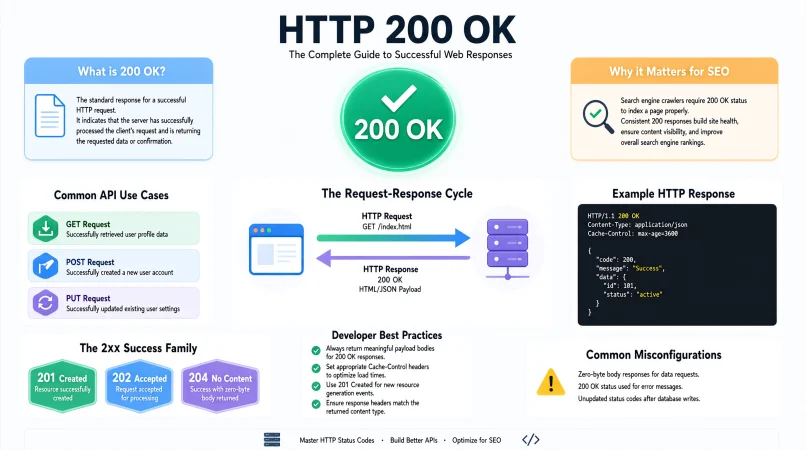
An HTTP 200 response code means a request was successful. It tells your browser, application, or API that the server received and successfully processed the request. Common alternatives include OK, Request Successful, Success Status, HTTP Success, and Successful Response.
Ever visited a website, refreshed a page, or sent an API request and wondered whether everything worked correctly? That’s where HTTP 200 response codes come into play. They’re one of the most familiar messages in web development, quietly telling browsers and applications that everything went according to plan.
Whether you’re checking website performance, debugging an API, reviewing server logs, or learning HTTP status codes for the first time, understanding this little three-digit number can save you plenty of confusion. HTTP 200 response codes indicate that a request was successfully handled by the server. In simple terms, your request made it through without a problem. However, there’s more to this status code than just seeing the word “OK.” Let’s explore its meaning, examples, variations, and practical uses in a simple, developer-friendly way.
1. Simple HTTP 200 Responses
Sometimes, the simplest explanation is the best one. These responses explain HTTP 200 in everyday language.
1. The request was successful.
Example: Used when explaining a successful website request to a beginner.
Meaning: The server successfully handled the request.
2. Everything worked as expected.
Example: Used when confirming that a webpage loaded properly.
Meaning: The requested operation completed successfully.
3. The server returned an OK status.
Example: Used when reviewing a successful HTTP response in developer tools.
Meaning: The server returned the standard 200 OK status.
4. Your request went through successfully.
Example: Used when documenting a working API request.
Meaning: The server successfully processed the incoming request.
5. The requested resource was available.
Example: Used when explaining a successful request for an existing webpage.
Meaning: The server successfully fulfilled the resource request.
6. No request error occurred.
Example: Used when describing a successful response in a testing report.
Meaning: The server did not report an HTTP error for the request.
7. The server responded positively.
Example: Used when explaining a successful connection test.
Meaning: The server returned a successful status response.
8. The webpage loaded successfully.
Example: Used when confirming that a website page opened correctly.
Meaning: The browser received a successful response for the page request.
9. The API request worked perfectly.
Example: Used when reporting a successful API test.
Meaning: The API returned an HTTP 200 response.
10. The server completed the operation.
Example: Used in technical documentation describing a completed request.
Meaning: The requested operation was successfully processed.
11. The response indicates success.
Example: Used when interpreting a status code in server logs.
Meaning: HTTP 200 communicates successful request handling.
12. Everything is responding normally.
Example: Used when describing a successful response during routine testing.
Meaning: The particular request received a successful response.
2. Professional HTTP 200 Responses
Professional communication requires clarity and accuracy. These responses are suitable for reports, technical documentation, and workplace discussions.
1. The HTTP request completed successfully.
Example: Used in a development team’s daily progress report.
Meaning: The server successfully processed the request.
2. The server returned HTTP status 200 OK.
Example: Used when documenting API testing results.
Meaning: The response contained the standard successful status code.
3. The requested resource was successfully retrieved.
Example: Used in a report about successful GET requests.
Meaning: The server successfully provided the requested resource.
4. The endpoint returned a successful response.
Example: Used when reporting endpoint performance during testing.
Meaning: The requested API endpoint returned an HTTP 200 status.
5. The request was processed without an HTTP error.
Example: Used in a technical quality assurance report.
Meaning: The response did not indicate an HTTP-level failure.
6. The server successfully fulfilled the request.
Example: Used in formal technical documentation.
Meaning: The server completed the requested operation.
7. The API returned the expected status code.
Example: Used when documenting a successful API integration test.
Meaning: The API response matched the expected HTTP status.
8. The resource retrieval operation was successful.
Example: Used in a report covering website resource requests.
Meaning: The server successfully handled the retrieval request.
9. The response confirms successful request handling.
Example: Used in a technical review meeting.
Meaning: The returned status indicates successful processing.
10. The requested operation returned an HTTP 200 status.
Example: Used in an application monitoring report.
Meaning: The server responded with a successful HTTP status.
11. The endpoint is returning successful HTTP responses.
Example: Used when summarizing endpoint test results.
Meaning: The tested endpoint is producing HTTP 200 responses.
12. The transaction request received a successful response.
Example: Used when describing a successful application request.
Meaning: The server successfully handled the particular transaction request.
3. Funny HTTP 200 Responses
Technical conversations don’t always have to sound serious. These playful responses make HTTP 200 easier to remember.
1. The server understood the assignment!
Example: Used when a website successfully loads during a demonstration.
Meaning: The server successfully handled the request.
2. No drama, just HTTP 200.
Example: Used when sharing a successful API test result with teammates.
Meaning: The request completed without an HTTP error.
3. The server woke up and chose success.
Example: Used when a previously tested endpoint starts responding correctly.
Meaning: The server returned a successful response.
4. Request sent, mission accomplished.
Example: Used when celebrating a successful GET request.
Meaning: The server successfully processed the request.
5. The internet is behaving today!
Example: Used when a website loads correctly after troubleshooting.
Meaning: The particular HTTP request received a successful response.
6. 200 means we’re having a good server day.
Example: Used in a lighthearted development team discussion.
Meaning: The server returned an HTTP success status.
7. The server passed the vibe check.
Example: Used when an API test returns the expected 200 status.
Meaning: The server handled the tested request successfully.
8. No errors invited to this party.
Example: Used when celebrating a successful webpage request.
Meaning: The response indicates successful HTTP request handling.
9. Green light from the server!
Example: Used when sharing a positive testing result.
Meaning: The server returned a success status.
10. HTTP 200: The plot has a happy ending.
Example: Used in a humorous programming presentation.
Meaning: The requested operation received a successful response.
11. The request showed up and delivered.
Example: Used when an API returns the expected result.
Meaning: The server successfully handled the request.
12. The server said, ‘All good over here!’
Example: Used in a casual conversation about website troubleshooting.
Meaning: HTTP 200 indicates successful processing of the request.
4. Short and Casual HTTP 200 Responses
Need a quick explanation without a technical lecture? These short responses work perfectly.
1. It’s an OK response.
Example: Used in a quick chat about HTTP status codes.
Meaning: The server returned a successful status.
2. Request successful!
Example: Used in a testing summary.
Meaning: The request was successfully processed.
3. Everything looks good.
Example: Used when sharing a successful request result.
Meaning: The response indicates successful handling.
4. The server said OK.
Example: Used when explaining HTTP 200 to a friend.
Meaning: The server returned the standard OK status.
5. No HTTP error here.
Example: Used when reviewing a successful response.
Meaning: The request did not receive an HTTP error status.
6. The page loaded.
Example: Used when confirming that a requested page opened.
Meaning: The browser received a successful response.
7. API is responding.
Example: Used when checking an API endpoint.
Meaning: The endpoint returned a response with a successful status.
8. That’s a successful request.
Example: Used when explaining a 200 response in a class.
Meaning: The server successfully handled the request.
9. All systems look good.
Example: Used in a casual testing update.
Meaning: The particular request returned a successful status.
10. 200 means OK.
Example: Used in a beginner-friendly technical explanation.
Meaning: HTTP 200 represents a successful response.
11. The response came through.
Example: Used when confirming that an API returned data.
Meaning: The server successfully responded to the request.
12. Success confirmed!
Example: Used when recording a successful HTTP test.
Meaning: The returned HTTP status indicates success.
5. Technical HTTP 200 Responses
For developers and IT professionals, technical accuracy matters. These responses explain the code in a more precise way.
1. HTTP 200 OK indicates successful request handling.
Example: Used in HTTP protocol documentation.
Meaning: The server successfully handled the request according to the requested method.
2. The response belongs to the HTTP 2xx success class.
Example: Used when explaining HTTP status code categories.
Meaning: Status codes beginning with 2 indicate successful requests.
3. The server successfully processed the GET request.
Example: Used when documenting a successful resource retrieval.
Meaning: The GET request was handled successfully.
4. The response includes a successful HTTP status line.
Example: Used when examining raw HTTP response headers.
Meaning: The response status line contains code 200 and its reason phrase.
5. The requested representation was returned successfully.
Example: Used when documenting a successful resource response.
Meaning: The server successfully returned the requested representation.
6. The HTTP response contains a 200 status code.
Example: Used when inspecting network activity in browser developer tools.
Meaning: The server reported a successful HTTP response.
7. The origin server returned an OK response.
Example: Used when analyzing a successful server response.
Meaning: The responding server reported successful request handling.
8. The request method was handled successfully.
Example: Used when documenting a successful HTTP operation.
Meaning: The server successfully processed the request method.
9. The response metadata confirms HTTP success.
Example: Used when inspecting response headers.
Meaning: The response status indicates that the request succeeded.
10. The server returned the requested resource representation.
Example: Used when explaining a successful API data retrieval.
Meaning: The server supplied the requested representation.
11. The response status is within the successful 2xx range.
Example: Used when reviewing HTTP monitoring results.
Meaning: The response belongs to the HTTP success category.
12. The server completed the request with status 200.
Example: Used in a backend request-processing report.
Meaning: The server returned the HTTP 200 success status.
6. Beginner-Friendly HTTP 200 Responses
Learning HTTP can feel confusing initially. These explanations make the concept easier for students and beginners.
1. HTTP 200 means the request worked.
Example: Used when teaching someone their first HTTP status code.
Meaning: The server successfully handled the request.
2. It’s like getting an OK message from a website.
Example: Used when explaining browser-server communication.
Meaning: The server is reporting a successful request.
3. Your browser received a successful response.
Example: Used when explaining why a webpage appeared.
Meaning: The browser received an HTTP response with status 200.
4. The website understood your request.
Example: Used when explaining how a browser requests a page.
Meaning: The server successfully processed the request.
5. The server found and returned what you requested.
Example: Used when explaining a successful page retrieval.
Meaning: The requested resource was successfully provided.
6. It means the server didn’t report a request error.
Example: Used in an introductory programming lesson.
Meaning: The response indicates successful HTTP processing.
7. Think of it as a digital thumbs-up.
Example: Used when introducing HTTP status codes to new developers.
Meaning: HTTP 200 represents a successful request.
8. The request received a positive response.
Example: Used when explaining an API response to a student.
Meaning: The server returned a success status.
9. Your website request got the green light.
Example: Used when describing a successful browser request.
Meaning: The server returned HTTP 200 OK.
10. The server completed the requested task.
Example: Used in a beginner’s web development tutorial.
Meaning: The requested operation was successfully handled.
11. The number 200 belongs to the success category.
Example: Used when introducing the HTTP status code system.
Meaning: The first digit identifies the successful response category.
12. It is one of the most common success codes.
Example: Used when discussing frequently encountered HTTP responses.
Meaning: HTTP 200 is widely used to indicate successful requests.
7. API HTTP 200 Responses
APIs rely on HTTP status codes to communicate request results. These responses are useful when testing or documenting API endpoints.
1. The API returned HTTP 200 OK.
Example: Used after testing an API endpoint successfully.
Meaning: The API returned a successful HTTP status.
2. The endpoint processed the request successfully.
Example: Used when documenting a working REST API endpoint.
Meaning: The endpoint successfully handled the request.
3. The API request completed as expected.
Example: Used in an integration testing report.
Meaning: The API returned the expected successful result.
4. The server returned the requested API data.
Example: Used when confirming a successful data retrieval request.
Meaning: The API successfully provided the requested representation.
5. The endpoint responded with a 200 status.
Example: Used when checking API response codes.
Meaning: The endpoint returned an HTTP success status.
6. The API response passed the status check.
Example: Used when reporting automated API test results.
Meaning: The returned status matched the successful response requirement.
7. The request was accepted and processed successfully.
Example: Used when describing a completed API operation.
Meaning: The server successfully handled the request.
8. The API returned a valid success response.
Example: Used when checking a successful application integration.
Meaning: The API returned an HTTP 200 response.
9. The resource endpoint is working correctly.
Example: Used after testing a resource retrieval endpoint.
Meaning: The tested endpoint returned a successful status.
10. The API successfully completed the requested operation.
Example: Used in API development documentation.
Meaning: The server handled the requested API operation successfully.
11. The response body contains the requested data.
Example: Used when validating a successful JSON response.
Meaning: The response body contains the expected resource representation, if applicable.
12. The endpoint returned the expected HTTP response.
Example: Used when reviewing API automation results.
Meaning: The endpoint produced the expected successful status.
8. Website and SEO HTTP 200 Responses
HTTP 200 is important when checking website accessibility, crawling, and technical SEO performance.
1. The webpage returned a 200 OK status.
Example: Used when auditing a website’s important landing pages.
Meaning: The requested webpage returned a successful HTTP response.
2. The page is responding successfully to HTTP requests.
Example: Used when reviewing website accessibility.
Meaning: The server successfully handled the page request.
3. The requested URL returned HTTP 200.
Example: Used when checking important URLs during an SEO audit.
Meaning: The requested URL returned a successful response.
4. The server successfully delivered the page content.
Example: Used when examining website response behavior.
Meaning: The server provided a successful page response.
5. The URL is returning a successful status code.
Example: Used when monitoring website URLs.
Meaning: The URL returned HTTP 200.
6. The page did not return an HTTP error.
Example: Used when checking a website’s technical health.
Meaning: The request did not receive an HTTP error response.
7. The requested page is accessible through HTTP.
Example: Used when reviewing website availability.
Meaning: The page request received a successful HTTP response.
8. The crawler received a successful response.
Example: Used when examining search engine crawler activity.
Meaning: The crawler received an HTTP 200 status for the request.
9. The website returned the expected page response.
Example: Used when checking indexed landing pages.
Meaning: The server returned the expected successful HTTP response.
10. The page returned successfully without a redirect status.
Example: Used when distinguishing a direct 200 response from a 3xx redirect.
Meaning: The response itself used status 200 rather than a redirect status.
11. The URL is returning a successful server response.
Example: Used when preparing a technical SEO report.
Meaning: The server successfully responded to the URL request.
12. The requested resource returned HTTP 200 OK.
Example: Used when reviewing website crawl results.
Meaning: The server successfully handled the resource request.
9. Creative HTTP 200 Responses
Want to explain a technical concept without making it sound like a textbook? These creative responses add personality.
1. A successful handshake between browser and server.
Example: Used in a creative web development presentation.
Meaning: The server returned a successful response to the browser’s request.
2. The digital door opened successfully.
Example: Used when introducing website request processing.
Meaning: The requested resource was successfully accessed.
3. The server delivered the good news.
Example: Used when sharing a successful testing result.
Meaning: HTTP 200 indicates successful request handling.
4. A little three-digit celebration.
Example: Used in a programming class presentation.
Meaning: The number 200 represents a successful HTTP response.
5. The request reached its happy destination.
Example: Used when explaining a successful API request.
Meaning: The server successfully handled the request.
6. The browser got its green signal.
Example: Used when discussing successful webpage requests.
Meaning: The server returned a successful status code.
7. A smooth landing for your HTTP request.
Example: Used in a technical blog about HTTP basics.
Meaning: The request received a successful response.
8. The server opened the success chapter.
Example: Used in a beginner-friendly coding presentation.
Meaning: The server reported successful request processing.
9. A successful delivery from server to client.
Example: Used when explaining a resource retrieval operation.
Meaning: The server successfully returned the requested representation.
10. The website’s way of saying mission complete.
Example: Used in a social media post about web development.
Meaning: HTTP 200 communicates successful request handling.
11. The request crossed the finish line.
Example: Used when explaining a successful API test.
Meaning: The server successfully processed the request.
12. Success packed into three little digits.
Example: Used in a creative HTTP status code infographic.
Meaning: HTTP 200 represents a successful response.
10. Sarcastic HTTP 200 Responses
A little sarcasm can make technical conversations more entertaining while keeping the explanation understandable.
1. Look at that, the server actually cooperated.
Example: Used after a successful request following a debugging session.
Meaning: The server returned a successful response.
2. Finally, a request that knows what it’s doing.
Example: Used when an API test passes after several failures.
Meaning: The request was successfully processed.
3. No errors? What a refreshing experience.
Example: Used after reviewing a successful testing result.
Meaning: The particular request returned HTTP 200 instead of an error status.
4. The server decided to be helpful today.
Example: Used when a website works after troubleshooting.
Meaning: The server successfully handled the request.
5. Well, that went surprisingly smoothly.
Example: Used when a complicated API request returns 200.
Meaning: The request received a successful HTTP response.
6. Someone tell the error logs to take a day off.
Example: Used in a humorous development team update.
Meaning: The tested request returned a successful status.
7. The server finally got the memo.
Example: Used after fixing an endpoint configuration issue.
Meaning: The endpoint is now returning a successful response.
8. An HTTP request without a plot twist.
Example: Used when sharing a successful website test.
Meaning: The request completed without an unexpected HTTP error.
9. Who knew success could look so simple?
Example: Used when explaining the 200 status code to colleagues.
Meaning: HTTP 200 is the standard successful response status.
10. The server behaved itself for once.
Example: Used after a successful request during debugging.
Meaning: The server returned a successful status.
11. No complaints from the HTTP department.
Example: Used when discussing a successful API response.
Meaning: The response indicates successful request handling.
12. Even the server deserves a little applause.
Example: Used when celebrating a successful deployment test.
Meaning: The tested request received a successful response.
11. Confident HTTP 200 Responses
These responses are direct, informative, and useful when you want to explain HTTP 200 with confidence.
1. HTTP 200 confirms a successful response.
Example: Used when presenting API testing results.
Meaning: The server returned the successful 200 status.
2. The server handled the request correctly.
Example: Used when reporting a successful resource request.
Meaning: The server successfully processed the requested operation.
3. This is the standard HTTP success response.
Example: Used when explaining status code categories.
Meaning: HTTP 200 is the standard OK response.
4. The requested operation returned a positive result.
Example: Used in a development project update.
Meaning: The server successfully handled the requested operation.
5. The endpoint returned the expected status.
Example: Used when validating a REST API.
Meaning: The endpoint returned the expected HTTP 200 response.
6. The resource request was completed successfully.
Example: Used when documenting a successful resource retrieval.
Meaning: The requested resource was successfully provided.
7. The response confirms that the request succeeded.
Example: Used in a technical review.
Meaning: The HTTP status indicates successful processing.
8. The server returned a valid 200 response.
Example: Used when reviewing an HTTP request.
Meaning: The response contains the HTTP 200 status code.
9. The request received the expected success status.
Example: Used when confirming a successful test case.
Meaning: The returned status matches the expected success result.
10. The response meets the successful status requirement.
Example: Used in an API quality assurance report.
Meaning: The request received the required HTTP success status.
11. The server successfully completed the requested operation.
Example: Used when explaining a backend process.
Meaning: The requested operation was handled successfully.
12. HTTP 200 is the expected success indicator here.
Example: Used when reviewing a successful GET request.
Meaning: The response indicates successful HTTP processing.
12. Polite HTTP 200 Responses
These explanations are suitable for customer support, team discussions, and helping nontechnical users understand website responses.
1. Your request was successfully processed.
Example: Used in a customer support update.
Meaning: The server successfully handled the request.
2. The website has returned a successful response.
Example: Used when helping someone troubleshoot a webpage.
Meaning: The website returned HTTP 200.
3. Everything appears to be working correctly for this request.
Example: Used when providing a technical support update.
Meaning: The particular request received a successful response.
4. The server has confirmed successful request handling.
Example: Used in a polite technical email.
Meaning: The server returned an HTTP success status.
5. The requested information was successfully returned.
Example: Used when confirming successful data retrieval.
Meaning: The server provided the requested information.
6. Your page request received an OK response.
Example: Used when explaining browser activity to a customer.
Meaning: The requested page returned HTTP 200.
7. The API responded successfully to your request.
Example: Used when updating a client about an integration test.
Meaning: The API returned a successful HTTP status.
8. The requested resource was delivered successfully.
Example: Used in a polite project update.
Meaning: The server successfully provided the requested resource.
9. The response indicates that the operation was completed.
Example: Used when communicating test results to a client.
Meaning: The server reported successful request processing.
10. The server returned the expected successful status.
Example: Used in a formal technical support message.
Meaning: The response status matched the expected result.
11. There were no HTTP-level errors in this response.
Example: Used when explaining a successful request to a customer.
Meaning: The request received an HTTP response outside the error categories.
12. The request was handled successfully by the server.
Example: Used when providing a technical status update.
Meaning: The server successfully processed the request.
13. Educational HTTP 200 Responses
Students, teachers, and beginners can use these explanations to understand the HTTP protocol more clearly.
1. HTTP 200 is a successful HTTP status code.
Example: Used in an introductory computer science assignment.
Meaning: It belongs to the 2xx success category.
2. The code tells the client that the request succeeded.
Example: Used when explaining client-server communication.
Meaning: The server returned a successful response.
3. The number 200 represents the OK status.
Example: Used in a lesson about HTTP response codes.
Meaning: HTTP 200 is officially associated with the reason phrase OK.
4. It is part of the HTTP response status system.
Example: Used in a web development classroom discussion.
Meaning: HTTP 200 communicates a successful response.
5. The server returns this code after successful processing.
Example: Used when describing a basic HTTP request cycle.
Meaning: The server indicates that the request was handled successfully.
6. It is commonly used for successful GET requests.
Example: Used in an API fundamentals lesson.
Meaning: HTTP 200 commonly indicates that requested data was successfully retrieved.
7. The response may include a message body.
Example: Used when explaining HTTP response structure.
Meaning: A 200 response can contain a representation of the requested resource.
8. The client receives a successful status from the server.
Example: Used when explaining browser-server communication.
Meaning: The server responds with an HTTP success status.
9. HTTP 200 is different from a redirect response.
Example: Used when comparing 200 and 301 status codes.
Meaning: A 200 response indicates success rather than a redirection instruction.
10. The first digit identifies the response category.
Example: Used when teaching HTTP status code classifications.
Meaning: The digit 2 identifies successful responses.
11. It can appear in website and API requests.
Example: Used when discussing practical HTTP applications.
Meaning: Both websites and APIs can return HTTP 200.
12. It is one of the basic HTTP codes developers should know.
Example: Used in a beginner web development course.
Meaning: HTTP 200 is fundamental to understanding successful requests.
14. Troubleshooting and Monitoring HTTP 200 Responses
A successful status code is useful, but monitoring requires more than simply checking whether a server returned 200.
1. The endpoint returned HTTP 200 during monitoring.
Example: Used in an application monitoring report.
Meaning: The monitored request received a successful status.
2. The response status matches the expected result.
Example: Used when checking an automated monitoring alert.
Meaning: The observed HTTP status matches the configured expectation.
3. The server successfully responded to the health check.
Example: Used when reviewing a service health-check endpoint.
Meaning: The health-check request received a successful response.
4. The requested URL returned an OK status.
Example: Used when investigating website availability.
Meaning: The requested URL returned HTTP 200.
5. The response time should also be evaluated.
Example: Used when analyzing a slow endpoint returning 200.
Meaning: A successful status does not guarantee acceptable performance.
6. The response body should be checked for accuracy.
Example: Used when debugging an API that returns unexpected data.
Meaning: HTTP 200 alone does not guarantee correct response content.
7. The endpoint passed the HTTP status check.
Example: Used when reviewing automated endpoint tests.
Meaning: The endpoint returned the expected successful status.
8. The server returned a successful monitoring response.
Example: Used in a server monitoring dashboard update.
Meaning: The monitored request received HTTP 200.
9. The request completed without an HTTP error status.
Example: Used when documenting a successful request during troubleshooting.
Meaning: The server returned a non-error HTTP status.
10. The response headers should be reviewed.
Example: Used when investigating unexpected behavior despite HTTP 200.
Meaning: Headers can provide additional information about the response.
11. A successful status does not guarantee application correctness.
Example: Used when troubleshooting an API that returns incorrect information.
Meaning: The response body and application behavior also need validation.
12. The request passed the initial HTTP response check.
Example: Used when summarizing a basic monitoring test.
Meaning: The request returned a successful HTTP status but may require further validation.
15. Clever HTTP 200 Responses
These clever explanations combine technical accuracy with memorable wording.
1. 200 is the server’s official OK stamp.
Example: Used when explaining the code in a technical presentation.
Meaning: HTTP 200 is the standard OK response.
2. A green light, not a guessing game.
Example: Used when explaining successful API testing.
Meaning: The server returned an identifiable success status.
3. Three digits that make developers smile.
Example: Used in a programming community post.
Meaning: HTTP 200 indicates successful request handling.
4. The request got its success certificate.
Example: Used in a lighthearted web development tutorial.
Meaning: The server returned HTTP 200.
5. The server’s way of saying job done.
Example: Used when explaining a successful resource request.
Meaning: The server successfully handled the request.
6. 200 is the happy ending of an HTTP request.
Example: Used in a beginner-friendly technical article.
Meaning: The request received a successful response.
7. The browser asked, and the server delivered.
Example: Used when explaining a successful webpage retrieval.
Meaning: The server successfully provided the requested resource.
8. A successful response with no mystery attached.
Example: Used when reviewing a straightforward API request.
Meaning: The HTTP status indicates successful request handling.
9. The server’s favorite way to say OK.
Example: Used in a casual discussion about HTTP codes.
Meaning: HTTP 200 represents the OK status.
10. A successful response deserves a green check.
Example: Used in a testing dashboard explanation.
Meaning: The request returned a successful HTTP status.
11. The request made it through the digital front door.
Example: Used when explaining successful website access.
Meaning: The server successfully handled the requested operation.
12. HTTP 200: Proof that this request worked.
Example: Used when summarizing a successful API test.
Meaning: The server returned the HTTP 200 success status.
FAQs
What Does HTTP 200 Mean?
HTTP 200 means the server successfully handled the request and returned a successful response.
Is HTTP 200 a Good Response?
Yes, HTTP 200 is a successful status code indicating that the request was handled successfully.
What Does HTTP 200 Mean Emotionally or in a Flirty Context?
HTTP 200 has no standard romantic meaning. In playful chats, it can represent an OK or green light.
How Is HTTP 200 Used Professionally?
Developers use HTTP 200 to report successful website requests, API operations, and resource retrieval.
What Should You Say If You Don’t Actually Mean HTTP 200?
Clarify that a 200 status confirms HTTP success, not necessarily that the returned information is correct.
Is Humor Appropriate When Explaining HTTP 200?
Yes! Light humor can make technical explanations easier to understand, especially for beginners.
Is HTTP 200 the Same as HTTP 201?
No. HTTP 200 indicates success, while HTTP 201 means a new resource was created.
Is HTTP 200 Different From HTTP 204?
Yes. HTTP 200 can include response content, while HTTP 204 indicates success without response content.
Can HTTP 200 Still Indicate a Website Problem?
Yes. A page can return 200 while displaying incorrect content or application errors.
Does HTTP 200 Mean a Website Is Fully Working?
Not necessarily. It confirms HTTP request success, not complete website functionality or performance.
Is HTTP 200 Better Than HTTP 301?
Neither is universally better. HTTP 200 indicates success, while HTTP 301 indicates permanent redirection.
Can an API Return HTTP 200 With Incorrect Data?
Yes. An API can return status 200 even when its response body contains unexpected information.
Conclusion
Understanding HTTP 200 response codes makes website troubleshooting, API testing, and technical communication much easier. Whether you’re a beginner learning HTTP basics or a developer checking server responses, this little status code deserves a place in your technical vocabulary.
Remember that 200 OK indicates successful request handling, but it doesn’t automatically guarantee that every part of an application is working perfectly. Always check the response content, headers, and performance when necessary. Try using these explanations in your technical notes, development discussions, or learning projects. If you found this guide helpful, save it, share it with your developer friends, and keep those successful requests coming.