Dover is primarily a geographical name associated with the historic coastal town of Dover in Kent, England. Its traditional etymology comes from the ancient Celtic word Dubras, generally interpreted as “the waters” or “water.” The name is closely connected with the River Dour, which flows through the town into the English Channel. Dover is also used as an English surname and appears in other geographical names.
1. What Does Dover Mean?
Dover is a proper noun rather than an ordinary English word with one universally accepted dictionary definition. Most commonly, it refers to a coastal town in southeastern England, but it also appears as a family name and in the names of other places.
The traditional explanation connects it to an ancient Celtic term associated with water. This interpretation makes sense geographically because the historic settlement developed around the River Dour, which reaches the sea at Dover.
The name has therefore become strongly associated with water, coastal geography, and maritime history.
Depending on where you encounter it, Dover can have several meanings:
- Geographical meaning: A historic port town in Kent, England.
- Traditional linguistic meaning: Associated with the ancient Celtic word for water or waters.
- Surname meaning: An English habitational surname connected with places named Dover.
- Historical meaning: A name linked with Roman Britain and centuries of cross-Channel travel.
Understanding the context is important because a person using Dover as a surname is not necessarily referring to the town itself.
2. Where Does the Name Dover Come From?
The traditional origin of Dover is traced to an ancient British Celtic word, commonly reconstructed as Dubras. It is generally translated as “the waters” or “streams.”
This interpretation is connected with a wider family of Celtic words for water.
For example, the Welsh word dŵr means water, while the Breton word dour also carries the meaning of water. Cornish dofer and Old Irish dobur are other related linguistic forms traditionally discussed in connection with this ancient root.
These similarities help explain why historians and place-name researchers have associated Dover with water for so long.
The Connection With the River Dour
The River Dour is one of the most important geographical features behind the traditional explanation.
It is a relatively short river in Kent that flows through Dover before reaching the English Channel. Although it is not a major river by length, it has a strong historical connection with the settlement.
The relationship between the river and the town is especially interesting because many ancient settlements developed around freshwater sources. Rivers supplied drinking water, supported agriculture, and provided routes for transporting goods.
In Dover’s case, the river also helped create the conditions for an important coastal settlement.
The traditional explanation suggests that the settlement’s name developed from the ancient name associated with the river.
However, the precise linguistic history is more complicated than a simple translation.
3. The Historical Development of the Name
Dover has a long recorded history, extending back to Roman Britain.
One of its earliest known recorded forms is Dubris, which appears in Roman geographical documents. The name was used in connection with the port and settlement that occupied this important coastal position.
Over time, the spelling changed as different languages and writing traditions influenced the region.
| Historical period | Recorded form or usage | Significance |
| Roman period | Dubris | Early recorded form associated with the settlement |
| Around AD 300 | Portus Dubris | Appears in the Antonine Itinerary |
| Anglo-Saxon period | Dofras | An early English form |
| Medieval period | Dover | The familiar modern form gradually became established |
| Modern period | Dover | Used for the English town and other geographical and family names |
The Antonine Itinerary was a Roman collection of routes and travel information. Its references to Dubris demonstrate that Dover was already recognized as a significant location during Roman times.
The transition from Dubris to Dover reflects the linguistic changes that took place in Britain following the Roman period.
Anglo-Saxon speech, medieval spelling practices, and regional pronunciation all contributed to the development of modern English place names.
It is also important to remember that historical spellings do not always reveal exactly how people pronounced a name. Written records were produced by different individuals, sometimes in Latin, and spelling conventions were not standardized as they are today.
The name Dover is therefore an example of how a place name can survive while changing its written form across many centuries.
4. Dover as a Place Name
The best-known use of Dover is the town in Kent, England.
Situated on the southeastern coast of Britain, Dover faces the Strait of Dover, the narrowest part of the English Channel. Its position has made it an important point of connection between Britain and continental Europe.
However, Dover is not the name of only one geographical location.
Other places also contain or use the name, showing how geographical names can spread through settlement, migration, and local naming traditions.
Famous Places Associated With the Name
Dover, Kent, England
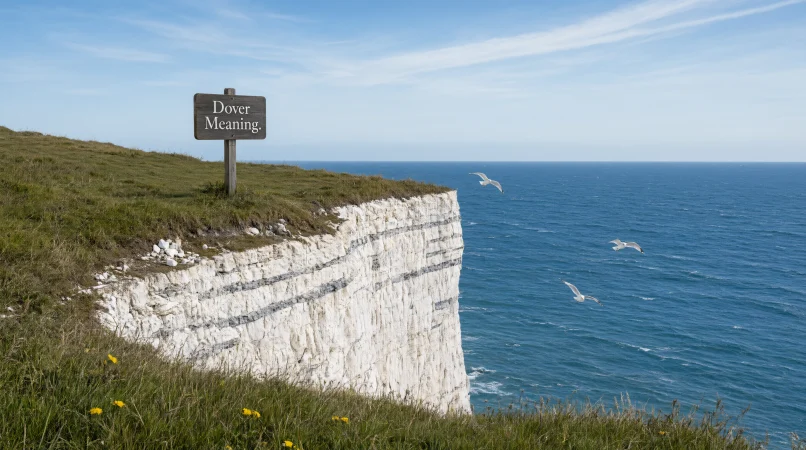
This is the most recognized location carrying the name. It is famous for its historic harbour, coastal position, and White Cliffs of Dover.
Dover, New Hampshire, United States
This American city is located along the Cocheco River. It has a long history dating back to early European settlement in New England.
Dover, Delaware, United States
Dover is the capital of Delaware. It serves as the state’s political and administrative center.
Dover, New Jersey, United States
This is another American municipality that shares the name and has its own local industrial and community history.
Dover, Wigan, Lancashire, England
Dover also appears in the history of English family and place names through the settlement near Wigan.
These examples demonstrate that the same geographical name can refer to very different communities.
Its original historical association does not necessarily explain why every later settlement adopted the name.
5. Dover as a Surname
Dover is also an established family surname, particularly in English-speaking countries.
According to surname research documented by FamilySearch and the Dictionary of American Family Names, the English surname can be habitational. This means it may have originally identified someone who came from a particular place.
In medieval England, people were often identified by their occupation, family relationship, physical characteristics, or place of origin.
For example, someone who moved from Dover to another town might have become known by the name of their former home. Over generations, that geographical description could become a permanent family surname.
Different Possible Origins of the Surname
The surname Dover does not necessarily have one family origin.
Several possibilities exist:
- English habitational origin: A family may have taken its surname from Dover in Kent.
- Other English place connections: The surname may also be associated with another location carrying the same name.
- Irish surname adaptation: Some surname records connect Dover with shortened Anglicized forms of Irish Gaelic family names, including forms associated with Ó Dubhuidhir or Mac Duibhidhir.
- German surname adaptation: Some American families may have adopted Dover as an altered spelling of a similar-sounding German surname.
These possibilities matter when researching family history.
Two people with the surname Dover may have completely different ancestral backgrounds. A shared spelling does not automatically establish a shared family connection.
Anyone researching this surname should consider historical documents, immigration records, census information, and family relationships rather than relying only on the name’s general meaning.
6. How to Pronounce Dover
Dover is generally pronounced:
DOH-ver
It has two syllables:
- DOH: The first syllable sounds like the beginning of the word “door.”
- ver: The second syllable sounds like the ending of “river.”
The emphasis falls on the first syllable.
In phonetic notation, the common English pronunciation is /ˈdoʊvər/.
The spelling is straightforward, which makes the name relatively easy for English speakers to recognize and pronounce.
However, accents can slightly change the sound of the second syllable.
For example, British and American speakers may pronounce the final vowel differently, even though the overall pronunciation remains recognizable.
7. Why Is Dover Historically Significant?
Dover’s importance extends far beyond its name.
Its geographical position has influenced British history, international trade, military planning, and transportation for centuries.
A Gateway Between Britain and Europe
Dover sits opposite the French coastline, making it one of the closest points between southeastern England and mainland Europe.
The Strait of Dover connects the North Sea with the English Channel. It has been an important maritime passage for commercial ships, fishing vessels, military fleets, and passenger transportation.
This position made Dover particularly valuable during periods when sea travel was the main way to cross between Britain and continental Europe.
The White Cliffs of Dover
The White Cliffs are among the most recognizable natural landmarks in England.
They are formed mainly from chalk, a soft white limestone created from the accumulated remains of microscopic marine organisms over millions of years.
Their bright appearance makes them visible from the sea under suitable weather and lighting conditions.
The cliffs have also become a symbol of Britain’s coastline and national identity.
For many people, seeing the White Cliffs represents the experience of arriving in or leaving Britain.
Dover Castle
Dover Castle is another major historical feature of the town.
The castle occupies a strategically important position above the coastline and has been used for defensive purposes across different historical periods.
Its history includes medieval fortifications and later military modifications.
During the Second World War, the castle and its underground tunnels became important parts of Britain’s coastal military infrastructure.
These historical connections explain why Dover is recognized as more than just a place name. It represents a location that has influenced the movement and defense of people across the English Channel.
Modern Transportation
Dover continues to serve as an important transportation center.
The Port of Dover handles passenger and freight traffic between Britain and mainland Europe. Ferry services connect the town with Calais in France.
The Channel Tunnel, which opened in 1994, created another major connection between Britain and France, although it operates separately from the town’s ferry port.
Together, these transport connections reflect Dover’s continuing geographical importance.
8. Traditional Meaning vs. Alternative Theories
Although the water-related explanation is widely repeated, the exact origin of Dover is not completely settled.
Some place-name researchers have questioned whether the traditional Celtic explanation accounts for all the historical evidence.
An article published in the Kent Archaeological Society’s historical research journal examines the possibility that the name could instead be connected with an older Germanic word associated with a shore, bank, or coastal feature.
The discussion considers early recorded spellings, the geography of the ancient harbour, and comparisons with similar place-name elements.
One alternative suggestion connects the name with coastal sandbanks or strips of land near water.
This is interesting because Dover’s ancient harbour environment was shaped by sediment movement, changing shorelines, and the natural conditions of the English Channel.
However, this alternative remains a scholarly proposal rather than a universally accepted replacement for the traditional explanation.
Comparing the Main Interpretations
| Interpretation | Suggested meaning | Explanation |
| Traditional Celtic theory | Waters or water | Connects the name with the River Dour and related Celtic words |
| Alternative Germanic theory | Shore, bank, or coastal feature | Examines possible connections with ancient shoreline terminology |
| Surname interpretation | Person from Dover | Describes a geographical origin rather than a literal translation |
| Modern geographical usage | A named place | Identifies the English town and other locations |
The traditional interpretation remains the most commonly encountered explanation in general reference works.
Nevertheless, the debate demonstrates why historical place-name research requires careful attention to language, geography, and early written evidence.
A name that appears simple today may have a much more complicated history.
9. FAQ,s
Is Dover a real English word?
Yes. Dover is a recognized proper noun used primarily as a geographical name and surname. It is not generally used as an ordinary descriptive word in everyday English.
Is Dover a popular baby name?
Dover is an uncommon given name. It is more widely recognized as a place name and family surname than as a traditional first name.
What is the old Roman name for Dover?
The settlement was known as Dubris during the Roman period. The form Portus Dubris also appears in Roman geographical records.
Is Dover connected to the French language?
The English town has a historical connection with France through its geographical position and maritime activity. However, its traditional name origin is generally associated with an ancient British Celtic root rather than a French word.
What is the difference between Dover and the River Dour?
Dover is the town, while the River Dour is the watercourse that flows through it. The traditional explanation connects their names through an ancient water-related linguistic root.
Does Dover have a symbolic meaning?
Although it does not have one official symbolic definition, Dover is often associated with coastal heritage, travel, maritime history, and the connection between Britain and Europe.
10. Conclusion
Dover is a short name with a surprisingly long history. Its traditional connection with ancient Celtic words for water reflects the geographical importance of the River Dour and the surrounding coastline. From its early Roman form, Dubris, to its modern use as a place name and surname, it has continued to appear in different historical and cultural settings. Understanding its background reveals how geography, language, and human settlement can shape the names that survive for centuries.