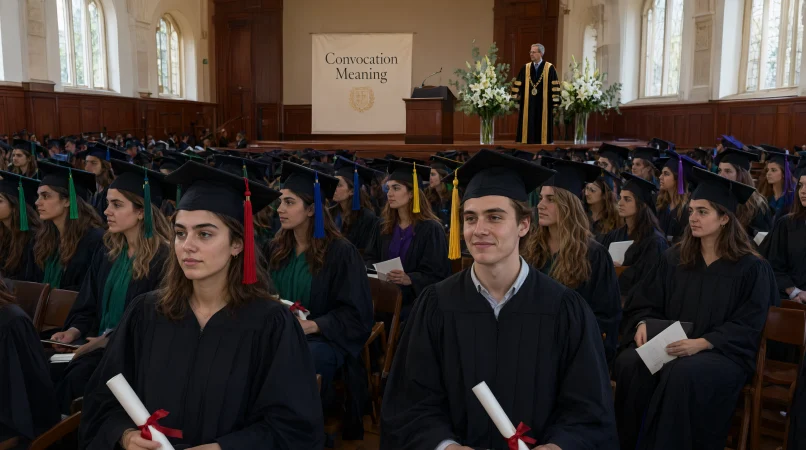
Convocation means a formal gathering of people who have been called together for a particular purpose. The word is most commonly used for university ceremonies where students receive degrees and celebrate completing their academic programs. It can also describe official meetings of religious organizations, academic authorities, and professional institutions. Its origin comes from the Latin word convocare, meaning “to call together.”
1. What Does Convocation Mean?
Convocation refers to an organized gathering or formal assembly of people who come together for a specific reason. The gathering is usually official and may involve an institution, organization, religious body, or educational authority.
In modern English, the word is especially familiar in higher education. Universities use it to describe ceremonies where graduating students are formally recognized and awarded their academic degrees.
For example, when a university announces that its annual convocation will take place in December, it usually means that graduates, faculty members, university officials, and invited guests will attend a formal academic event.
However, education is not the only setting in which the word appears.
Religious organizations may use it for official assemblies, while some academic institutions use it to describe meetings of their governing or representative bodies.
The exact meaning depends on the situation.
Simple Definition
In simple words, convocation means a formal gathering of people for an official meeting, ceremony, or important occasion.
Here are a few examples:
- A university holds a convocation to award degrees to graduating students.
- A religious organization organizes a convocation for its members.
- An academic institution calls a convocation to discuss important administrative matters.
- A professional association arranges a formal gathering for its members.
The common idea behind all these examples is that people are officially invited or called together.
2. Origin and History of the Word
The word has an interesting linguistic history that explains why it refers to gatherings.
Convocation comes from the Latin verb convocare, which means “to call together” or “to summon.” This Latin word combines two elements:
- Con-: A prefix meaning together or with.
- Vocare: A verb meaning to call.
Together, these elements express the idea of calling people together for a shared purpose.
The Latin root vocare also appears in several familiar English words. For example, vocation relates to a calling or occupation, while vocal concerns the voice.
Convocation entered English through historical religious and institutional usage. It became particularly associated with formal assemblies of clergy and representatives of established organizations.
Over time, universities adopted the word for important academic gatherings.
Historical Religious Usage
One of the older institutional uses of the term comes from the Church of England.
The Convocations of Canterbury and York are historic assemblies associated with the church’s provinces. They bring together clergy and other representatives to consider matters concerning church life and administration.
These assemblies demonstrate that the word originally had a much wider institutional meaning than its modern association with graduation ceremonies.
Development in Education
As universities developed formal academic traditions, convocation became associated with official university gatherings.
Academic institutions needed ceremonies to recognize students who had completed their studies. These occasions also provided an opportunity for university leaders to present awards, deliver speeches, and celebrate academic achievement.
Today, universities in countries such as Pakistan, India, Canada, and other parts of the Commonwealth commonly use the term for degree-awarding ceremonies.
Its original meaning has remained recognizable: bringing people together for an important formal occasion.
3. What Does Convocation Mean in Education?
In education, convocation usually refers to a formal university ceremony during which students receive recognition for completing their academic programs.
It is one of the most memorable occasions in a student’s educational journey.
After spending years attending lectures, completing assignments, preparing for examinations, and meeting academic requirements, graduates finally gather to celebrate their achievements.
The ceremony is generally organized by the university or another degree-awarding institution.
What Happens During a University Convocation?
Although arrangements differ between universities, most ceremonies follow a formal program.
Common activities include:
1. Academic Procession
The ceremony often begins with an academic procession. University officials, professors, faculty members, and invited guests enter the hall wearing traditional academic gowns.
2. Opening Address
A senior university representative, such as the chancellor, vice-chancellor, or presiding officer, officially opens the ceremony.
3. Welcome and Speeches
University leaders and distinguished guests may deliver speeches about education, achievement, responsibility, and future opportunities.
4. Presentation of Degrees
Graduates are called according to their academic programs or departments. Their names are announced as they come forward to receive their degrees or formal recognition.
5. Academic Awards
Students who achieve exceptional results may receive medals, distinctions, scholarships, or other academic honors.
6. Closing Ceremony
The presiding official concludes the formal proceedings. Graduates and guests may then participate in photographs and celebrations.
Not every university follows exactly the same schedule. Some institutions organize separate ceremonies for different faculties, while others hold several sessions across multiple days.
Who Attends a Convocation?
A university ceremony usually includes several groups of people.
- Graduating students receiving their degrees.
- Parents, relatives, and friends celebrating with graduates.
- Professors and department representatives.
- The chancellor and vice-chancellor.
- Distinguished guests and invited speakers.
- University administrative staff.
Each group contributes to the occasion in a different way.
For students, it marks the completion of an academic journey. For families, it is an opportunity to celebrate years of support and hard work.
4. How Does a University Convocation Work?
A convocation is not simply a gathering where students receive certificates. It is an organized institutional process that formally recognizes academic qualifications.
Before the ceremony, universities usually complete several administrative steps.
Eligibility and Registration
Students must first satisfy the academic requirements of their programs.
These may include completing required courses, passing examinations, fulfilling credit requirements, and clearing outstanding university obligations.
Once eligible, students may be required to register for the ceremony.
Some universities also require graduates to confirm their attendance, submit personal details, or arrange academic dress.
Degree Verification
The university checks academic records to confirm that each student has successfully completed the necessary requirements.
This process helps prevent errors in degree names, student information, and award classifications.
Academic Dress
Academic clothing is another recognizable feature.
Graduates commonly wear gowns and caps, while faculty members and university officials may wear distinctive academic robes.
The colors and designs often represent different academic disciplines, degrees, or institutional traditions.
For example, some universities use different hood colors for bachelor’s, master’s, and doctoral qualifications.
Receiving the Degree
During the ceremony, graduates are usually called individually or in organized groups.
Depending on the institution, they may receive a diploma, degree certificate, or ceremonial document.
Some universities distribute official certificates separately from the ceremony, so receiving a degree at convocation does not always mean that the student receives every original academic document on the same day.
5. Different Types of Convocation
The word is used in several institutional settings. Its meaning changes slightly depending on who organizes the gathering and why people attend.
| Type | Main purpose | Typical participants |
| University convocation | Recognizing graduates and awarding degrees | Graduates, professors, and university officials |
| Religious convocation | Discussing religious matters and gathering members | Clergy, religious leaders, and representatives |
| Academic convocation | Holding an official academic assembly | Faculty members, scholars, and administrators |
| Institutional convocation | Bringing an organization’s representatives together | Members, officials, and invited guests |
| Special convocation | Recognizing an important achievement or holding a special ceremony | Award recipients and institutional representatives |
University Convocation
This is the most familiar form of the term.
It celebrates students who have completed their degrees and provides an official setting for presenting academic awards.
Religious Convocation
Religious convocations are formal gatherings organized by religious institutions.
They may involve discussions about organizational decisions, religious education, leadership, and matters affecting the wider religious community.
The Church of England’s historic Convocations of Canterbury and York are established examples.
Academic Convocation
Some universities use the term for gatherings that involve faculty members, administrators, and other academic representatives.
These meetings may concern institutional policies, academic developments, and university governance rather than graduating students.
Special Convocation
A special convocation is arranged for an unusual or significant institutional occasion.
For instance, a university may organize a special ceremony to award an honorary doctorate to a distinguished individual.
The exact format depends on the university’s regulations and traditions.
6. Convocation vs. Graduation vs. Commencement
These three terms are closely related, but they are not always interchangeable.
People often use them as though they mean exactly the same thing. However, there are differences in their common usage.
| Term | Meaning | Main focus |
| Convocation | A formal institutional gathering or ceremony | Official assembly and recognition |
| Graduation | Completing the academic requirements for a qualification | Academic achievement |
| Commencement | A formal ceremony marking the completion of studies | Celebrating graduates and their next steps |
| Degree award | The official granting of an academic qualification | Formal recognition of a degree |
What Is the Difference Between Convocation and Graduation?
Graduation refers to the achievement of completing an academic program and qualifying for a degree.
Convocation refers to the formal gathering where the institution may publicly recognize that achievement.
For example, a student may complete all degree requirements in June but attend the university’s convocation ceremony several months later.
The student has already graduated academically, even though the formal ceremony takes place afterward.
What Is the Difference Between Convocation and Commencement?
Commencement is particularly common in American universities.
It usually describes the formal ceremony where graduates are recognized and celebrated.
Convocation is a broader term for a formal gathering and is frequently used for degree-awarding ceremonies in universities across Commonwealth countries.
However, institutional terminology varies. Some American universities also use convocation for special academic gatherings, orientation events, and other official ceremonies.
The most reliable way to understand a university’s terminology is to check how that institution defines its own events.
7. Why Is Convocation Important?
A university ceremony may last only a few hours, but its importance extends beyond the event itself.
For many students, it represents the end of a long period of academic effort and the beginning of a different stage of life.
Recognition of Academic Achievement
Completing a university degree requires time, discipline, and commitment.
Students face examinations, research projects, financial responsibilities, and personal challenges along the way.
A formal ceremony gives universities an opportunity to publicly recognize those achievements.
It also allows students to celebrate their progress with the people who supported them.
Family and Community Celebration
Education is rarely an individual achievement alone.
Parents, guardians, siblings, friends, and teachers often provide encouragement throughout a student’s academic journey.
Convocation gives these people an opportunity to share the moment.
For families, seeing a graduate receive a degree can be deeply meaningful, especially when the student has overcome financial or personal difficulties.
Building Institutional Identity
Academic ceremonies also connect graduates with their universities.
The academic dress, formal speeches, traditional processions, and presentation of degrees reflect the institution’s history and identity.
Graduates may carry this association with them long after leaving campus.
Encouraging Future Goals
Completing one qualification often leads to new ambitions.
Some graduates continue with master’s or doctoral studies, while others enter professional employment or begin businesses.
The ceremony provides a natural opportunity to reflect on past achievements and think about future responsibilities.
A degree is an accomplishment, but it is also the beginning of further opportunities.
Example: Convocation at Universities in Pakistan
Convocation ceremonies are an established part of university life in Pakistan.
Institutions such as the University of the Punjab, the University of Karachi, and the National University of Sciences and Technology organize formal degree-awarding ceremonies.
These events recognize graduates from different academic disciplines and may include the presentation of medals and distinctions.
The arrangements differ between institutions, but the central purpose remains the same: formally celebrating academic achievement.
8. Common Uses of the Word in Everyday Life
Although the term is formal, it appears in ordinary conversations, university announcements, invitations, and professional communication.
Understanding common expressions makes it easier to use the word correctly.
Examples of Convocation in Sentences
- “My university is holding its annual convocation next month.”
This means the university is organizing its yearly formal ceremony or gathering. - “She received her master’s degree at the convocation.”
This describes the ceremony where her academic achievement was recognized. - “All eligible graduates must register for convocation.”
This means students who qualify for the degree-awarding ceremony must complete the registration process. - “His family traveled from another city to attend his convocation.”
This explains that his relatives came to celebrate his academic achievement. - “The university announced a special convocation for distinguished scholars.”
This refers to a specially organized institutional event.
Common Phrases Related to Convocation
| Phrase | Meaning |
| Convocation ceremony | A formal gathering, commonly for degree awards |
| Convocation date | The scheduled date of the event |
| Convocation invitation | An official invitation to attend |
| Convocation gown | Academic clothing worn during the ceremony |
| Convocation hall | The venue where the event takes place |
| Convocation speech | An address delivered during the gathering |
| Convocation list | A list of graduates or participants |
| Convocation registration | The process of registering to participate |
These expressions are especially common in university emails, notices, and academic announcements.
9. Frequently Asked Questions
Is convocation a formal or informal word?
Convocation is a formal word. It is mainly used in educational, religious, and institutional communication rather than casual everyday conversation.
Is convocation a noun or a verb?
Convocation is a noun. The related verb is convoke, which means to call people together for a formal gathering.
What is the opposite of convocation?
There is no exact universal opposite. Depending on the context, dismissal, adjournment, or dispersal may describe the ending of a gathering.
Can someone attend convocation without graduating?
Yes. Parents, guests, faculty members, university officials, and invited speakers can attend without receiving a degree.
Is a convocation certificate the same as a degree certificate?
Not necessarily. A degree certificate confirms an academic qualification, while convocation documents may include ceremony-related records or participation certificates. University policies determine the difference.
Does every university hold a convocation every year?
No. The frequency depends on institutional policies, the number of eligible graduates, and administrative arrangements. Some universities hold several ceremonies annually, while others organize them less frequently.
10. Final Thoughts
Convocation is more than a formal gathering; it is a word that represents the idea of bringing people together for an important institutional occasion. Although it has historical connections with religious assemblies, its most familiar modern use is in higher education. For graduates, it marks an opportunity to celebrate academic achievement alongside family, friends, and teachers. Understanding the term also makes university announcements, academic traditions, and formal invitations easier to interpret.