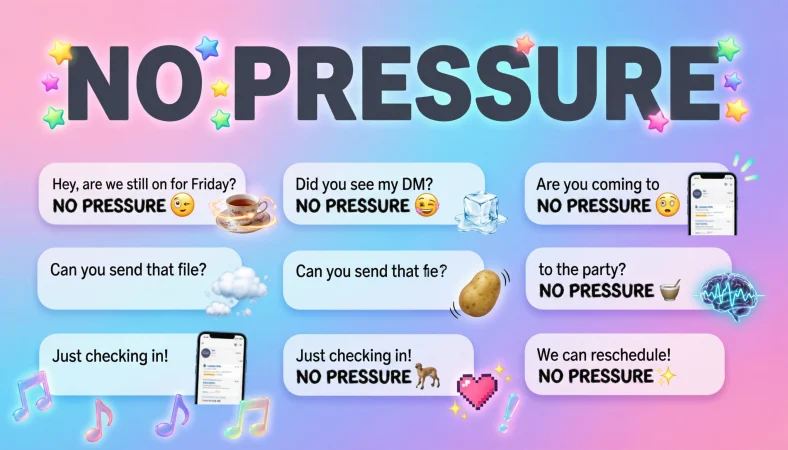
Quick Answer: The best funny replies to “no pressure” turn the awkward pressure into a joke while keeping the mood light. Pick a response that matches your relationship and how dramatic you want to be.
Top alternatives: “Zero pressure, just mild panic,” “Perfect, I’ll only overthink it,” “No pressure? Too late,” “Cool, I’ll panic casually,” “Thanks, I needed that pressure”
Someone says “no pressure,” and somehow that creates 100% pressure. You know the feeling. It happens when a friend asks for a favor, your crush wants an answer, your coworker needs something “whenever you can,” or someone slides into your DMs with a suspiciously relaxed request. The words sound reassuring, but your brain immediately starts acting like it is the season final.
That is exactly why having funny replies to “no pressure” can save the moment. A clever response can make a conversation feel easier, funnier, and more natural without turning everything into a serious negotiation. Whether you want to sound sarcastic, confident, dramatic, flirty, or completely unbothered, the right comeback can instantly change the vibe. Here are plenty of text-ready options for your next conversation.
Funny Responses
“Zero pressure, just mild panic.”
Use this when someone tries to reassure you before asking for something.
Meaning: You are joking that the situation still feels stressful.
“Perfect, I’ll only overthink it.”
Use this when you already know you are going to analyze every detail.
Meaning: You are playfully admitting your tendency to overthink.
“No pressure? Too late.”
Use this when their request has already made you nervous.
Meaning: You are joking that the pressure has already arrived.
“Cool, I’ll panic casually.”
Use this when you want to make a stressful situation sound funny.
Meaning: You are pretending to stay relaxed while secretly freaking out.
“Thanks, I needed that pressure.”
Use this when someone says “no pressure” after giving you an important task.
Meaning: You are using sarcasm to point out the obvious pressure.
“Absolutely no pressure, only expectations.”
Use this when expectations are clearly hiding underneath the request.
Meaning: You are teasing them about their supposedly relaxed attitude.
“Say less. My anxiety has already clocked in.”
Use this when you want a modern, meme-friendly comeback.
Meaning: You are joking that your nerves are already working overtime.
“No pressure, just the fate of the universe.”
Use this when someone makes a small request sound extremely important.
Meaning: You are exaggerating the stakes for comedic effect.
“Got it. I’ll pretend this is casual.”
Use this when you want to acknowledge the request with humor.
Meaning: You are joking that the situation is anything but casual.
“Relax, I’m only internally screaming.”
Use this when you want a dramatic but playful response.
Meaning: You are saying you look calm while feeling nervous.
“Perfect. I love unnecessary stress.”
Use this when someone gives you a task at the worst possible time.
Meaning: You are sarcastically embracing the pressure.
“No pressure detected. Just vibes and consequences.”
Use this when you want a witty internet-style comeback.
Meaning: You are joking that the situation still has serious consequences.
Sarcastic Responses
“Oh good, because I was worried this might be stressful.”
Use this when the request is obviously stressful.
Meaning: You are sarcastically highlighting the pressure.
“Thank goodness you said that.”
Use this when their words clearly contradict the situation.
Meaning: You are joking about their attempt to make things sound easy.
“Wonderful. I feel completely relaxed now.”
Use this when you are absolutely not relaxed.
Meaning: You are using irony to make your point.
“That definitely makes everything less intimidating.”
Use this when someone gives you an important request casually.
Meaning: You are teasing them for pretending it is no big deal.
“No pressure. Just my entire reputation.”
Use this when the outcome matters to you.
Meaning: You are dramatically exaggerating the stakes.
“Ah yes, famously pressure-free.”
Use this when the situation obviously contains pressure.
Meaning: You are playfully calling out the contradiction.
“I feel so emotionally supported right now.”
Use this when someone gives you a stressful task.
Meaning: You are sarcastically pretending their comment helped.
“Excellent. My stress levels were getting too comfortable.”
Use this when you want a dramatic sarcastic comeback.
Meaning: You are joking that they just increased your stress.
“No pressure, only an impossible deadline.”
Use this when someone wants something quickly.
Meaning: You are sarcastically pointing out the urgency.
“Perfect. I was running dangerously low on anxiety.”
Use this when their request adds unnecessary stress.
Meaning: You are joking about needing more anxiety.
“Love the confidence in me.”
Use this when someone expects you to deliver something difficult.
Meaning: You are playfully acknowledging their high expectations.
“Totally chill. Nothing could possibly go wrong.”
Use this when the situation feels risky.
Meaning: You are jokingly pretending everything is under control.
Flirty Responses
“No pressure, but impressing you sounds fun.”
Use this when a crush gives you a playful challenge.
Meaning: You are showing interest while keeping things light.
“No pressure? I was planning to impress you anyway.”
Use this when you want confident flirting.
Meaning: You are suggesting you already care about their opinion.
“Pressure makes diamonds, right?”
Use this when flirting around a playful challenge.
Meaning: You are turning the pressure into confident banter.
“Only pressure I want is you texting me.”
Use this when the conversation is already flirty.
Meaning: You are redirecting the joke toward romantic interest.
“I can handle it, especially if you’re watching.”
Use this when you want a confident flirt.
Meaning: You are hinting that their attention motivates you.
“No pressure, just trying to make you smile.”
Use this when someone has challenged you to say something funny.
Meaning: You are making your interest sweet and playful.
“I perform better when cute people are involved.”
Use this when flirting with someone you find attractive.
Meaning: You are giving them a playful compliment.
“No pressure, but you’re making this dangerously interesting.”
Use this when the conversation has romantic tension.
Meaning: You are acknowledging the chemistry.
“I’ll try not to make you too impressed.”
Use this when you want playful confidence.
Meaning: You are teasing them while implying you can deliver.
“Relax, I’ve got this. Probably.”
Use this when you want flirty humor without sounding too serious.
Meaning: You are combining confidence with playful uncertainty.
“No pressure, handsome.”
Use this when you want a short, direct flirt.
Meaning: You are responding warmly while adding attraction.
“For you? I might actually put in some effort.”
Use this when you want to make your interest obvious.
Meaning: You are teasing that they are worth the extra effort.
Cute Responses
“Aww, you’re making it sound so easy.”
Use this when someone is trying to reassure you.
Meaning: You are responding warmly with playful hesitation.
“Okayyy, I’ll try my best.”
Use this when you want an innocent and friendly reply.
Meaning: You are showing willingness without taking things too seriously.
“You’re sweet for saying that.”
Use this when someone tries to make you comfortable.
Meaning: You appreciate their considerate attitude.
“Okay, I’ll breathe first.”
Use this when you are pretending to be nervous.
Meaning: You are keeping the moment cute and playful.
“Deal, but I’m still allowed to be nervous.”
Use this when someone wants you to relax.
Meaning: You are admitting your nerves in a charming way.
“You make everything sound less scary.”
Use this when someone is being reassuring.
Meaning: You appreciate their comforting presence.
“Okay, tiny bit of pressure accepted.”
Use this when you want a playful response.
Meaning: You are agreeing while keeping the mood light.
“Fine, I’ll trust you.”
Use this when someone is encouraging you.
Meaning: You are showing warmth and confidence in them.
“That actually made me feel better.”
Use this when their reassurance genuinely helps.
Meaning: You are responding honestly and positively.
“Okay, but you better cheer me on.”
Use this when you want friendly encouragement.
Meaning: You are asking them to support you playfully.
“You’re making this way too cute.”
Use this when their reassurance feels sweet.
Meaning: You are acknowledging the warm vibe.
“Okay, I’m officially less nervous now.”
Use this when their words help calm you down.
Meaning: You are showing appreciation with a light tone.
Chill And Casual Responses
“Haha, got you.”
Use this when you want a simple, relaxed reply.
Meaning: You understand and are not taking the situation too seriously.
“All good.”
Use this when the request is easygoing.
Meaning: You are showing that everything is fine.
“No worries, I got it.”
Use this when you are comfortable handling the situation.
Meaning: You are reassuring them that you can manage.
“Say less.”
Use this when you want a short, modern response.
Meaning: You understand without needing more explanation.
“Easy enough.”
Use this when the request feels manageable.
Meaning: You are confidently saying it is no big deal.
“We’re chilling.”
Use this when you want an extremely casual vibe.
Meaning: You are saying there is nothing to stress about.
“Haha, I’ll survive.”
Use this when the situation is mildly stressful.
Meaning: You are making light of the pressure.
“Gotcha.”
Use this when you want a quick acknowledgment.
Meaning: You understand what they mean.
“I’ll figure it out.”
Use this when you want to sound calm and capable.
Meaning: You are confident you can handle the situation.
“Fair enough.”
Use this when you want a neutral but friendly response.
Meaning: You accept their comment without making it dramatic.
“We’ll see how it goes.”
Use this when you are unsure of the outcome.
Meaning: You are keeping expectations relaxed.
“Haha, no stress.”
Use this when you want to match their casual tone.
Meaning: You are reassuring them that you are comfortable.
Confident Responses
“Pressure or not, I’ve got this.”
Use this when you want to sound self-assured.
Meaning: You believe you can handle the situation.
“I don’t need pressure to deliver.”
Use this when someone doubts your ability.
Meaning: You are confidently saying you perform without being pushed.
“Relax, I know what I’m doing.”
Use this when you want a strong response.
Meaning: You are assuring them that you are capable.
“No pressure needed. I’m already on it.”
Use this when you have started working on something.
Meaning: You are showing initiative and confidence.
“Trust me, I’ll make it happen.”
Use this when someone is counting on you.
Meaning: You are confidently promising effort.
“I work better when everyone stays calm.”
Use this when someone is stressing unnecessarily.
Meaning: You are confidently asking for a relaxed environment.
“Pressure doesn’t scare me.”
Use this when you want a bold comeback.
Meaning: You are showing resilience and confidence.
“Consider it handled.”
Use this when you want a concise confident response.
Meaning: You are saying the task is under control.
“I’ve got bigger things to worry about.”
Use this when the request is not a major concern.
Meaning: You are showing that you are not easily intimidated.
“Easy. I’ll take care of it.”
Use this when you want to sound capable.
Meaning: You are calmly accepting responsibility.
“I don’t crack that easily.”
Use this when someone is teasing you about pressure.
Meaning: You are confidently saying you can handle challenges.
“Pressure is just extra motivation.”
Use this when you enjoy a challenge.
Meaning: You are turning pressure into something positive.
Clever Responses
“No pressure is still a form of pressure.”
Use this when you want a witty observation.
Meaning: You are cleverly pointing out the irony.
“Interesting choice of words.”
Use this when the request feels suspiciously stressful.
Meaning: You are subtly calling out the contradiction.
“I see what you did there.”
Use this when someone says “no pressure” before asking something important.
Meaning: You understand their attempt to soften the request.
“Pressure disguised as politeness. Classic.”
Use this when someone is clearly trying to sound casual.
Meaning: You are cleverly identifying the hidden expectation.
“I respect the psychological strategy.”
Use this when someone says “no pressure” before a challenge.
Meaning: You are joking that they are strategically lowering your defenses.
“A fascinating way to create pressure.”
Use this when you want intellectual-style sarcasm.
Meaning: You are humorously exposing the irony.
“The wording says relaxed, the situation says otherwise.”
Use this when the circumstances are stressful.
Meaning: You are cleverly contrasting words with reality.
“Noted. Pressure has been renamed.”
Use this when someone tries to disguise an expectation.
Meaning: You are joking that the pressure still exists.
“I appreciate the diplomatic phrasing.”
Use this when someone makes a demanding request sound casual.
Meaning: You are playfully praising their wording.
“So we’re calling expectations ‘no pressure’ now?”
Use this when expectations are obvious.
Meaning: You are cleverly challenging their wording.
“That phrase is doing a lot of heavy lifting.”
Use this when “no pressure” is clearly not reassuring.
Meaning: You are joking that the phrase is trying too hard.
“Very casual. Very suspicious.”
Use this when you sense hidden expectations.
Meaning: You are playfully saying you do not fully believe them.
Dramatic Responses
“No pressure? My destiny is now in your hands.”
Use this when you want maximum exaggeration.
Meaning: You are making a simple request hilariously dramatic.
“Excellent. I shall now prepare for battle.”
Use this when someone gives you a challenge.
Meaning: You are pretending the task is an epic mission.
“This is how my villain arc begins.”
Use this when the request annoys you in a funny way.
Meaning: You are dramatically exaggerating your reaction.
“Tell my family I tried.”
Use this when the task sounds ridiculously difficult.
Meaning: You are joking as if the challenge is life-threatening.
“Well, this escalated quickly.”
Use this when a casual request suddenly feels serious.
Meaning: You are highlighting how dramatically the situation changed.
“I was not emotionally prepared for this.”
Use this when someone gives you an unexpected challenge.
Meaning: You are joking about being caught off guard.
“My final words will be ‘I tried.’”
Use this when you want theatrical humor.
Meaning: You are exaggerating the difficulty of the task.
“Time to activate emergency mode.”
Use this when you suddenly have something important to handle.
Meaning: You are joking that the situation requires extreme action.
“Everyone remain calm. Nobody panic except me.”
Use this when you want dramatic self-deprecation.
Meaning: You are pretending to manage the situation while panicking.
“This feels suspiciously important.”
Use this when someone says “no pressure” before a major request.
Meaning: You suspect their request matters more than they admit.
“I shall carry this burden bravely.”
Use this when you want an overdramatic response.
Meaning: You are playfully treating the task like a heroic sacrifice.
“The pressure has entered its final boss era.”
Use this when the situation feels ridiculously intense.
Meaning: You are comparing the challenge to a video game boss battle.
Brutal Responses
“No pressure? Then stop making it sound urgent.”
Use this when someone is pretending not to pressure you.
Meaning: You are directly calling out their behavior.
“If there’s no pressure, why are you reminding me?”
Use this when someone keeps following up.
Meaning: You are pointing out the contradiction.
“You can just say you expect it.”
Use this when their expectations are obvious.
Meaning: You prefer honesty over fake casualness.
“That’s a funny way to say ‘do it now.’”
Use this when someone is clearly rushing you.
Meaning: You are bluntly exposing the hidden demand.
“No pressure would mean actually giving me space.”
Use this when someone keeps checking on progress.
Meaning: You are setting a clear boundary.
“You had me at ‘no pressure’ and lost me immediately.”
Use this when their wording makes you suspicious.
Meaning: You are sarcastically rejecting the reassurance.
“If you want it done, just say that.”
Use this when direct communication would be better.
Meaning: You want them to be straightforward.
“We both know there’s pressure.”
Use this when everyone understands the real situation.
Meaning: You are refusing to pretend otherwise.
“Let’s not pretend this is casual.”
Use this when expectations are high.
Meaning: You are asking for honesty.
“No pressure is usually where the pressure starts.”
Use this when you recognize the classic phrase.
Meaning: You are jokingly calling out the tactic.
“I respect honesty more than fake reassurance.”
Use this when you want to sound firm.
Meaning: You value direct communication.
“You can skip the disclaimer.”
Use this when “no pressure” clearly precedes a demand.
Meaning: You are saying the hidden expectation is obvious.
Sweet Responses
“Thanks for being understanding.”
Use this when someone genuinely gives you room to respond.
Meaning: You appreciate their patience.
“That’s kind of you to say.”
Use this when their reassurance feels sincere.
Meaning: You are acknowledging their thoughtfulness.
“I appreciate that.”
Use this when you want a warm but simple response.
Meaning: You are grateful for their relaxed attitude.
“You’re making this easier already.”
Use this when their reassurance genuinely helps.
Meaning: Their words are reducing your stress.
“That means a lot.”
Use this when someone is giving you emotional space.
Meaning: You appreciate their consideration.
“I’ll do my best.”
Use this when you want to respond sincerely.
Meaning: You are promising genuine effort.
“Thanks for not making it complicated.”
Use this when someone is giving you freedom.
Meaning: You appreciate the lack of unnecessary pressure.
“You’re sweet for saying that.”
Use this when their reassurance feels caring.
Meaning: You are responding with warmth.
“I feel better knowing that.”
Use this when you were nervous about expectations.
Meaning: Their reassurance has genuinely helped.
“I’ll keep that in mind.”
Use this when you want a calm and respectful response.
Meaning: You appreciate their relaxed approach.
“Thanks for giving me some breathing room.”
Use this when someone genuinely gives you time.
Meaning: You are grateful for their patience.
“That’s exactly what I needed to hear.”
Use this when their reassurance calms you.
Meaning: Their words make you feel more comfortable.
Cute And Playful Responses
“Okay, but I’m still gonna be dramatic.”
Use this when you want to acknowledge their reassurance humorously.
Meaning: You are keeping your personality playful.
“Fine, I’ll stop pretending I’m stressed.”
Use this when their comment makes you laugh.
Meaning: You are jokingly agreeing to relax.
“No pressure, just a little sparkle of chaos.”
Use this when you want a quirky reply.
Meaning: You are making the situation sound playful.
“I’ll try not to turn this into a whole event.”
Use this when you tend to overcomplicate things.
Meaning: You are joking about your dramatic tendencies.
“Okay, I’ll be brave.”
Use this when the challenge feels slightly intimidating.
Meaning: You are making your nervousness sound cute.
“I can handle a tiny bit of pressure.”
Use this when you want a playful response.
Meaning: You are saying you can manage the situation.
“Okay, but snacks may be required.”
Use this when you want to make a task funny.
Meaning: You are pretending snacks are essential emotional support.
“I’ll bring my emotional support playlist.”
Use this when you want to joke about a stressful situation.
Meaning: You are playfully preparing for the challenge.
“Fine, I’ll be responsible today.”
Use this when someone gives you an important task.
Meaning: You are jokingly promising to take it seriously.
“Okay, tiny panic, then action.”
Use this when you want a cute motivational response.
Meaning: You are admitting nerves but staying productive.
“Deal. I’ll try not to combust.”
Use this when the task feels challenging.
Meaning: You are jokingly exaggerating your stress.
“I got this. Probably. Maybe. Hopefully.”
Use this when you want cute self-deprecating humor.
Meaning: You are balancing confidence with playful uncertainty.
Professional Responses
“Thanks, I’ll take care of it.”
Use this when responding to a coworker or client.
Meaning: You are professionally confirming responsibility.
“Understood. I’ll keep you updated.”
Use this when the task requires communication.
Meaning: You are showing reliability and organization.
“Thanks for the flexibility.”
Use this when someone gives you a reasonable amount of time.
Meaning: You appreciate their understanding.
“I appreciate the flexibility on timing.”
Use this when deadlines are negotiable.
Meaning: You are professionally acknowledging their accommodation.
“I’ll do my best to have it ready.”
Use this when you want to sound responsible without overpromising.
Meaning: You are committing to genuine effort.
“Got it. I’ll prioritize it accordingly.”
Use this when a request has become important.
Meaning: You are confirming that you understand its priority.
“Thanks for clarifying.”
Use this when “no pressure” removes uncertainty.
Meaning: You appreciate having clearer expectations.
“I’ll keep the timeline in mind.”
Use this when there is an implied deadline.
Meaning: You are acknowledging the expected timing.
“Understood. I’ll get back to you shortly.”
Use this when you need time before responding fully.
Meaning: You are professionally requesting space to handle it.
“Thanks, I appreciate your patience.”
Use this when someone is giving you additional time.
Meaning: You are politely acknowledging their patience.
“That works for me.”
Use this when their flexible approach suits you.
Meaning: You are confirming that the arrangement is acceptable.
“I’ll make sure it’s handled.”
Use this when you want to sound dependable.
Meaning: You are confidently accepting the responsibility.
Creative Responses
“No pressure, just a tiny mountain to climb.”
Use this when a simple request feels surprisingly difficult.
Meaning: You are creatively exaggerating the challenge.
“Pressure has entered the group chat.”
Use this when you want a meme-style response.
Meaning: You are joking that the pressure has officially arrived.
“Adding ‘panic professionally’ to my schedule.”
Use this when a work task is stressful.
Meaning: You are turning stress into workplace humor.
“I’ll put that on my emotional to-do list.”
Use this when you want a quirky comeback.
Meaning: You are joking about mentally preparing for the task.
“No pressure, just a side quest.”
Use this when the request feels like an unexpected task.
Meaning: You are framing it like a fun game mission.
“My brain has opened seventeen tabs.”
Use this when you are already overthinking.
Meaning: You are joking about mental overload.
“Adding dramatic background music as we speak.”
Use this when the situation feels intense.
Meaning: You are turning the moment into a movie scene.
“I’ll consult the council of overthinkers.”
Use this when you want absurd humor.
Meaning: You are joking that you need an entire committee to decide.
“Activating responsible adult mode.”
Use this when you need to handle something seriously.
Meaning: You are joking about temporarily becoming responsible.
“Let me summon my last remaining brain cell.”
Use this when the task requires concentration.
Meaning: You are playfully exaggerating your mental effort.
“I’ll add it to today’s episode of chaos.”
Use this when your schedule is already packed.
Meaning: You are joking that the request fits your chaotic day.
“No pressure, just character development.”
Use this when a difficult situation is teaching you something.
Meaning: You are framing the challenge as personal growth.
Witty Responses
“No pressure, but I noticed the pressure.”
Use this when someone tries to hide their expectations.
Meaning: You are humorously acknowledging the obvious.
“That sentence definitely made me feel less relaxed.”
Use this when their reassurance backfires.
Meaning: You are teasing them about their wording.
“I’ll accept the assignment from the pressure department.”
Use this when someone gives you another task.
Meaning: You are turning the request into a fictional workplace joke.
“I sense a suspicious amount of casualness.”
Use this when the request seems more serious than it sounds.
Meaning: You suspect hidden expectations.
“Noted. The stakes are apparently nonexistent and enormous.”
Use this when someone says “no pressure” about something important.
Meaning: You are humorously highlighting the contradiction.
“Interesting. My nervous system disagrees.”
Use this when you are pretending to be calm.
Meaning: You are joking that your body is not convinced.
“I hear ‘no pressure,’ but my brain hears ‘good luck.’”
Use this when you feel nervous about succeeding.
Meaning: You are describing the difference between their words and your reaction.
“That sounds exactly like something pressure would say.”
Use this when you want a clever comeback.
Meaning: You are personifying pressure for comedic effect.
“I’ll pretend I didn’t hear the invisible deadline.”
Use this when there is an unspoken expectation.
Meaning: You are joking about hidden urgency.
“Okay, I’ll respectfully ignore the pressure.”
Use this when you want a confident joke.
Meaning: You are choosing not to take the pressure seriously.
“The pressure is subtle, but it has excellent marketing.”
Use this when someone disguises expectations well.
Meaning: You are joking that the pressure is cleverly packaged.
“I appreciate the pressure-free pressure.”
Use this when you want a short ironic response.
Meaning: You are playfully calling out the contradiction.
Short And Clever Responses
“Sure, no pressure.”
Use this when you want dry humor.
Meaning: You are subtly acknowledging that there is definitely pressure.
“I’ll panic later.”
Use this when you want a quick comeback.
Meaning: You are postponing your imaginary stress.
“Too late.”
Use this when the pressure has already started.
Meaning: You are giving a short, funny rejection of the reassurance.
“Noted with anxiety.”
Use this when you want internet-style humor.
Meaning: You are saying you received the message while feeling nervous.
“Pressure received.”
Use this when someone says “no pressure” before a task.
Meaning: You are joking that their reassurance failed.
“Loud and stressful.”
Use this when their supposedly relaxed request feels intense.
Meaning: You are exaggerating the pressure.
“Bold of you to say that.”
Use this when their words seem ironic.
Meaning: You are playfully questioning their reassurance.
“That’s what they all say.”
Use this when you want a mysterious joke.
Meaning: You are pretending “no pressure” is a suspicious cliché.
“I’m choosing denial.”
Use this when the task feels overwhelming.
Meaning: You are joking that ignoring the pressure is your strategy.
“Cool story.”
Use this when you want a dry response.
Meaning: You are playfully refusing to take the reassurance seriously.
“My stress disagrees.”
Use this when you want a short sarcastic reply.
Meaning: You are joking that your feelings contradict their statement.
“Anyway, I’m scared.”
Use this when you want self-deprecating humor.
Meaning: You are admitting the situation feels intimidating.
Friendly Responses
“Haha, I’ll do my best!”
Use this when a friend gives you a playful request.
Meaning: You are responding warmly while showing effort.
“You got it!”
Use this when the task is simple.
Meaning: You are happily agreeing to help.
“No worries, I’ll handle it.”
Use this when you want to reassure someone.
Meaning: You are showing that you can manage the situation.
“Haha, I’ll survive.”
Use this when the request is mildly stressful.
Meaning: You are keeping things positive and humorous.
“I appreciate that!”
Use this when someone is trying to make you comfortable.
Meaning: You are thanking them for their relaxed attitude.
“We’re good.”
Use this when you want to keep the mood casual.
Meaning: You are saying everything is under control.
“I’ll see what I can do.”
Use this when you do not want to overpromise.
Meaning: You are willing to try while keeping expectations realistic.
“Haha, challenge accepted.”
Use this when the request feels fun.
Meaning: You are turning the situation into a playful challenge.
“Alright, I’m in.”
Use this when you want to accept confidently.
Meaning: You are agreeing without making things complicated.
“Let’s do it.”
Use this when you are ready to move forward.
Meaning: You are showing enthusiasm.
“I’ve got you.”
Use this when a friend needs your help.
Meaning: You are offering support and reassurance.
“Okay, I’m game.”
Use this when you want a casual response to a challenge.
Meaning: You are happily agreeing to participate.
Extra Funny Responses
“No pressure, just emotional damage.”
Use this when someone gives you a stressful challenge.
Meaning: You are exaggerating your reaction for humor.
“I’ll add that to my list of things to overthink.”
Use this when you already know you will obsess over the request.
Meaning: You are joking about your overthinking habits.
“My anxiety just liked this message.”
Use this when someone says “no pressure” ironically.
Meaning: You are joking that the phrase makes you more nervous.
“Cool, my heart rate says otherwise.”
Use this when you are pretending to be calm.
Meaning: You are humorously revealing your nervousness.
“No pressure, just vibes with consequences.”
Use this when the outcome actually matters.
Meaning: You are making the situation sound casually dramatic.
“I’ll be calm right after I finish panicking.”
Use this when you want a self-deprecating joke.
Meaning: You are admitting that calmness will take a moment.
“Perfect, I was looking for a new reason to stress.”
Use this when someone gives you an unexpected task.
Meaning: You are sarcastically welcoming the extra stress.
“My brain has officially left the building.”
Use this when you feel overwhelmed.
Meaning: You are joking that your mental capacity has disappeared.
“No pressure, just a cinematic amount of tension.”
Use this when the moment feels dramatic.
Meaning: You are turning ordinary tension into movie-level drama.
“I’ll pretend I’m naturally this confident.”
Use this when you are nervous but want to look composed.
Meaning: You are joking about performing confidence.
“Adding this to my personal Olympics.”
Use this when the task feels competitive.
Meaning: You are joking that completing it is an athletic achievement.
“Okay, let me put on my brave little face.”
Use this when you want an adorable dramatic response.
Meaning: You are playfully admitting you need courage.
Clever And Flirty Responses
“No pressure, but I do enjoy impressing you.”
Use this when a crush gives you a playful challenge.
Meaning: You are flirting while sounding confident.
“Pressure aside, your opinion matters.”
Use this when you care what the other person thinks.
Meaning: You are subtly showing emotional interest.
“I’ll try not to let your expectations go to my head.”
Use this when someone seems impressed by you.
Meaning: You are teasing them while enjoying the compliment.
“No pressure, but you make me want to show off.”
Use this when the conversation has playful chemistry.
Meaning: You are admitting their attention motivates you.
“I could handle the pressure if you keep smiling.”
Use this when you want a charming flirt.
Meaning: You are using their attention as playful motivation.
“For you, I might make an exception.”
Use this when someone asks you for a favor.
Meaning: You are suggesting they are special to you.
“No pressure, just trying to earn bonus points.”
Use this when you are flirting through playful competition.
Meaning: You want their approval in a lighthearted way.
“I’m calm. You’re just distracting.”
Use this when the other person is attractive.
Meaning: You are turning your nervousness into flirtation.
“I’d say I’m nervous, but you already know that.”
Use this when there is obvious chemistry.
Meaning: You are acknowledging the playful tension.
“No pressure, just a reason to impress you.”
Use this when you want confident flirting.
Meaning: You are making your interest clear without being too serious.
“I’ll handle it. You just keep being cute.”
Use this when you want a warm flirt.
Meaning: You are confidently accepting the challenge while complimenting them.
“Pressure looks better when you’re the reason.”
Use this when the conversation is strongly flirty.
Meaning: You are turning the stressful situation into romantic banter.
FAQs
What Does “No Pressure” Mean?
“No pressure” usually means someone does not want you to feel forced or rushed. Depending on the context, it can also be a playful way of saying that they have expectations.
Is “No Pressure” Sometimes Flirty?
Yes. In a conversation with a crush, “no pressure” can sound playful, teasing, or suggestive depending on the situation and existing chemistry.
What Is a Funny Reply To “No Pressure”?
Try “Zero pressure, just mild panic” or “Cool, I’ll panic casually.” Both keep the mood humorous without sounding rude.
Can I Use Humor With Someone I Do Not Know Well?
Yes, but keep it mild. A simple response like “Haha, I’ll do my best” is safer than a sarcastic or Clever comeback.
Can “No Pressure” Be Used Professionally?
Absolutely. It is common in casual workplace communication, especially when someone wants to show flexibility. For formal situations, a response such as “Thanks, I appreciate the flexibility” works well.
What If I Do Not Actually Want To Do What They Asked?
You do not have to agree just because they said “no pressure.” Try “I appreciate you asking, but I don’t think I can commit to that.”
Is “No Pressure” Always Genuine?
Not necessarily. Sometimes it is sincere reassurance, while other times it is used humorously or when someone actually has an expectation.
What Is A Good Flirty Reply?
Try “No pressure, but impressing you sounds fun.” It is playful, confident, and easy to send.
What Is A Good Sarcastic Reply?
“Wonderful. I feel completely relaxed now.” It works especially well when the situation is obviously stressful.
What Is A Good Professional Reply?
“Thanks, I’ll take care of it.” It is concise, polite, and confident.
Is It Okay To Say “No Pressure” Back?
Yes. It can be a playful way to mirror the other person’s wording, especially when you both understand the joke.
How Do I Avoid Sounding Rude?
Choose humor that targets the situation rather than the person. Light sarcasm usually works better than a harsh comeback.
Conclusion
The phrase “no pressure” may sound simple, but the right reply can completely change the energy of a conversation. Whether you want to make someone laugh, flirt with a crush, calm down a stressful situation, or simply sound confident, there is a comeback for almost every mood. The trick is knowing your audience and choosing a response that feels natural instead of forced. Sometimes a tiny joke is enough to turn awkward tension into a memorable moment. Save your favorites, steal one for your next text, and experiment with different styles until you find your signature comeback. Because when someone says “no pressure,” you might as well reply with personality. Share this list with the friend who always needs the perfect comeback!