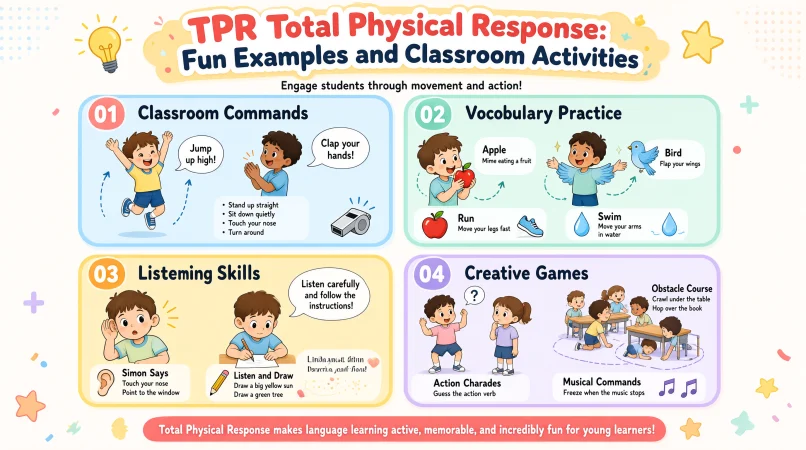
Quick Answer: TPR (Total Physical Response) is a language-teaching method that connects words with physical movements, helping learners understand and remember vocabulary through action. It is especially useful for beginners, young learners, and interactive classrooms.
Top alternatives: movement-based learning, action-based teaching, kinesthetic learning, gesture-based instruction, physical language activities.
Ever tried teaching someone a new word and realized that a simple movement explains it better than a long lecture? That is where TPR Total Physical Response makes learning fun, memorable, and interactive. Instead of sitting quietly and memorizing vocabulary, learners listen to instructions, move their bodies, and connect language with real actions.
Whether you are a teacher planning classroom activities, a student studying language-learning methods, or a parent helping a child learn English, TPR offers a practical way to turn lessons into engaging experiences. From jumping and clapping to following classroom commands, even simple movements can make unfamiliar words easier to understand.
The beauty of TPR is that students can participate before they feel confident speaking. This approach reduces pressure, encourages listening, and adds energy to everyday lessons. Ready to explore useful examples, creative activities, and teaching ideas? Let’s get moving!
1. Funny TPR Total Physical Response Examples
1. Jump Like a Frog! Example: A teacher uses this instruction during a playful animal vocabulary lesson. Meaning: Makes movement-based learning amusing and memorable.
2. Walk Like a Robot! Example: Students practice walking around the classroom with stiff movements. Meaning: Connects action vocabulary with humor.
3. Wiggle Your Fingers! Example: A teacher introduces body-part vocabulary to young learners. Meaning: Encourages playful participation.
4. Dance Like a Penguin! Example: Children imitate penguins during an animal-themed activity. Meaning: Combines imagination with physical learning.
5. Pretend You’re a Sleeping Bear! Example: Learners practice the word “sleep” through an animal game. Meaning: Makes vocabulary easier to visualize.
6. March Like a Tiny Soldier! Example: Students follow a marching command during a movement break. Meaning: Reinforces action words in an entertaining way.
7. Freeze Like a Statue! Example: The teacher calls this command during a classroom movement game. Meaning: Practices listening and self-control.
8. Flap Your Arms Like a Chicken! Example: Children act out farm animals while learning new words. Meaning: Encourages expressive physical responses.
9. Tiptoe Like a Secret Agent! Example: Students practice walking quietly during a listening exercise. Meaning: Makes the concept of tiptoeing fun.
10. Spin Like a Whirling Top! Example: Learners demonstrate spinning during a movement activity. Meaning: Connects an action with a memorable image.
11. Make Your Funniest Face! Example: A teacher introduces facial expressions through gestures. Meaning: Encourages facial movement and active participation.
12. Pretend the Floor Is Lava! Example: Students carefully step between classroom floor markers. Meaning: Adds imaginative play to movement-based instruction.
2. Simple TPR Classroom Commands
1. Stand Up! Example: A teacher begins a lesson by asking everyone to rise. Meaning: Teaches a basic classroom instruction.
2. Sit Down! Example: Learners return to their chairs after a warm-up. Meaning: Reinforces an everyday classroom command.
3. Raise Your Hand! Example: Students practice the gesture used to ask a question. Meaning: Connects classroom language with appropriate behavior.
4. Open Your Book! Example: A teacher prepares students for a reading activity. Meaning: Teaches a practical instruction.
5. Close Your Notebook! Example: Learners finish writing and follow the teacher’s command. Meaning: Reinforces common classroom vocabulary.
6. Look at the Board! Example: Students turn toward the board during a demonstration. Meaning: Connects listening with directional attention.
7. Point to the Door! Example: Beginners identify objects around the classroom. Meaning: Practices pointing and object recognition.
8. Touch Your Head! Example: Children follow body-part instructions during a warm-up. Meaning: Builds body vocabulary through movement.
9. Clap Your Hands! Example: Students clap twice when the teacher gives the command. Meaning: Demonstrates an action in a clear, physical way.
10. Stamp Your Feet! Example: Learners practice action verbs during a group game. Meaning: Connects vocabulary with a strong physical movement.
11. Turn Around! Example: Students rotate their bodies during a direction-following exercise. Meaning: Teaches turning through direct experience.
12. Walk to the Window! Example: Learners move toward a familiar classroom object. Meaning: Combines movement with location vocabulary.
3. TPR Activities for Young Learners
1. Simon Says! Example: Children follow instructions only when the teacher says the special phrase. Meaning: Develops listening and movement coordination.
2. Animal Action Game! Example: Children imitate animals after hearing their names. Meaning: Reinforces animal vocabulary through imitation.
3. Body-Part Challenge! Example: Students touch their elbows, knees, shoulders, and toes. Meaning: Helps children remember body-part names.
4. Color Hunt! Example: Learners walk to an object matching the color called out. Meaning: Connects colors with physical exploration.
5. Action Song Time! Example: Children sing a familiar movement song and copy its gestures. Meaning: Combines rhythm, language, and movement.
6. Follow the Leader! Example: Students copy a leader’s simple actions around the room. Meaning: Practices observation and action vocabulary.
7. Shape Stepping! Example: Children step onto paper circles, squares, and triangles. Meaning: Connects shape names with physical recognition.
8. Emotion Faces! Example: Learners act happy, sad, surprised, and sleepy. Meaning: Teaches emotional vocabulary through facial expressions.
9. Copy My Movement! Example: A teacher waves, claps, and stretches for students to imitate. Meaning: Encourages attention and movement imitation.
10. Musical Freeze! Example: Children dance while music plays and stop when it ends. Meaning: Practices listening and responding to cues.
11. Treasure Direction Game! Example: Learners follow simple directions to find a classroom object. Meaning: Reinforces directional language.
12. Move and Match! Example: Students match picture cards with the correct physical action. Meaning: Links visual recognition with vocabulary.
4. TPR Activities for English Vocabulary
1. Run in Place! Example: Students demonstrate the meaning of “run” without moving across the room. Meaning: Teaches a common action verb.
2. Pretend to Eat! Example: Learners mime eating while studying food-related vocabulary. Meaning: Makes an everyday verb easy to understand.
3. Drink Some Water! Example: Students imitate drinking during a lesson on daily routines. Meaning: Connects language with a familiar action.
4. Brush Your Teeth! Example: Learners mime their morning hygiene routine. Meaning: Reinforces personal-care vocabulary.
5. Comb Your Hair! Example: Children pretend to use a comb during a daily-routine lesson. Meaning: Demonstrates grooming-related language.
6. Wash Your Hands! Example: Students perform the steps of handwashing without needing water. Meaning: Connects a useful phrase with a recognizable sequence.
7. Write Your Name! Example: Learners pretend to write in the air with a finger. Meaning: Reinforces writing vocabulary.
8. Read a Book! Example: Students mime holding and reading an imaginary book. Meaning: Demonstrates the meaning of “read.”
9. Kick the Ball! Example: Learners practice a football-related action without a real ball. Meaning: Teaches movement and sports vocabulary.
10. Throw the Ball! Example: Students mime throwing during an action-verb activity. Meaning: Connects a verb with its physical meaning.
11. Catch the Ball! Example: Children imitate catching an imaginary ball. Meaning: Helps learners distinguish related sports actions.
12. Open the Window! Example: Students mime opening a window during a household vocabulary lesson. Meaning: Reinforces a practical action phrase.
5. Creative TPR Teaching Ideas
1. Magic Movement Words! Example: Students perform a gesture whenever the teacher says a target word. Meaning: Makes vocabulary practice feel like a game.
2. Invisible Object Game! Example: Learners pretend to hold, open, or carry imaginary objects. Meaning: Encourages imagination and action-based comprehension.
3. Classroom Adventure! Example: Students follow a sequence of instructions to explore different stations. Meaning: Combines movement with listening practice.
4. Action Dice! Example: Learners roll a picture dice and perform the displayed action. Meaning: Adds variety to repeated vocabulary practice.
5. Movement Storytelling! Example: Students act out a story as the teacher narrates each event. Meaning: Connects language comprehension with a meaningful sequence.
6. Gesture Guessing Game! Example: One student acts out a verb while classmates guess the word. Meaning: Encourages expressive communication and recall.
7. Human Alphabet! Example: Learners use their arms and bodies to represent selected letters. Meaning: Adds movement to letter recognition.
8. Weather Reporter! Example: Students mime sunshine, rain, wind, and snow during a weather lesson. Meaning: Makes weather vocabulary more concrete.
9. Pretend Shopping! Example: Learners mime selecting, carrying, and paying for items. Meaning: Practices everyday vocabulary in context.
10. Daily Routine Theater! Example: Students act out waking up, dressing, eating, and leaving home. Meaning: Reinforces routine-related phrases in sequence.
11. Direction Maze! Example: Learners follow left, right, forward, and backward instructions. Meaning: Teaches directional language through movement.
12. TPR Mystery Box! Example: Students pick an action card and silently perform its instruction. Meaning: Encourages active recall and playful participation.
6. Polite and Inclusive TPR Instructions
1. Please Stand Up! Example: A teacher introduces polite commands to beginner learners. Meaning: Combines a classroom instruction with courteous language.
2. Please Sit Down! Example: Students return to their seats after a group activity. Meaning: Models a polite request.
3. Could You Raise Your Hand? Example: A teacher encourages students to signal before speaking. Meaning: Demonstrates a respectful classroom request.
4. Please Point to the Picture! Example: Learners identify an image on the board. Meaning: Gives a clear and courteous instruction.
5. Let’s Clap Together! Example: A teacher invites the whole class to clap in rhythm. Meaning: Encourages group participation.
6. Show Me a Wave! Example: Students practice greeting gestures at the start of class. Meaning: Connects language with friendly nonverbal communication.
7. Take One Step Forward! Example: Learners practice movement directions in a safe space. Meaning: Teaches a specific action clearly.
8. Please Turn to Your Partner! Example: Students prepare for a paired classroom activity. Meaning: Encourages cooperative participation.
9. Reach Up If You’re Comfortable! Example: Learners stretch their arms during a warm-up. Meaning: Makes participation flexible and respectful.
10. Choose Your Own Movement! Example: Students select a gesture to represent a vocabulary word. Meaning: Supports choice and individual expression.
11. Move at Your Own Pace! Example: Learners practice a sequence of physical commands. Meaning: Reduces pressure and accommodates different abilities.
12. You Can Watch First! Example: A hesitant learner observes a demonstration before joining. Meaning: Makes participation welcoming and low-pressure.
7. TPR Activities for Beginners
1. Wave Hello! Example: Beginners greet classmates with a wave. Meaning: Teaches a basic greeting through gesture.
2. Nod Your Head! Example: Students practice nodding in response to a simple question. Meaning: Connects a familiar gesture with communication.
3. Shake Your Head! Example: Learners demonstrate a negative response using their heads. Meaning: Helps beginners understand a common gesture.
4. Point to Yourself! Example: Students identify the meaning of “I” through a gesture. Meaning: Connects a pronoun with self-reference.
5. Point to Your Friend! Example: Learners identify another person during a pronoun lesson. Meaning: Helps distinguish self-reference from other people.
6. Pick Up the Pencil! Example: Students follow a command using a classroom object. Meaning: Teaches a practical verb and noun together.
7. Put Down the Pencil! Example: Learners place the pencil back on the desk. Meaning: Demonstrates the opposite of picking something up.
8. Walk Slowly! Example: Students adjust their pace when practicing adverbs. Meaning: Teaches how an action can be performed.
9. Walk Quickly! Example: Learners demonstrate a faster walking pace in a clear area. Meaning: Introduces a contrast in movement speed.
10. Bend Your Knees! Example: Students follow a simple physical instruction. Meaning: Builds understanding of body movements.
11. Stretch Your Arms! Example: Learners stretch during a classroom break. Meaning: Connects a useful action verb with a physical demonstration.
12. Take a Deep Breath! Example: Students practice a gentle breathing exercise before class. Meaning: Teaches a practical phrase through guided action.
8. TPR Activities for Teaching Grammar
1. Show Me One Finger! Example: Students hold up one finger when practicing singular nouns. Meaning: Connects number concepts with physical signals.
2. Show Me Two Fingers! Example: Learners demonstrate plural quantities using their hands. Meaning: Reinforces the difference between one and two.
3. Step Forward for Present Tense! Example: Students step forward when they hear a present-tense example. Meaning: Makes grammar categories physically distinguishable.
4. Step Back for Past Tense! Example: Learners step backward when they hear a past-tense sentence. Meaning: Uses movement as a memory cue for past events.
5. Point to the Person! Example: Students point to a picture representing the subject of a sentence. Meaning: Reinforces subject identification.
6. Act Out the Verb! Example: Learners perform the action described by a verb card. Meaning: Connects grammatical verbs with their meanings.
7. Raise One Hand for Yes! Example: Students respond physically to simple yes-or-no questions. Meaning: Provides a clear response signal.
8. Cross Your Arms for No! Example: Learners use a classroom gesture to indicate a negative answer. Meaning: Practices negative responses through movement.
9. Make a Big Circle! Example: Students form a circle while learning shape vocabulary. Meaning: Connects descriptive words with physical arrangements.
10. Stand Beside the Chair! Example: Learners demonstrate the meaning of “beside.” Meaning: Teaches prepositions through spatial relationships.
11. Stand Behind the Desk! Example: Students position themselves behind classroom furniture. Meaning: Demonstrates the preposition “behind.”
12. Place the Book Under the Chair! Example: Learners follow an instruction involving object placement. Meaning: Reinforces the preposition “under.”
9. TPR Activities for Listening Skills
1. Listen and Touch! Example: Students touch the named body part after hearing the instruction. Meaning: Builds careful listening and quick comprehension.
2. Listen and Point! Example: Learners point to an object mentioned by the teacher. Meaning: Connects spoken words with visual recognition.
3. Listen and Move! Example: Students perform an action when they hear its name. Meaning: Strengthens the connection between language and movement.
4. Follow Three Instructions! Example: Learners stand up, clap, and sit down in the correct order. Meaning: Practices listening to sequences.
5. Find the Named Object! Example: Students locate a classroom object after hearing its name. Meaning: Improves recognition of spoken vocabulary.
6. Move When You Hear Your Color! Example: Learners move when the teacher calls their assigned color. Meaning: Encourages selective listening.
7. Copy the Sound and Action! Example: Students imitate an animal sound and its movement. Meaning: Combines auditory recognition with physical response.
8. Listen for Left and Right! Example: Learners turn in the direction announced by the teacher. Meaning: Reinforces directional comprehension.
9. Follow the Rhythm! Example: Students clap or step according to a spoken rhythm pattern. Meaning: Develops attention to auditory cues.
10. Listen for the Opposite! Example: Students sit when told to stand and stand when told to sit. Meaning: Challenges learners to process instructions carefully.
11. Remember the Action Sequence! Example: Students repeat a sequence of movements after hearing it once. Meaning: Exercises listening memory and recall.
12. Listen and Choose! Example: Learners move toward one of two pictures matching a spoken word. Meaning: Tests listening comprehension through a physical choice.
10. TPR Activities for Speaking Confidence
1. Say It and Show It! Example: Learners say an action word while demonstrating it. Meaning: Connects spoken production with physical understanding.
2. Name Your Movement! Example: Students perform a gesture and say its English name. Meaning: Encourages vocabulary recall and speaking practice.
3. Describe Your Action! Example: A learner says, “I am jumping,” while jumping gently. Meaning: Connects spoken sentences with visible actions.
4. Give a Partner a Command! Example: Students take turns giving simple instructions to a classmate. Meaning: Builds confidence in producing commands.
5. Act and Explain! Example: A learner demonstrates an action and names it afterward. Meaning: Supports speaking through concrete examples.
6. Choose and Announce! Example: Students select an action card and say the phrase aloud. Meaning: Encourages independent language production.
7. Lead the Movement! Example: A learner leads classmates through familiar commands. Meaning: Develops leadership and speaking confidence.
8. Describe Your Feelings! Example: Students act happy or tired and say how they feel. Meaning: Combines emotional vocabulary with verbal expression.
9. Complete the Action Sentence! Example: A teacher says, “I can…” and learners finish with an action. Meaning: Practices simple sentence structures.
10. Ask and Perform! Example: Students ask a classmate to perform a familiar movement. Meaning: Practices basic requests and responses.
11. Tell a Movement Story! Example: Learners describe a short sequence of actions they perform. Meaning: Encourages connected speech.
12. Teach the Teacher! Example: A student explains and demonstrates a familiar command. Meaning: Builds confidence through learner-led practice.
11. TPR Activities for Online Classes
1. Show Your Hands! Example: Students raise their hands in front of the camera. Meaning: Makes participation visible during online lessons.
2. Touch Your Nose! Example: Learners follow a body-part command during a video call. Meaning: Practices listening without special materials.
3. Wave at the Camera! Example: Students greet classmates at the start of an online lesson. Meaning: Encourages friendly interaction.
4. Stand Up and Sit Down! Example: Learners perform two simple commands beside their desks. Meaning: Adds physical participation to screen-based learning.
5. Point Left! Example: Students point toward their left while practicing directions. Meaning: Reinforces directional vocabulary.
6. Make a Heart with Your Hands! Example: Learners follow a gesture instruction during a themed lesson. Meaning: Combines visual demonstration with an easy action.
7. Show Me Something Blue! Example: Students find and hold up a blue object near them. Meaning: Practices colors and object recognition.
8. Mime Your Favorite Hobby! Example: Learners act out reading, swimming, or painting on camera. Meaning: Encourages vocabulary recall and personal expression.
9. Copy My Gesture! Example: The teacher demonstrates movements for students to imitate. Meaning: Keeps online learners actively engaged.
10. Freeze on Screen! Example: Students stop moving when the teacher calls “Freeze!” Meaning: Practices listening and response control.
11. Move to the Beat! Example: Learners clap or step along with a short rhythm. Meaning: Adds movement and energy to remote lessons.
12. Find Something Round! Example: Students bring a round object into view during a lesson. Meaning: Connects shape vocabulary with everyday surroundings.
12. TPR Activities for Adult Learners
1. Follow Workplace Directions! Example: Learners practice instructions used in a simulated office environment. Meaning: Applies language learning to practical situations.
2. Mime a Daily Routine! Example: Adults demonstrate commuting, cooking, or exercising. Meaning: Reinforces everyday vocabulary without childish materials.
3. Practice Travel Commands! Example: Learners follow instructions such as “turn left” and “go straight.” Meaning: Supports practical communication while traveling.
4. Demonstrate a Recipe! Example: Students mime chopping, stirring, and pouring. Meaning: Teaches food preparation vocabulary through action.
5. Act Out a Meeting! Example: Learners practice gestures for greeting, sitting, and presenting. Meaning: Combines workplace vocabulary with relevant movements.
6. Practice Shopping Gestures! Example: Students mime choosing items, carrying bags, and paying. Meaning: Reinforces common shopping expressions.
7. Show Directions on a Map! Example: Learners trace a route using their fingers. Meaning: Connects directional language with visual movement.
8. Demonstrate a Fitness Routine! Example: Students follow simple commands for stretching and bending. Meaning: Practices action verbs in a familiar adult context.
9. Role-Play Customer Service! Example: Learners mime greeting a customer and handing over an item. Meaning: Applies language to professional interactions.
10. Act Out an Appointment! Example: Students practice gestures for arriving, waiting, and leaving. Meaning: Reinforces practical appointment vocabulary.
11. Practice Emergency Directions! Example: Learners follow safe, simulated instructions for moving toward an exit. Meaning: Builds comprehension of important directional language.
12. Present with Gestures! Example: Students use hand movements to support a short presentation. Meaning: Develops confidence with verbal and nonverbal communication.
13. TPR Activities for Teaching Directions and Prepositions
1. Move Forward! Example: Students take a step ahead when they hear the command. Meaning: Demonstrates forward movement.
2. Move Backward! Example: Learners take a careful step backward in a clear space. Meaning: Teaches the opposite of forward movement.
3. Turn Left! Example: Students rotate left during a directional game. Meaning: Reinforces leftward movement.
4. Turn Right! Example: Learners turn right after hearing the instruction. Meaning: Teaches rightward movement.
5. Put the Pencil on the Desk! Example: Students place a pencil on a desk to demonstrate location. Meaning: Teaches the preposition “on.”
6. Put the Pencil in the Box! Example: Learners place an object inside a container. Meaning: Demonstrates the preposition “in.”
7. Put the Pencil Beside the Book! Example: Students position a pencil next to a book. Meaning: Teaches the meaning of “beside.”
8. Stand Between Two Chairs! Example: Learners position themselves between two classroom chairs. Meaning: Demonstrates the preposition “between.”
9. Walk Around the Table! Example: Students follow a safe route around a table. Meaning: Reinforces the word “around.”
10. Stand Near the Door! Example: Learners move to a position close to the door. Meaning: Demonstrates the concept of proximity.
11. Move Away from the Chair! Example: Students increase their distance from a chair. Meaning: Teaches the phrase “move away.”
12. Place the Bag Behind You! Example: Learners position a bag behind their bodies. Meaning: Reinforces the preposition “behind.”
14. Confident TPR Teaching Strategies
1. Demonstrate Before Explaining! Example: A teacher performs an action before asking students to copy it. Meaning: Makes instructions easier to understand through modeling.
2. Start with Easy Commands! Example: Beginners practice standing, sitting, and clapping first. Meaning: Builds familiarity before introducing complexity.
3. Repeat with Confidence! Example: The class performs the same movement after hearing it again. Meaning: Reinforces comprehension through repetition.
4. Let Students Lead! Example: A learner gives a familiar command to the group. Meaning: Encourages ownership and participation.
5. Use Clear Gestures! Example: A teacher points while introducing a directional phrase. Meaning: Supports spoken instructions with visual cues.
6. Celebrate Every Attempt! Example: A teacher praises students for trying a new movement. Meaning: Builds a supportive learning atmosphere.
7. Mix Familiar and New Actions! Example: Students review known commands before learning new verbs. Meaning: Connects previous knowledge with new vocabulary.
8. Keep Instructions Short! Example: A teacher introduces one action at a time. Meaning: Reduces confusion for beginner learners.
9. Check Understanding Through Action! Example: Students demonstrate an instruction without translating it. Meaning: Helps teachers assess comprehension directly.
10. Offer Different Ways to Participate! Example: Students can point, gesture, or perform a movement. Meaning: Makes activities accessible to different learners.
11. Use Props When Helpful! Example: A teacher uses a ball to demonstrate throwing and catching. Meaning: Makes unfamiliar actions more concrete.
12. Build from Listening to Speaking! Example: Students first follow commands and later give commands themselves. Meaning: Progresses from comprehension toward language production.
15. Advanced TPR Activities for Language Practice
1. Follow a Five-Step Story! Example: Learners act out a short story with five sequential instructions. Meaning: Combines listening, memory, and comprehension.
2. Perform Opposite Actions! Example: Students alternate between standing and sitting or opening and closing. Meaning: Reinforces contrasting vocabulary.
3. Complete a Movement Sequence! Example: Learners clap, turn, jump, and sit in a specified order. Meaning: Practices multi-step listening comprehension.
4. Act Out Conditional Commands! Example: Students jump only when the teacher says a chosen keyword. Meaning: Encourages careful processing of conditional instructions.
5. Follow Commands with Objects! Example: Learners pick up a book, place it on a chair, and point to it. Meaning: Combines vocabulary, prepositions, and sequencing.
6. Create a Movement Dialogue! Example: Pairs act out a short exchange involving requests and actions. Meaning: Connects physical responses with conversational language.
7. Tell a Story in the Past Tense! Example: Students mime yesterday’s activities while describing them. Meaning: Links physical demonstrations with past-tense practice.
8. Use Actions to Compare! Example: Learners demonstrate walking slowly and walking quickly. Meaning: Teaches comparative concepts through visible differences.
9. Follow a Classroom Treasure Trail! Example: Students follow several directional clues to find an object. Meaning: Combines reading or listening with movement and problem-solving.
10. Create Your Own TPR Commands! Example: Students invent instructions using verbs they have learned. Meaning: Encourages creativity and independent language use.
11. Lead a Group Movement Story! Example: One student narrates while classmates act out each event. Meaning: Integrates speaking, listening, and cooperative learning.
12. Complete a Vocabulary Action Challenge! Example: Learners demonstrate a series of verbs without seeing picture cues. Meaning: Checks independent recall and comprehension.
FAQs
What Does TPR Total Physical Response Mean?
TPR is a language-teaching method that connects spoken instructions with physical actions.
Can TPR Have Emotional or Flirty Interpretations?
TPR is an educational term, not a common flirty phrase. Its meaning depends on the context.
Is TPR Used in Professional or Formal Education?
Yes, teachers use TPR in language classrooms, training sessions, and beginner learning activities.
What Should You Say If You Don’t Mean TPR?
If the term is unclear, explain your intended teaching method or ask what the speaker means.
Is Humor Appropriate When Teaching with TPR?
Yes, gentle humor can make movement activities enjoyable, provided learners feel comfortable and respected.
Conclusion
TPR Total Physical Response shows that learning a language does not have to mean sitting still and memorizing endless vocabulary lists. Simple actions, clear instructions, and playful activities can help learners connect words with meaning while building listening confidence. Whether you teach children, support adult beginners, or study language-learning techniques, the right TPR activity can make your lesson more engaging and easier to remember.
Try a few commands, experiment with different movement games, and adjust the activities to suit your learners’ needs. Remember, participation matters more than perfect performance. Save this list for your next lesson, share your favorite activity with another teacher, and keep making learning active, welcoming, and fun.