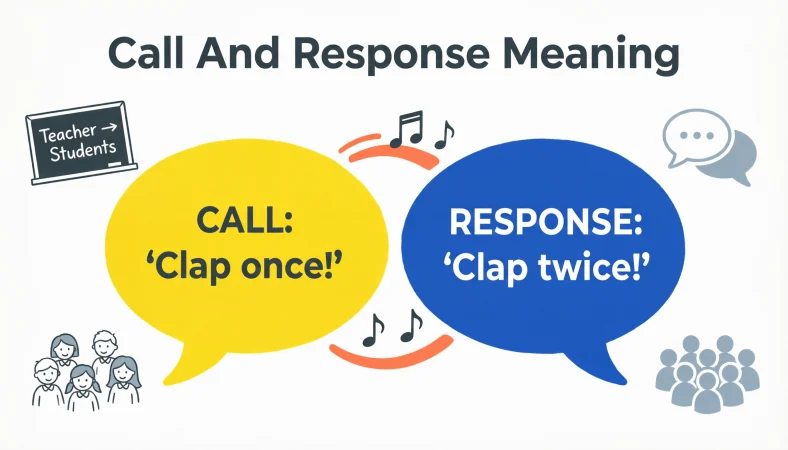
Quick Answer: Call and response meaning refers to a communication pattern where one person, group, or speaker makes a “call” and another person or group answers with a “response.” It appears in music, conversations, classrooms, worship, sports, and everyday social moments.
Top alternatives: question and answer, prompt and reply, speaker and response, cue and reaction, statement and reply
Call and response is one of those phrases that sounds complicated until you realize you’ve probably used it a hundred times without thinking about it. Someone says something, you answer, and boom, you’ve got a call and response moment.
Ever shouted “How are we doing?” at a crowd and heard everyone yell “Great!” back? That’s call and response in action. The call and response meaning is surprisingly simple: one person or group gives a verbal, musical, or social cue, and another person or group answers it. You can see it in songs, church services, classrooms, sports events, comedy routines, texting, DMs, and even playful conversations with friends.
It can make communication feel more energetic because both sides actively participate. A teacher might ask a question and have students answer together. A singer might perform a line while the audience responds. Even a friend saying “You ready?” followed by “Always!” can create the same basic pattern. Once you understand it, you’ll start spotting call and response everywhere. It is basically communication with a little bounce-back energy.
1. Simple Call And Response Examples
These easy examples make the basic concept instantly understandable. They work especially well when explaining the idea to beginners.
“How are you?” “I’m doing great!”
Example: Use this when explaining a basic everyday conversational exchange.
Meaning: One person initiates communication and another provides the answer.
“Are you ready?” “Absolutely!”
Example: Use this before starting an activity with friends.
Meaning: The response confirms readiness after the initial prompt.
“Good morning!” “Good morning!”
Example: Use this as a simple classroom or workplace example.
Meaning: The second greeting directly answers the first.
“Can you hear me?” “Yes, we can!”
Example: Use this when demonstrating audience participation.
Meaning: The group responds collectively to a speaker’s question.
“Who’s excited?” “We are!”
Example: Use this at a party or event.
Meaning: The audience responds to an energetic prompt.
“Ready, set?” “Go!”
Example: Use this when starting a race or game.
Meaning: The response completes the verbal cue.
“Hello, everyone!” “Hello!”
Example: Use this when demonstrating a simple group interaction.
Meaning: The group answers the speaker’s greeting.
“How’s everyone feeling?” “Amazing!”
Example: Use this at a social gathering.
Meaning: The group responds enthusiastically to a shared prompt.
“Can I get an amen?” “Amen!”
Example: Use this as a recognizable worship example.
Meaning: The audience gives a collective verbal response.
“Who’s ready to party?” “We are!”
Example: Use this before a celebration or event.
Meaning: The response reinforces group excitement.
“Do we have a deal?” “Deal!”
Example: Use this during a friendly agreement.
Meaning: The reply confirms mutual agreement.
“Are you with me?” “Always!”
Example: Use this between close friends or teammates.
Meaning: The response communicates support and connection.
2. Funny Call And Response Examples
Want to explain the concept without sounding like a textbook? These playful examples bring the idea to life.
“Who ate the last cookie?” “Not me!”
Example: Use this jokingly when snacks mysteriously disappear.
Meaning: The response humorously denies responsibility.
“Who needs coffee?” “Everybody!”
Example: Use this during a sleepy morning at work.
Meaning: The response exaggerates shared tiredness.
“Are we productive today?” “Define productive.”
Example: Use this with coworkers or friends joking about procrastination.
Meaning: The response humorously questions the original assumption.
“Who’s ready to work?” “After lunch!”
Example: Use this during a casual workplace joke.
Meaning: The response playfully delays the expected enthusiasm.
“Did anyone study?” “Absolutely not.”
Example: Use this before a difficult quiz with classmates.
Meaning: The response humorously admits a lack of preparation.
“Who wants dessert?” “Is that even a question?”
Example: Use this when someone offers cake or ice cream.
Meaning: The response enthusiastically accepts the idea.
“Are we adults?” “Technically.”
Example: Use this when joking with friends about responsibilities.
Meaning: The response playfully questions everyone’s maturity.
“Who broke it?” “Let’s not focus on details.”
Example: Use this after something accidentally goes wrong.
Meaning: The response dodges responsibility for comedic effect.
“Ready for Monday?” “Absolutely not.”
Example: Use this during a weekend group chat.
Meaning: The response humorously expresses resistance to the workweek.
“Who needs a vacation?” “My soul does.”
Example: Use this when everyone feels exhausted.
Meaning: The response dramatically exaggerates the need for rest.
“Are we behaving?” “Define behaving.”
Example: Use this during playful mischief with friends.
Meaning: The response jokingly avoids giving a straightforward answer.
“Who ordered chaos?” “Apparently, we did.”
Example: Use this when a simple plan becomes messy.
Meaning: The response turns disorder into a shared joke.
3. Call And Response In Music
Music is one of the most familiar places to encounter call and response. These examples show how the pattern works without requiring technical music terminology.
“Leader sings a line, group repeats it.”
Example: Use this when explaining the pattern in a music lesson.
Meaning: One musical phrase is answered by another voice or group.
“Hey!” “Hey!”
Example: Use this when describing a simple concert audience interaction.
Meaning: The audience echoes the singer’s vocal cue.
“Can you feel it?” “Yes!”
Example: Use this during a live performance.
Meaning: The crowd answers the performer’s prompt.
“Everybody say yeah!” “Yeah!”
Example: Use this at a concert or party.
Meaning: The audience participates by repeating the requested response.
“I say one word, you say another.”
Example: Use this when teaching the basic musical structure.
Meaning: Two sides alternate vocal phrases.
“Leader sings, audience answers.”
Example: Use this as a quick explanation of musical call and response.
Meaning: The performer initiates while listeners provide the reply.
“Clap once!” “Clap!”
Example: Use this during an interactive performance.
Meaning: The audience follows a rhythmic cue.
“Sing it back!” “We sing it back!”
Example: Use this when describing audience participation.
Meaning: Listeners repeat a musical phrase after hearing it.
“Who wants more?” “We do!”
Example: Use this at a live show.
Meaning: The crowd responds to an invitation for continued performance.
“Leader starts the melody, group completes it.”
Example: Use this in a music classroom.
Meaning: Different performers contribute alternating parts.
“Question in song, answer in song.”
Example: Use this when explaining the concept simply.
Meaning: Musical phrases interact like conversational questions and answers.
“Voice leads, voices answer.”
Example: Use this as a beginner-friendly music explanation.
Meaning: The pattern depends on alternating musical participation.
4. Call And Response In Everyday Conversation
You don’t need a stage or microphone to use this communication style. Everyday conversations naturally create small call and response moments.
“What’s up?” “Not much!”
Example: Use this during a casual greeting with a friend.
Meaning: The response directly answers the social opening.
“How was your day?” “Pretty good!”
Example: Use this when chatting with someone after work.
Meaning: The response provides information requested by the speaker.
“You coming?” “Of course!”
Example: Use this when confirming plans with a friend.
Meaning: The reply confirms participation.
“Need help?” “Actually, yes.”
Example: Use this when accepting someone’s offer.
Meaning: The response acknowledges and accepts assistance.
“Want coffee?” “Always.”
Example: Use this during a casual morning conversation.
Meaning: The answer enthusiastically accepts the offer.
“Are you okay?” “I’m getting there.”
Example: Use this during a supportive conversation.
Meaning: The response acknowledges concern while giving an honest update.
“Did you finish?” “Almost.”
Example: Use this during a work or school conversation.
Meaning: The response gives a brief progress update.
“Want to go out?” “Definitely.”
Example: Use this when making casual plans.
Meaning: The answer clearly communicates interest.
“You ready?” “Let’s go.”
Example: Use this before leaving for an event.
Meaning: The response signals readiness.
“Did you hear me?” “Loud and clear.”
Example: Use this during a playful conversation.
Meaning: The response confirms that the message was understood.
“Should we do it?” “Why not?”
Example: Use this when deciding whether to try something new.
Meaning: The response expresses openness.
“Everything good?” “Better now.”
Example: Use this when someone checks in on you.
Meaning: The response communicates reassurance with warmth.
5. Call And Response In Texting And DMs
Call and response does not disappear when communication moves online. Text messages and DMs can create the same rhythm with a few words.
“You up?” “Yep, unfortunately.”
Example: Use this as a humorous late-night text response.
Meaning: The reply confirms availability while adding personality.
“Guess what?” “What?”
Example: Use this when someone teases you with a surprise.
Meaning: The response invites them to continue.
“Wanna hang out?” “I’m down.”
Example: Use this when accepting a friend’s invitation by text.
Meaning: The reply shows casual agreement.
“Miss me?” “Maybe a little.”
Example: Use this in a playful exchange with someone close.
Meaning: The response adds teasing affection.
“You free tonight?” “Depends on the plan.”
Example: Use this when you want more information before agreeing.
Meaning: The reply keeps the conversation open.
“Still awake?” “Sadly, yes.”
Example: Use this during a late-night DM.
Meaning: The response humorously confirms wakefulness.
“Want the tea?” “Always.”
Example: Use this when a friend hints at gossip.
Meaning: The response enthusiastically asks for the details.
“Can I tell you something?” “Of course.”
Example: Use this when someone starts a serious conversation.
Meaning: The response creates a welcoming opening.
“Guess who I saw?” “Tell me everything.”
Example: Use this when chatting about an unexpected encounter.
Meaning: The response encourages the sender to continue.
“Are you busy?” “Not for you.”
Example: Use this in a warm or lightly flirty text exchange.
Meaning: The reply signals special attention.
“Want to come?” “Send the address.”
Example: Use this when accepting an informal invitation.
Meaning: The response confirms interest and readiness.
“Can we talk?” “I’m listening.”
Example: Use this when someone needs emotional support.
Meaning: The reply communicates attention and openness.
6. Call And Response In Classrooms
Teachers use call and response to keep students engaged, reinforce information, and create an interactive learning environment.
“What is two plus two?” “Four!”
Example: Use this as a simple classroom participation example.
Meaning: Students collectively answer the teacher’s question.
“Eyes on me!” “Eyes on you!”
Example: Use this when demonstrating an attention signal.
Meaning: Students acknowledge the teacher’s instruction.
“Are we ready to learn?” “Yes!”
Example: Use this at the beginning of a lesson.
Meaning: Students respond to the teacher’s opening prompt.
“What’s the answer?” “We know!”
Example: Use this during an energetic review session.
Meaning: Students signal confidence and participation.
“Repeat after me.” “Repeat after me.”
Example: Use this when demonstrating language-learning practice.
Meaning: Students imitate the teacher’s words.
“Who remembers?” “I do!”
Example: Use this during a review activity.
Meaning: Students volunteer knowledge through a group response.
“Ready for the next question?” “Ready!”
Example: Use this during a classroom quiz game.
Meaning: Students indicate preparedness.
“Say it together.” “We say it together.”
Example: Use this when teaching vocabulary or pronunciation.
Meaning: Students practice by responding collectively.
“What comes next?” “The answer!”
Example: Use this as a playful classroom prompt.
Meaning: Students respond with humor while staying engaged.
“Can everyone see?” “Yes!”
Example: Use this before presenting classroom material.
Meaning: Students confirm visibility.
“Who needs another example?” “Me!”
Example: Use this when students need more explanation.
Meaning: The response identifies a need for clarification.
“Are we finished?” “Not yet!”
Example: Use this during a lesson review.
Meaning: Students recognize that the activity continues.
7. Call And Response In Church And Worship
Call and response has a long history in religious and worship settings. The exact wording varies across traditions, but the interactive structure is easy to recognize.
“The leader speaks, the congregation responds.”
Example: Use this when explaining worship participation.
Meaning: A leader’s statement receives a communal answer.
“Can I get an amen?” “Amen!”
Example: Use this as a familiar example of congregational response.
Meaning: The congregation verbally affirms the statement.
“Peace be with you.” “And with you.”
Example: Use this when discussing responsive worship language.
Meaning: The second phrase responds directly to the first.
“Give thanks to the Lord.” “We give thanks.”
Example: Use this as an example of communal worship language.
Meaning: The response expresses shared acknowledgment.
“Let us pray.” “Amen.”
Example: Use this when explaining a simple worship sequence.
Meaning: The response traditionally marks agreement or completion.
“Praise the Lord!” “Hallelujah!”
Example: Use this when describing enthusiastic congregational participation.
Meaning: The response reinforces shared praise.
“Can we hear the congregation?” “Yes!”
Example: Use this during an interactive worship gathering.
Meaning: The group answers a direct invitation to participate.
“Blessings to you.” “And to you.”
Example: Use this when illustrating reciprocal religious greetings.
Meaning: The response returns the goodwill.
“Let everyone say…” “Amen!”
Example: Use this when describing group participation.
Meaning: The congregation repeats a requested affirmation.
“Will you join us?” “Yes.”
Example: Use this when demonstrating a simple communal invitation.
Meaning: The response confirms participation.
“We gather together.” “Together we gather.”
Example: Use this as a simple illustration of shared participation.
Meaning: Both sides reinforce the communal message.
“Are we thankful?” “Yes, we are.”
Example: Use this when explaining responsive worship language.
Meaning: The group collectively affirms gratitude.
8. Call And Response At Sports Events
Stadiums, gyms, and sports crowds are full of call and response moments. Fans use short chants to create energy and group identity.
“Let’s go!” “Team name!”
Example: Use this when describing a crowd chant at a sporting event.
Meaning: Fans respond with support for their team.
“Who are we?” “The champions!”
Example: Use this as a fictional sports chant example.
Meaning: The response builds group identity.
“Defense!” “Defense!”
Example: Use this when fans encourage players during a game.
Meaning: The crowd repeats a coordinated chant.
“We want more!” “More!”
Example: Use this when describing excited crowd participation.
Meaning: Fans respond enthusiastically to the action.
“Are you ready?” “Let’s go!”
Example: Use this before a game begins.
Meaning: The response signals collective excitement.
“Who’s got this?” “We do!”
Example: Use this among teammates before competition.
Meaning: The response expresses confidence and unity.
“One team!” “One goal!”
Example: Use this during a team-building activity.
Meaning: The response emphasizes shared purpose.
“Make some noise!” “Let’s go!”
Example: Use this when describing an arena hype moment.
Meaning: Fans answer the invitation with enthusiasm.
“Can you hear us?” “Yes!”
Example: Use this between fans and players.
Meaning: The crowd confirms its presence.
“Who wants the win?” “We do!”
Example: Use this before a recreational game.
Meaning: The response expresses competitive motivation.
“Together!” “All the way!”
Example: Use this as a team-support chant.
Meaning: The exchange emphasizes unity.
“Ready for the final?” “Bring it on!”
Example: Use this before the final stage of a competition.
Meaning: The response communicates enthusiasm and readiness.
9. Flirty Call And Response Examples
A call and response exchange can become playful when two people are flirting. The key is matching the other person’s energy without overdoing it.
“Miss me?” “Maybe more than I should.”
Example: Use this during a playful text exchange with someone you like.
Meaning: The response hints at affection while staying teasing.
“Thinking about me?” “Caught me.”
Example: Use this when someone playfully calls you out.
Meaning: The reply admits interest with charm.
“You free tonight?” “For you? Maybe.”
Example: Use this when teasing someone you’re attracted to.
Meaning: The response creates playful anticipation.
“Are you flirting with me?” “Would it be working?”
Example: Use this when someone notices your playful tone.
Meaning: The response turns the question into a flirtatious challenge.
“Want to see me?” “That’s a dangerous question.”
Example: Use this when teasing someone through text.
Meaning: The reply creates playful mystery.
“You look good.” “You noticed?”
Example: Use this after receiving a compliment.
Meaning: The response encourages the flirtation.
“Can I steal you for a while?” “You can try.”
Example: Use this during a playful exchange.
Meaning: The reply adds teasing confidence.
“You always this charming?” “Only with you.”
Example: Use this when flirting with someone special.
Meaning: The response makes the interaction feel personal.
“Should I text you later?” “You should.”
Example: Use this when encouraging continued communication.
Meaning: The response clearly signals interest.
“Are you trouble?” “Only if you are.”
Example: Use this during playful flirting.
Meaning: The reply mirrors teasing energy.
“Want to hang out?” “I was hoping you’d ask.”
Example: Use this when accepting a date or casual meetup.
Meaning: The response openly communicates interest.
“Why are you smiling?” “You know why.”
Example: Use this when flirting through messages.
Meaning: The response hints that the other person’s attention caused the smile.
10. Sarcastic Call And Response Examples
Sarcasm can make call and response exchanges memorable, especially among friends who understand each other’s humor.
“Are you serious?” “Do I look like I’m joking?”
Example: Use this when playfully defending an obviously serious statement.
Meaning: The response exaggerates confidence for humorous effect.
“Did you finish?” “Define finish.”
Example: Use this when joking about unfinished work.
Meaning: The response avoids a simple yes or no.
“Are you ready?” “Emotionally? Never.”
Example: Use this before an intimidating activity.
Meaning: The reply humorously admits hesitation.
“You coming?” “Eventually, probably.”
Example: Use this when teasing friends about being late.
Meaning: The response playfully avoids commitment to timing.
“Did you sleep?” “I blinked for several hours.”
Example: Use this when exhausted.
Meaning: The response humorously describes poor sleep.
“Need help?” “No, I enjoy struggling.”
Example: Use this when joking with a friend who offers assistance.
Meaning: The reply sarcastically emphasizes that help is welcome.
“Everything under control?” “Absolutely not.”
Example: Use this when a situation becomes chaotic.
Meaning: The response humorously admits things are messy.
“Are you listening?” “Physically, yes.”
Example: Use this during playful teasing.
Meaning: The reply jokingly questions your attention.
“Want advice?” “I was hoping you’d keep it.”
Example: Use this when joking with a close friend.
Meaning: The response playfully rejects unsolicited advice.
“Did you plan this?” “Obviously. Poorly.”
Example: Use this after an unexpected mishap.
Meaning: The response uses self-deprecating humor.
“You got this?” “Let’s not get ambitious.”
Example: Use this when facing a difficult task.
Meaning: The reply humorously expresses uncertainty.
“Are we done?” “Wouldn’t that be nice?”
Example: Use this during a long task or meeting.
Meaning: The response jokingly suggests the task is taking too long.
11. Cute Call And Response Examples
These exchanges work well for friends, couples, family members, and anyone who enjoys wholesome communication.
“You okay?” “Better now.”
Example: Use this when someone checks on you kindly.
Meaning: The response suggests their attention helped.
“Miss me?” “Always.”
Example: Use this with someone close to you.
Meaning: The response expresses affection.
“Need a hug?” “Definitely.”
Example: Use this during a comforting moment.
Meaning: The response accepts emotional support.
“Want some company?” “Please.”
Example: Use this when you would enjoy someone’s presence.
Meaning: The reply warmly welcomes them.
“Are you happy?” “I am now.”
Example: Use this when someone brings positive energy.
Meaning: The response connects happiness with their presence.
“Thinking of me?” “A little.”
Example: Use this during a sweet text exchange.
Meaning: The response gently expresses affection.
“Need anything?” “Just you.”
Example: Use this with someone you’re close to.
Meaning: The reply emphasizes emotional connection.
“Want to stay a little longer?” “I’d love that.”
Example: Use this during a pleasant visit.
Meaning: The response shows appreciation for shared time.
“Are we friends?” “Best ones.”
Example: Use this with a close friend.
Meaning: The reply reinforces friendship and affection.
“Can I call you?” “Anytime.”
Example: Use this when welcoming more communication.
Meaning: The response signals availability and warmth.
“You smiling?” “Because of you.”
Example: Use this in a sweet conversation.
Meaning: The response gives a direct affectionate compliment.
“Promise?” “Promise.”
Example: Use this when offering reassurance.
Meaning: The response provides emotional certainty.
12. Confident Call And Response Examples
Confidence can make a call and response exchange feel energetic and memorable. These examples are useful for teams, friends, and motivational moments.
“Are we ready?” “More than ready.”
Example: Use this before starting an important activity.
Meaning: The response communicates strong confidence.
“Can we do this?” “Absolutely.”
Example: Use this before tackling a challenging task.
Meaning: The reply expresses certainty and determination.
“Who’s stepping up?” “I am.”
Example: Use this during a leadership or team-building moment.
Meaning: The response shows willingness to take responsibility.
“Do we have what it takes?” “We do.”
Example: Use this before a group challenge.
Meaning: The response expresses collective confidence.
“Are you prepared?” “Completely.”
Example: Use this in a professional or competitive setting.
Meaning: The answer communicates readiness.
“Who’s making it happen?” “We are.”
Example: Use this during a team activity.
Meaning: The response emphasizes shared action.
“Ready to begin?” “Let’s make it count.”
Example: Use this before an important project.
Meaning: The response communicates purposeful confidence.
“Can you handle it?” “Watch me.”
Example: Use this during a playful challenge.
Meaning: The reply expresses self-belief.
“Who’s got the plan?” “I’ve got it.”
Example: Use this when taking charge of a situation.
Meaning: The response communicates leadership.
“Are we backing down?” “Not today.”
Example: Use this during motivational group talk.
Meaning: The response communicates determination.
“Do you believe in yourself?” “Every day.”
Example: Use this as a motivational exchange.
Meaning: The response reinforces personal confidence.
“Ready for the next level?” “Bring it on.”
Example: Use this before a new challenge.
Meaning: The reply welcomes difficulty with confidence.
13. Emotional Call And Response Examples
Call and response can also carry emotional weight. These examples are useful for reassurance, connection, support, and meaningful conversations.
“Are you okay?” “I’m trying.”
Example: Use this when honestly answering someone who cares about you.
Meaning: The response acknowledges difficulty without pretending everything is perfect.
“Do you need me?” “Right now, yes.”
Example: Use this when asking someone for emotional support.
Meaning: The response openly communicates vulnerability.
“Are you still here?” “I’m not going anywhere.”
Example: Use this when reassuring someone you care about.
Meaning: The response provides emotional security.
“Do you understand?” “More than you know.”
Example: Use this during a meaningful conversation.
Meaning: The reply communicates empathy and deeper understanding.
“Can I stay?” “Please do.”
Example: Use this during an emotional or supportive moment.
Meaning: The response welcomes someone’s presence.
“Are we okay?” “We’re getting there.”
Example: Use this after a disagreement.
Meaning: The response acknowledges progress without pretending everything is fixed.
“Do you believe me?” “I want to.”
Example: Use this during a serious conversation.
Meaning: The reply communicates uncertainty and emotional openness.
“Will you be there?” “I’ll try my best.”
Example: Use this when discussing an important future moment.
Meaning: The response shows intention while avoiding an unrealistic promise.
“Do you remember?” “I remember everything.”
Example: Use this when discussing a meaningful shared memory.
Meaning: The response emphasizes emotional significance.
“Are you listening?” “With my whole heart.”
Example: Use this during a deeply personal conversation.
Meaning: The reply emphasizes sincere attention.
“Do you care?” “More than I say.”
Example: Use this when expressing feelings indirectly.
Meaning: The response communicates affection beneath the surface.
“Can we start again?” “I’d like that.”
Example: Use this after a disagreement or difficult period.
Meaning: The response expresses openness to reconciliation.
14. Creative Call And Response Ideas
If you’re creating content, teaching a group, writing dialogue, or planning an event, these creative patterns can make your examples stand out.
“When I say go, you say now!”
Example: Use this as an energetic event participation pattern.
Meaning: The speaker establishes a predictable verbal exchange.
“I say sunshine, you say smiles!”
Example: Use this during a cheerful group activity.
Meaning: The response creates a positive rhythmic interaction.
“When I say coffee, you say please!”
Example: Use this as a playful social media caption idea.
Meaning: The pattern turns a familiar desire into a group joke.
“I ask the question, you bring the answer.”
Example: Use this when introducing an interactive activity.
Meaning: The structure clearly assigns roles to both sides.
“I bring the energy, you bring the echo.”
Example: Use this during a performance or group activity.
Meaning: The phrase describes the shared rhythm of participation.
“One voice starts, many voices answer.”
Example: Use this when explaining group communication.
Meaning: The pattern emphasizes collective participation.
“I say the cue, you say the word.”
Example: Use this when teaching a simple audience response.
Meaning: The exchange establishes a predictable response.
“You ask, I answer, then we switch.”
Example: Use this when explaining alternating communication.
Meaning: Both participants take turns initiating and responding.
“Call it out, send it back.”
Example: Use this as a playful description of interactive communication.
Meaning: The phrase emphasizes the back-and-forth rhythm.
“One says it, everyone echoes it.”
Example: Use this for a group activity or event.
Meaning: The audience repeats the original cue.
“Start the phrase, finish it together.”
Example: Use this when designing an audience participation activity.
Meaning: The group completes a shared verbal pattern.
“Give the cue, get the answer.”
Example: Use this when explaining the basic structure to beginners.
Meaning: The phrase summarizes how call and response works.
15. Clever Call And Response Explanations
These concise explanations are useful when someone asks you to define the phrase without wanting a long academic answer.
“It’s basically communication with a built-in reply.”
Example: Use this when explaining the phrase casually to a friend.
Meaning: The definition focuses on the back-and-forth structure.
“One person starts, another person answers.”
Example: Use this when giving a beginner-friendly definition.
Meaning: It describes the simplest form of call and response.
“Think of it as a verbal ping-pong match.”
Example: Use this when explaining the concept playfully.
Meaning: The metaphor highlights alternating communication.
“It’s a prompt followed by a matching response.”
Example: Use this in a simple educational explanation.
Meaning: The response follows an initial cue or statement.
“Someone calls, someone answers.”
Example: Use this when you need the shortest possible explanation.
Meaning: It captures the basic concept directly.
“It’s communication designed to bounce back.”
Example: Use this when explaining the interactive nature of the phrase.
Meaning: The description emphasizes participation.
“One voice opens the door, another walks through it.”
Example: Use this when giving a creative explanation.
Meaning: The metaphor describes how one statement invites a response.
“It’s the conversational version of echoing.”
Example: Use this when explaining repeated responses.
Meaning: The phrase connects the idea to familiar communication.
“A call starts the pattern, and the response completes it.”
Example: Use this when explaining the structure clearly.
Meaning: The response completes the interaction initiated by the call.
“Think question, answer, but with more rhythm.”
Example: Use this when explaining the idea in a casual way.
Meaning: The phrase highlights the rhythmic quality often involved.
“It’s a shared rhythm between a speaker and responder.”
Example: Use this in a slightly more polished explanation.
Meaning: The definition emphasizes cooperation and timing.
“The simplest formula is cue plus answer.”
Example: Use this when teaching the concept quickly.
Meaning: It reduces the idea to its essential structure.
FAQs
What Does Call And Response Mean?
Call and response is a pattern where one person or group speaks, sings, or acts first and another responds.
What Is A Simple Example Of Call And Response?
“How are you?” followed by “I’m good” is a simple conversational example of call and response.
What Does Call And Response Mean In Music?
In music, one voice or group performs a phrase and another voice or group answers it.
Is Call And Response Used In Everyday Conversation?
Yes. Greetings, questions, jokes, and quick replies can naturally create call and response patterns.
What Does Call And Response Mean Emotionally?
It can create connection because both sides actively participate instead of one person speaking alone.
Can Call And Response Be Flirty?
Yes. Playful questions and teasing answers can create a flirty call and response rhythm.
What Does Call And Response Mean In Church?
It describes interactive worship where a leader gives a phrase and the congregation responds.
Is Call And Response Used In Classrooms?
Yes. Teachers often use prompts and group answers to encourage attention and participation.
Is Call And Response Professional?
Yes. It can appear in presentations, training, meetings, workshops, and team activities.
Can Call And Response Be Funny?
Absolutely. Humor can make the exchange more memorable and encourage people to participate.
What If You Do Not Want To Respond?
You can politely acknowledge the message or explain that you need time before answering.
Is Call And Response The Same As Question And Answer?
They are similar, but call and response can involve statements, sounds, chants, or musical phrases too.
Conclusion
Understanding the call and response meaning makes a surprisingly large part of everyday communication easier to recognize. From music and worship to classrooms, sports, texting, DMs, and playful conversations, the pattern is everywhere. One person starts the interaction, another answers, and suddenly the exchange has rhythm and personality.
The best part is that you can use it in simple, funny, emotional, professional, or creative ways depending on the situation. Try a few of these examples the next time you’re chatting with friends or creating an interactive moment. Save this list for later, share it with someone who loves clever communication, and have fun turning ordinary conversations into memorable exchanges.