Quick Answer: When someone says “duh,” they usually mean “obviously,” “of course,” or “that should be obvious.” Your best reply depends on whether you want to be funny, playful, flirty, confident, or simply keep things chill.
Top alternatives: “Obviously, genius,” “Thanks for the update,” “Okay, Captain Obvious,” “Glad we agree,” “You’re adorable when you’re obvious.
Someone drops a casual “duh” in a text, DM, group chat, or even at work, and suddenly you have options. You can laugh it off, throw back a clever comeback, flirt a little, or simply keep the conversation moving. The phrase “duh” can sound playful between friends, teasing between a crush and you, or slightly condescending when the mood is off. That is why knowing how to reply to “duh” can make a surprisingly big difference. The right response keeps your personality intact without turning a tiny comment into a full courtroom drama. Whether you want to be funny with a friend, charming with your crush, professional with a coworker, or confidently witty in a group chat, there is a response for every vibe. Here are plenty of text-ready ideas to keep your comeback game strong.
Funny Responses
“Thanks, Captain Obvious.”
Use this when a friend states something painfully obvious.
Meaning: You are playfully teasing them for pointing out the obvious.
“Breaking news: You figured it out.”
Use this after someone makes an obvious observation.
Meaning: You are jokingly treating their realization like major news.
“We have discovered fire.”
Use this when their comment feels hilariously obvious.
Meaning: You are exaggerating their discovery for comedic effect.
“Gold star for noticing.”
Use this when you want a lighthearted tease.
Meaning: You are pretending to reward them for basic knowledge.
“Thank you for your groundbreaking research.”
Use this when their statement needs a little playful sarcasm.
Meaning: You are joking that their obvious comment was highly scientific.
“Your detective skills are unmatched.”
Use this when they figure out something easy.
Meaning: You are humorously exaggerating their investigative abilities.
“And water is wet. Next?”
Use this when you want a classic obvious-statement comeback.
Meaning: You are pointing out how predictable their comment was.
“Look at Sherlock over here.”
Use this with friends who enjoy playful roasting.
Meaning: You are comparing them to a detective for comedic effect.
“Congratulations, you passed level one.”
Use this in a playful gaming-style exchange.
Meaning: You are joking that they achieved a very basic accomplishment.
“I’ll alert the newspapers.”
Use this when someone acts proud of an obvious observation.
Meaning: You are humorously pretending their statement is headline-worthy.
“Someone give this person a trophy.”
Use this when their realization is hilariously basic.
Meaning: You are exaggerating their achievement for laughs.
“The genius has entered the chat.”
Use this when a friend makes an obvious point.
Meaning: You are teasing them while keeping the mood friendly.
Playful Teasing Responses
“Duh right back at you.”
Use this when you want to mirror their playful attitude.
Meaning: You are returning the same energy without being harsh.
“Okay, smarty pants.”
Use this when a friend gets a little too confident.
Meaning: You are teasing them affectionately.
“Someone’s feeling clever today.”
Use this when their “duh” sounds extra confident.
Meaning: You are lightly calling out their attitude.
“Look who suddenly knows everything.”
Use this with someone you joke around with often.
Meaning: You are playfully teasing their confidence.
“Easy there, professor.”
Use this when someone gives an obvious answer with attitude.
Meaning: You are jokingly treating them like an expert.
“Okay, genius, calm down.”
Use this for a playful comeback between friends.
Meaning: You are teasing them without creating real tension.
“You really thought you ate with that one.”
Use this for internet-style banter.
Meaning: You are playfully suggesting their comeback was not as impressive as they thought.
“I see the confidence is thriving.”
Use this when their tone is amusingly self-assured.
Meaning: You are acknowledging their confidence with a wink.
“That attitude came fully charged.”
Use this when their “duh” sounds particularly sassy.
Meaning: You are joking about their extra energy.
“Somebody woke up confident.”
Use this when they are acting unusually sure of themselves.
Meaning: You are lightly poking fun at their confidence.
“Not you serving obvious facts.”
Use this in a casual social media or texting exchange.
Meaning: You are jokingly praising their obvious statement.
“You’re hilarious when you get like this.”
Use this when you want teasing to stay affectionate.
Meaning: You are showing that their attitude amuses you rather than bothers you.
Flirty Responses
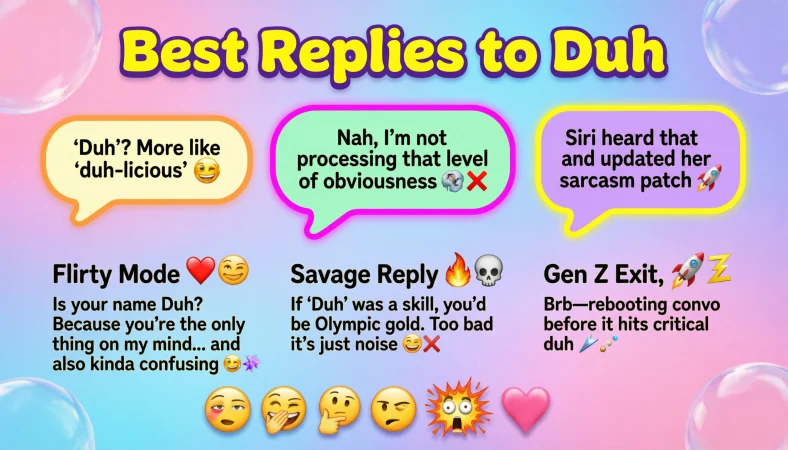
“Duh, you’re cute. What did you expect?”
Use this when the conversation already has romantic energy.
Meaning: You are turning their obvious comment into a compliment.
“Duh, because you’re always on my mind.”
Use this when you want a sweet romantic comeback.
Meaning: You are hinting that they occupy your thoughts.
“Duh, I thought that was obvious between us.”
Use this when flirting with someone who enjoys confidence.
Meaning: You are playfully suggesting mutual chemistry.
“Duh, I’m kind of into you.”
Use this when you want to be direct but playful.
Meaning: You are openly expressing romantic interest.
“Duh, you make it hard not to flirt.”
Use this when their message gives you an opening.
Meaning: You are blaming their charm for your flirting.
“Duh, look who finally noticed.”
Use this when they catch onto your flirting.
Meaning: You are teasing them for taking a while to realize your interest.
“Duh, I thought my flirting was obvious.”
Use this when you have been dropping hints.
Meaning: You are admitting that your attraction was intentional.
“Duh, you’re my favorite distraction.”
Use this for a cute, flirty text.
Meaning: You are saying they easily capture your attention.
“Duh, you have that effect on me.”
Use this when they ask why you are being affectionate.
Meaning: You are hinting that their presence affects you romantically.
“Duh, you’re impossible to ignore.”
Use this when you want a confident compliment.
Meaning: You are telling them they naturally attract your attention.
“Duh, I like you. Keep up.”
Use this when playful confidence fits your relationship.
Meaning: You are flirting while teasing them for being slow to notice.
“Duh, chemistry isn’t exactly subtle.”
Use this when the attraction feels mutual.
Meaning: You are confidently pointing out the connection between you.
Polite Responses
“Haha, fair enough.”
Use this when you want to keep things friendly.
Meaning: You are acknowledging their comment without escalating anything.
“You have a point.”
Use this when their observation is reasonable.
Meaning: You are calmly agreeing with them.
“True, I suppose.”
Use this when you want a relaxed response.
Meaning: You are accepting their point without making a big deal of it.
“Fair response.”
Use this when you want to stay neutral.
Meaning: You are acknowledging their answer respectfully.
“Okay, I see what you mean.”
Use this when their tone is slightly blunt.
Meaning: You are showing that you understand their perspective.
“Haha, noted.”
Use this when you want a casual but polite reply.
Meaning: You are acknowledging what they said without overthinking it.
“You’re right about that.”
Use this when they make a valid observation.
Meaning: You are agreeing in a straightforward way.
“Got it.”
Use this when you want to move the conversation forward.
Meaning: You are acknowledging their point without adding tension.
“That’s fair.”
Use this when their “duh” is not worth debating.
Meaning: You are keeping the exchange calm and mature.
“I’ll give you that one.”
Use this when you want to concede playfully.
Meaning: You are admitting they made a fair point.
“Fair enough, you got me.”
Use this when they correctly call something obvious.
Meaning: You are accepting the tease with good humor.
“Haha, I walked right into that.”
Use this when you realize their point was obvious.
Meaning: You are laughing at yourself rather than taking offense.
Professional Responses
“Understood.”
Use this when responding to a coworker in a formal setting.
Meaning: You are acknowledging the information professionally.
“That’s clear, thanks.”
Use this when you want to keep workplace communication smooth.
Meaning: You are confirming that you understand.
“Absolutely, noted.”
Use this when you need a concise professional reply.
Meaning: You are acknowledging their point respectfully.
“Point taken.”
Use this when someone makes an obvious correction.
Meaning: You are accepting their observation without arguing.
“Thanks for clarifying.”
Use this when their “duh” comes across as blunt.
Meaning: You are redirecting the exchange toward professionalism.
“Understood. I’ll keep that in mind.”
Use this when you want to close the subject politely.
Meaning: You are showing that you have received the message.
“Agreed.”
Use this when their point is straightforward and correct.
Meaning: You are confirming agreement efficiently.
“That makes sense.”
Use this when you want to avoid matching their blunt tone.
Meaning: You are keeping the conversation constructive.
“Yes, that’s correct.”
Use this when a formal response is appropriate.
Meaning: You are confirming the information directly.
“Thanks, I understand.”
Use this when you want to remain courteous.
Meaning: You are acknowledging their statement without reacting emotionally.
“Noted for next time.”
Use this after receiving a useful correction.
Meaning: You are showing that you will remember the point.
“Understood. Let’s move forward.”
Use this when the conversation needs to stay focused.
Meaning: You are politely steering things back to the task.
Creative Responses
“The obvious has spoken.”
Use this when you want a theatrical little comeback.
Meaning: You are turning their simple statement into a funny character moment.
“And thus, the mystery was solved.”
Use this after they reveal something obvious.
Meaning: You are making their observation sound like a dramatic conclusion.
“A remarkable revelation.”
Use this when you want clever dry humor.
Meaning: You are pretending their obvious statement is groundbreaking.
“The prophecy has been fulfilled.”
Use this when their comment confirms something predictable.
Meaning: You are giving the moment an exaggerated fantasy vibe.
“And the plot thickens.”
Use this when you want to make an ordinary exchange dramatic.
Meaning: You are jokingly pretending something major happened.
“File that under: Things We Already Knew.”
Use this when they point out something obvious.
Meaning: You are humorously categorizing their statement.
“Achievement unlocked: obvious.”
Use this for playful internet-style banter.
Meaning: You are turning their realization into a game achievement.
“The council has reached a decision.”
Use this when you want absurd humor.
Meaning: You are making their simple comment sound officially important.
“And suddenly, everything makes sense.”
Use this when their answer is predictable.
Meaning: You are playfully exaggerating the importance of what they said.
“Adding that to today’s list of discoveries.”
Use this when you want a witty response.
Meaning: You are joking that their observation counts as a new discovery.
“A historic moment for obvious statements.”
Use this when their comment is hilariously predictable.
Meaning: You are exaggerating the moment for entertainment.
“I shall treasure this wisdom forever.”
Use this when someone gives you an obvious answer.
Meaning: You are pretending their basic comment contains profound wisdom.
Sarcastic Responses
“Wow, groundbreaking.”
Use this when their statement is extremely obvious.
Meaning: You are sarcastically pretending they said something revolutionary.
“Thanks, I never would have guessed.”
Use this when you want dry humor.
Meaning: You are joking that their information was completely predictable.
“Really? I had no idea.”
Use this when their “duh” deserves a sarcastic mirror.
Meaning: You are pretending to be shocked by something obvious.
“What a shocking development.”
Use this when you want exaggerated sarcasm.
Meaning: You are joking that nothing surprising happened.
“Brilliant observation.”
Use this when they point out something everyone already knows.
Meaning: You are playfully mocking the obviousness of their comment.
“Thank goodness you were here to explain that.”
Use this when their comment adds little new information.
Meaning: You are sarcastically exaggerating their helpfulness.
“I’ll pretend to be surprised.”
Use this when their statement is completely predictable.
Meaning: You are joking that their revelation is not surprising.
“You solved the case.”
Use this when they figure out something simple.
Meaning: You are sarcastically praising their detective work.
“Well, that clears up absolutely nothing.”
Use this when their comment is unhelpfully obvious.
Meaning: You are joking that their response did not add much.
“Someone call the Nobel committee.”
Use this when their comment is amusingly basic.
Meaning: You are exaggerating their intelligence for sarcastic humor.
“Your wisdom is truly overwhelming.”
Use this when you want a dry comeback.
Meaning: You are pretending their obvious statement is incredibly profound.
“I’m writing this down for future generations.”
Use this when their statement is comically obvious.
Meaning: You are joking that their words deserve historical recognition.
Cute Responses
“Duh, silly.”
Use this when talking to someone you are comfortable with.
Meaning: You are gently teasing them in an affectionate way.
“You’re cute when you say ‘duh.’”
Use this when you want to make the exchange sweet.
Meaning: You are turning their teasing into a compliment.
“Okay, little genius.”
Use this when you want playful affection.
Meaning: You are teasing them while keeping the tone warm.
“Haha, you’re adorable.”
Use this when their attitude makes you smile.
Meaning: You are showing affection instead of annoyance.
“Look at you being all clever.”
Use this when you want a soft playful response.
Meaning: You are complimenting them while teasing them.
“You make ‘duh’ sound cute.”
Use this when you want something slightly flirty.
Meaning: You are telling them their attitude is charming.
“Okay, smarty. I hear you.”
Use this when you want affectionate banter.
Meaning: You are acknowledging their point playfully.
“Fine, you win this round.”
Use this when you want to end a playful debate.
Meaning: You are giving them a cute little victory.
“You’re too funny.”
Use this when their comment genuinely makes you laugh.
Meaning: You are responding with warmth and appreciation.
“Alright, sunshine, calm down.”
Use this with someone who enjoys affectionate teasing.
Meaning: You are playfully asking them to relax.
“Okay, cutie, point taken.”
Use this when you want to mix affection with agreement.
Meaning: You are acknowledging their point while adding charm.
“You’re lucky I like you.”
Use this when their teasing is slightly annoying but still cute.
Meaning: You are playfully saying their charm saves them.
Dramatic Responses
“Oh, the audacity.”
Use this when their “duh” comes with extra attitude.
Meaning: You are dramatically pretending to be offended.
“I cannot believe the disrespect.”
Use this when you want an exaggerated reaction.
Meaning: You are jokingly treating their comment as a serious offense.
“My entire day has been ruined.”
Use this for intentionally over-the-top humor.
Meaning: You are pretending their tiny comment caused enormous damage.
“I shall never recover.”
Use this when their comeback is unexpectedly sharp.
Meaning: You are exaggerating your reaction for fun.
“How could you do this to me?”
Use this when playful drama fits the conversation.
Meaning: You are pretending their comment deeply betrayed you.
“This is my villain origin story.”
Use this when their comment gives you an excuse for dramatic humor.
Meaning: You are joking that this tiny moment will change your life.
“I need a moment to process this.”
Use this when you want to exaggerate your reaction.
Meaning: You are pretending their obvious comment was overwhelming.
“Well, that was emotionally devastating.”
Use this when you want mock drama.
Meaning: You are humorously exaggerating how much their words affected you.
“I will be contacting my lawyer.”
Use this when the conversation is clearly joking.
Meaning: You are pretending their comment deserves legal action.
“This betrayal will be remembered.”
Use this when a friend teases you.
Meaning: You are turning a harmless exchange into fake drama.
“The friendship is officially under review.”
Use this for playful group-chat humor.
Meaning: You are jokingly threatening to reconsider the friendship.
“I expected better from you.”
Use this when you want mock disappointment.
Meaning: You are pretending their obvious comment was a major letdown.
Chill And Casual Responses
“Haha, fair.”
Use this when you want to keep things relaxed.
Meaning: You are acknowledging their point without overthinking it.
“Yeah, true.”
Use this when you agree with them.
Meaning: You are casually confirming their statement.
“Lol, exactly.”
Use this in a relaxed texting exchange.
Meaning: You are agreeing while keeping the mood light.
“Yep, you got me.”
Use this when they catch something obvious.
Meaning: You are casually admitting they are right.
“Can’t argue with that.”
Use this when their point is valid.
Meaning: You are accepting their reasoning in a laid-back way.
“Fair enough 😂.”
Use this when you want to signal that you are not offended.
Meaning: You are keeping the exchange friendly and humorous.
“You’re not wrong.”
Use this when their comment is technically correct.
Meaning: You are agreeing without making a big statement.
“True that.”
Use this when you want a short casual response.
Meaning: You are showing easy agreement.
“Okay, okay.”
Use this when someone is playfully calling you out.
Meaning: You are acknowledging them without getting defensive.
“Haha, I know.”
Use this when their obvious statement does not need discussion.
Meaning: You are keeping the conversation moving naturally.
“Yeah, yeah, I get it.”
Use this when a friend is teasing you repeatedly.
Meaning: You are playfully telling them the message has landed.
“All good.”
Use this when you want to keep the mood completely relaxed.
Meaning: You are signaling that there is no issue.
Confident Responses
“I know. I just wanted to hear you say it.”
Use this when you want a confident twist.
Meaning: You are turning their obvious remark into playful control of the conversation.
“Glad you finally caught up.”
Use this when someone realizes something you already knew.
Meaning: You are confidently teasing them for being behind.
“Exactly. Keep up.”
Use this when you want a bold playful comeback.
Meaning: You are confidently telling them to stay with you.
“I make obvious things look good.”
Use this when you want confident humor.
Meaning: You are turning the situation into a self-assured joke.
“Correct. Next question.”
Use this when you want a crisp confident response.
Meaning: You are playfully acting like the conversation is an interview.
“Glad we’re on the same page.”
Use this when their comment confirms your point.
Meaning: You are confidently acknowledging agreement.
“Exactly as planned.”
Use this when you want to sound playfully in control.
Meaning: You are joking that their reaction was expected.
“I knew you’d figure it out eventually.”
Use this when they finally understand your point.
Meaning: You are teasing them with confident humor.
“That’s what I thought.”
Use this when their comment confirms something.
Meaning: You are playfully acting certain that you were right.
“Glad you noticed.”
Use this when you want a short confident comeback.
Meaning: You are implying that the obvious point was already clear to you.
“You’re catching on. Impressive.”
Use this when someone realizes something you expected them to know.
Meaning: You are confidently teasing their delayed realization.
“Exactly. We love a quick learner.”
Use this when you want confident internet-style humor.
Meaning: You are playfully praising them for catching up.
Clever Responses
“Obvious to you, perhaps.”
Use this when you want a polished witty comeback.
Meaning: You are subtly challenging their assumption.
“Obvious now that you mention it.”
Use this when you want clever agreement.
Meaning: You are admitting their point while keeping your response thoughtful.
“That depends on who’s asking.”
Use this when you want to add mystery.
Meaning: You are deliberately avoiding a straightforward answer.
“You say ‘duh’ like context doesn’t exist.”
Use this when their certainty needs a clever response.
Meaning: You are pointing out that things are not always as obvious as they seem.
“Confidence and evidence are two different things.”
Use this when they sound overly certain.
Meaning: You are cleverly questioning their certainty.
“I appreciate the enthusiasm.”
Use this when their “duh” is overly confident.
Meaning: You are acknowledging their attitude without agreeing completely.
“Interesting conclusion.”
Use this when you want subtle dry humor.
Meaning: You are acknowledging their statement without fully endorsing it.
“That’s one interpretation.”
Use this when you want a calm clever comeback.
Meaning: You are suggesting there may be another way to see things.
“Obvious is doing a lot of work in that sentence.”
Use this when their statement feels too simplistic.
Meaning: You are cleverly challenging the idea that something is self-evident.
“I admire your certainty.”
Use this when they sound extremely confident.
Meaning: You are subtly teasing how sure they are.
“Well, that’s certainly one way to put it.”
Use this when you want polished understatement.
Meaning: You are acknowledging their comment while leaving room for disagreement.
“And yet, here we are discussing it.”
Use this when they dismiss something as obvious.
Meaning: You are cleverly pointing out that the subject clearly needed discussion.
Friendly Responses
“Haha, you’re right.”
Use this when you want to agree without making things awkward.
Meaning: You are accepting their point in a friendly way.
“Okay, I deserved that.”
Use this when their teasing is fair.
Meaning: You are showing that you can laugh at yourself.
“You got me there.”
Use this when they make a good point.
Meaning: You are admitting they caught you fairly.
“Fair play.”
Use this when you want a relaxed, friendly acknowledgment.
Meaning: You are giving them credit for their response.
“Touché.”
Use this when their comeback lands perfectly.
Meaning: You are admitting they made a clever point.
“Haha, I walked into that one.”
Use this when your comment made their response easy.
Meaning: You are laughing at your own setup.
“Okay, I’ll give you that.”
Use this when they have a valid point.
Meaning: You are acknowledging their win without making it serious.
“You’re not wrong, honestly.”
Use this when you genuinely agree.
Meaning: You are validating their observation casually.
“Haha, fair enough.”
Use this when you want to keep things positive.
Meaning: You are accepting their response without tension.
“That’s fair, friend.”
Use this when you want a warm and casual reply.
Meaning: You are acknowledging their point while reinforcing friendliness.
“Alright, I hear you.”
Use this when they are teasing but you want to stay calm.
Meaning: You are showing that their message has been understood.
“No arguments here.”
Use this when you agree completely.
Meaning: You are signaling that there is nothing worth debating.
Witty Comebacks
“Duh? That’s your big contribution?”
Use this when you want a playful challenge.
Meaning: You are teasing them for giving such a basic response.
“You really brought out the deluxe ‘duh.’”
Use this when their attitude is especially funny.
Meaning: You are joking that they delivered an upgraded version of the word.
“That response had zero plot twists.”
Use this when their answer is completely predictable.
Meaning: You are joking about the lack of surprise.
“I expected a little more character development.”
Use this when their response is too basic.
Meaning: You are humorously comparing the conversation to a story.
“And I thought we were having a sophisticated discussion.”
Use this when you want playful intellectual humor.
Meaning: You are exaggerating the seriousness of the conversation.
“That was almost impressively obvious.”
Use this when you want a clever tease.
Meaning: You are humorously acknowledging how predictable they were.
“Your subtlety is truly inspiring.”
Use this when they make an obvious statement.
Meaning: You are playfully pointing out that they were not subtle at all.
“You really said that with your whole chest.”
Use this when they sound extremely confident.
Meaning: You are teasing their strong delivery.
“Well, somebody skipped the mystery portion.”
Use this when they reveal something obvious.
Meaning: You are joking that there was never any suspense.
“That answer came with absolutely no suspense.”
Use this when you expected something more interesting.
Meaning: You are teasing how predictable their response was.
“The confidence was louder than the answer.”
Use this when their attitude stands out.
Meaning: You are humorously commenting on their delivery.
“You really woke up and chose obvious.”
Use this when their response is hilariously predictable.
Meaning: You are turning their obviousness into a playful personality choice.
Sweet Responses
“I know, but I like hearing it from you.”
Use this when you want to make a simple exchange warmer.
Meaning: You are saying their confirmation matters to you.
“That’s why I appreciate you.”
Use this when you want to add genuine warmth.
Meaning: You are showing appreciation for their straightforwardness.
“You always make me laugh.”
Use this when their “duh” genuinely makes you smile.
Meaning: You are turning the moment into a sincere compliment.
“Okay, I’ll take your word for it.”
Use this when you want a gentle response.
Meaning: You are trusting what they said without overthinking it.
“You’re honestly too cute sometimes.”
Use this when their attitude feels endearing.
Meaning: You are responding with affectionate warmth.
“I knew I could count on you.”
Use this when their answer confirms something helpful.
Meaning: You are expressing trust and appreciation.
“You always know what to say.”
Use this when their response makes you smile.
Meaning: You are complimenting their conversational style.
“That’s one reason I like talking to you.”
Use this when you want a subtle affectionate message.
Meaning: You are telling them their personality makes conversations enjoyable.
“You make even obvious things entertaining.”
Use this when you want a unique compliment.
Meaning: You are saying their personality makes ordinary moments fun.
“I’ll forgive the ‘duh’ because it’s you.”
Use this when you want affectionate teasing.
Meaning: You are playfully saying their charm excuses their attitude.
“Okay, I can’t even be annoyed at that.”
Use this when their comment is too cute to dislike.
Meaning: You are admitting their charm softened your reaction.
“You’re forgiven, little genius.”
Use this when you want a warm playful comeback.
Meaning: You are teasing them while showing affection.
Playful And Sassy Responses
“Duh? Watch that tone.”
Use this when their response is playful but slightly bold.
Meaning: You are teasing them about their attitude.
“Excuse me, the sass is unnecessary.”
Use this when they sound extra cheeky.
Meaning: You are jokingly calling out their attitude.
“Okay, attitude.”
Use this when you want a short sassy reply.
Meaning: You are playfully labeling their confident tone.
“Not the ‘duh’ with confidence.”
Use this when they deliver their response dramatically.
Meaning: You are teasing how confidently they said it.
“Careful, your attitude is showing.”
Use this when you want a light warning.
Meaning: You are playfully pointing out their sass.
“Someone has opinions today.”
Use this when their response sounds particularly confident.
Meaning: You are teasing their strong personality.
“That was unnecessarily confident.”
Use this when their answer is correct but overly assured.
Meaning: You are joking about their confidence.
“Okay, we see you.”
Use this when they are showing off a little.
Meaning: You are acknowledging their confident energy.
“Put the attitude back in the drawer.”
Use this when playful roasting fits the relationship.
Meaning: You are jokingly asking them to tone down their sass.
“You’re getting bold in my notifications.”
Use this when texting someone who likes banter.
Meaning: You are playfully calling out their confidence.
“That little ‘duh’ had some seasoning.”
Use this when their response has extra attitude.
Meaning: You are joking that their tone was particularly spicy.
“Okay, spicy human.”
Use this when you want a short playful comeback.
Meaning: You are teasing them for bringing extra attitude.
Responses For When “Duh” Feels Rude
“You could say that a little nicer.”
Use this when their tone genuinely bothers you.
Meaning: You are calmly asking them to communicate respectfully.
“No need for the attitude.”
Use this when their response crosses the line.
Meaning: You are setting a simple boundary.
“I was asking, not challenging you.”
Use this when they respond dismissively.
Meaning: You are clarifying that your question was genuine.
“You can answer without making me feel silly.”
Use this when their wording feels condescending.
Meaning: You are respectfully explaining how their tone affects you.
“I understand, but the tone wasn’t necessary.”
Use this when you want to stay composed.
Meaning: You are separating their point from their delivery.
“Okay, but there’s no need to be dismissive.”
Use this when their “duh” feels unnecessarily harsh.
Meaning: You are directly addressing the attitude.
“I got your point. Let’s keep it respectful.”
Use this in a tense conversation.
Meaning: You are setting a clear communication boundary.
“You’re right, but you didn’t have to say it like that.”
Use this when their information is correct but their tone is rude.
Meaning: You are acknowledging the point while objecting to the delivery.
“I was looking for an actual answer.”
Use this when “duh” does not address your question.
Meaning: You are asking them to communicate more helpfully.
“Let’s not turn a simple question into a problem.”
Use this when you want to de-escalate.
Meaning: You are encouraging a calmer exchange.
“I’m happy to clarify if needed.”
Use this when you want to remain mature.
Meaning: You are offering a constructive way forward.
“Understood. We can leave it there.”
Use this when continuing the conversation is not worthwhile.
Meaning: You are calmly ending the exchange.
Short And Clever Replies
“Obviously.”
Use this when you want to mirror their energy.
Meaning: You are giving a concise playful acknowledgment.
“Exactly.”
Use this when you agree with them.
Meaning: You are confirming their point directly.
“Touché.”
Use this when they have a good comeback.
Meaning: You are admitting they made a fair point.
“Fair.”
Use this when you want maximum brevity.
Meaning: You are acknowledging their statement without adding tension.
“Noted.”
Use this when you want a cool, concise reply.
Meaning: You are confirming that you heard them.
“Knew it.”
Use this when their response confirms what you expected.
Meaning: You are showing playful confidence.
“You got me.”
Use this when they catch you on an obvious point.
Meaning: You are admitting they were right.
“Exactly my point.”
Use this when their response supports your argument.
Meaning: You are saying they accidentally proved you right.
“Glad we agree.”
Use this when you want to close the exchange positively.
Meaning: You are emphasizing agreement.
“Case closed.”
Use this when the discussion is clearly settled.
Meaning: You are jokingly declaring the matter finished.
“Say less.”
Use this when you completely understand.
Meaning: You are saying no further explanation is necessary.
“Loud and clear.”
Use this when you want a confident acknowledgment.
Meaning: You are making it clear that their message was received.
FAQs
What Does “Duh” Mean?
“Duh” usually means “obviously” or “of course.” Depending on the tone, it can be playful, sarcastic, teasing, or dismissive.
Can “Duh” Be Flirty?
Yes. Between people who already flirt, “duh” can be playful banter. A cute or confident reply can easily turn the moment into flirting.
What Is A Good Flirty Reply To “Duh”?
Try “Duh, I thought my flirting was obvious,” “You’re cute when you say that,” or “Duh, I’m kind of into you.”
Is “Duh” Rude?
It can be. With close friends, it is often harmless teasing, but in professional or unfamiliar settings, it may sound dismissive or condescending.
How Should I Reply To “Duh” At Work?
Keep it professional with responses such as “Understood,” “Point taken,” “Thanks for clarifying,” or “That’s clear.”
What If I Don’t Actually Mean A Funny Reply?
Choose a neutral response such as “Okay, I understand,” “Fair enough,” or “Got it.” You do not have to joke when the situation does not feel right.
Is Humor Appropriate When Someone Says “Duh”?
Humor works best when you already have a friendly relationship and their tone is clearly playful. If they sound irritated or disrespectful, a calm response is safer.
What Is A Good Response If “Duh” Feels Condescending?
Try “I understand, but the tone wasn’t necessary” or “I was asking, not challenging you.” These responses address the attitude without unnecessarily escalating the situation.
What Is The Funniest Reply To “Duh”?
“Thanks, Captain Obvious,” “Breaking news: You figured it out,” and “I’ll alert the newspapers” are easy choices for playful banter.
What Is A Cute Reply To “Duh”?
“You’re cute when you say ‘duh’” or “Okay, little genius” keeps the exchange affectionate and light.
What Is A Clever Reply To “Duh”?
“Obvious to you, perhaps” is a polished choice, while “I admire your certainty” adds a subtle witty edge.
Should I Match Their Energy?
Usually, yes, but only if their tone is playful. If the “duh” feels rude, staying calm and direct usually creates a better outcome.
Conclusion
A simple “duh” can create anything from a laugh to a full-on text battle, depending on how you answer. The best reply is not always the funniest one. Sometimes a cute response works better, while other moments call for confidence, cleverness, professionalism, or simply “fair enough.” The key is matching the mood without losing your personality. Use these replies as inspiration, mix them with your own style, and keep your conversations natural. Whether you are texting a friend, flirting with a crush, handling workplace banter, or surviving the group chat, the right comeback can instantly change the energy. Save this list, share it with your funniest friend, and keep your best replies ready.