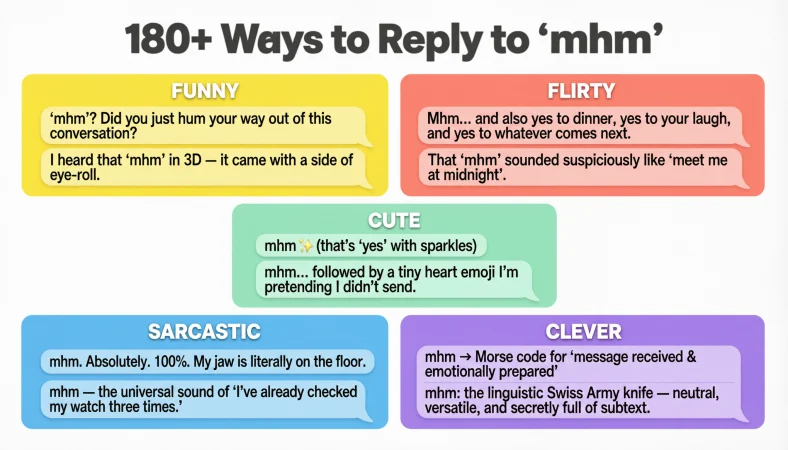
Quick Answer: “Mhm” can mean yes, I agree, I’m listening, or sometimes “I have absolutely no idea what to say.” The best reply depends on whether you want to be funny, flirty, playful, confident, or simply keep things moving.
Top alternatives: “That’s all I get?”, “You sure?”, “Use your words 😂”, “Mhm what?”, “I’ll take that as a yes.”
Few texts have the power to make you stare at your phone like “mhm.” It can be sweet, sarcastic, distracted, interested, or basically the texting equivalent of a shrug. Whether you get it from a friend, crush, partner, coworker, or someone sliding into your DMs, knowing what to say next can save the conversation from becoming a graveyard of one-word replies. The right response can turn a dry exchange into something funny, flirty, playful, or surprisingly meaningful. That is why having a few clever Replies to “mhm” ready can be seriously useful. You do not need to overthink it or send a paragraph worthy of a courtroom statement. Sometimes, one perfectly timed line is all it takes to bring the energy back.
Funny Responses
“That’s all I get? Mhm?”
Use this when their one-word reply feels hilariously underwhelming.
Meaning: You are playfully asking for more effort.
“Mhm detected. Conversation loading…”
Use this when the chat suddenly becomes suspiciously quiet.
Meaning: You are joking about the dry response.
“Please expand on this groundbreaking statement.”
Use this with a friend who loves giving short answers.
Meaning: You want them to elaborate in a playful way.
“Wow, Shakespeare has entered the chat.”
Use this when someone responds with maximum minimalism.
Meaning: You are teasing them for being unusually brief.
“Mhm? Fascinating. Truly inspiring.”
Use this when you want exaggerated sarcasm.
Meaning: You are jokingly pretending their reply was profound.
“Use your words, bestie.”
Use this when a friend sends a lazy one-word response.
Meaning: You want them to actually explain themselves.
“And the award for shortest reply goes to…”
Use this when their message is hilariously short.
Meaning: You are turning their dry reply into a joke.
“Mhm is doing a lot of heavy lifting today.”
Use this when they keep answering with the same word.
Meaning: You are playfully calling out the repetition.
“Okay, mysterious keyboard warrior.”
Use this when their response gives you nothing to work with.
Meaning: You are teasing their mysterious energy.
“I’ll need a translation for that.”
Use this when you are unsure what their “mhm” means.
Meaning: You are jokingly asking for clarification.
“Noted. Very detailed. Pulitzer-worthy.”
Use this when someone gives you an extremely short answer.
Meaning: You are using humor to call out the lack of detail.
“Mhm? Blink twice if you need help.”
Use this with someone who seems unusually quiet.
Meaning: You are joking about their suspiciously low energy.
Brutal Responses
“Mhm isn’t really giving conversation.”
Use this when you are tired of carrying the chat.
Meaning: You are directly pointing out their low effort.
“If you’re bored, you can just say that.”
Use this when their response feels dismissive.
Meaning: You are calling attention to their lack of interest.
“You seem very committed to one-word answers.”
Use this when the pattern keeps happening.
Meaning: You are confidently highlighting their dry texting.
“I can’t carry this conversation alone.”
Use this when you have been doing all the talking.
Meaning: You want mutual effort.
“That reply answered absolutely nothing.”
Use this when their response is too vague.
Meaning: You want a clearer answer.
“Mhm? That’s your contribution?”
Use this when their response feels lazy.
Meaning: You are challenging them to put in more effort.
“You could at least pretend to be interested.”
Use this when their tone feels particularly cold.
Meaning: You are expressing frustration.
“I asked for an answer, not a sound effect.”
Use this when you want a sharp comeback.
Meaning: You are jokingly criticizing the one-word reply.
“We’re really thriving on communication today.”
Use this when the conversation is painfully dry.
Meaning: You are sarcastically pointing out the problem.
“I’ll stop bothering you.”
Use this when you genuinely feel unwanted in the conversation.
Meaning: You are signaling that their lack of effort is affecting you.
“Your enthusiasm is overwhelming.”
Use this when they respond with obvious disinterest.
Meaning: You are using sarcasm to call out their attitude.
“Okay, I’ll let you get back to ignoring me.”
Use this when their replies consistently feel dismissive.
Meaning: You are making your disappointment clear.
Flirty Responses
“Mhm? Is that your way of flirting with me?”
Use this when the conversation already has romantic energy.
Meaning: You are playfully testing their intentions.
“You’re cute when you run out of words.”
Use this when their short reply seems shy.
Meaning: You are turning their awkwardness into flirtation.
“That sounded suspiciously interested.”
Use this after a teasing or romantic message.
Meaning: You are playfully suggesting they like what you said.
“Mhm right back at you, handsome.”
Use this when you want a simple flirty comeback.
Meaning: You are matching their energy with charm.
“That little ‘mhm’ was kinda cute.”
Use this when their reply feels shy or adorable.
Meaning: You are giving them a soft compliment.
“You could just admit you like me.”
Use this when there is obvious chemistry.
Meaning: You are teasing them about hidden feelings.
“Mhm sounds like someone agrees with me.”
Use this after making a confident statement.
Meaning: You are playfully claiming a win.
“Careful, that ‘mhm’ is making me smile.”
Use this when you want to show subtle interest.
Meaning: You are letting them know their attention affects you.
“Was that a shy yes?”
Use this when their message seems hesitant.
Meaning: You are giving their short reply a flirty interpretation.
“You’re gonna have to give me more than that, cutie.”
Use this when you want them to keep talking.
Meaning: You are asking for more attention in a playful way.
“Mhm? I think you meant ‘you’re right, I’m adorable.’”
Use this when you want confident teasing.
Meaning: You are playfully putting words in their mouth.
“That ‘mhm’ has me wondering what you’re really thinking.”
Use this when you want to create intrigue.
Meaning: You are inviting a deeper or flirtier response.
Polite Responses
“Got it, thanks for letting me know.”
Use this when you want to acknowledge their response politely.
Meaning: You are keeping the exchange respectful.
“Okay, understood.”
Use this in a simple everyday conversation.
Meaning: You are confirming that you understand.
“Alright, sounds good.”
Use this when their “mhm” confirms a plan.
Meaning: You are accepting their response positively.
“Thanks for confirming.”
Use this when the message involves a decision or arrangement.
Meaning: You appreciate the confirmation.
“Perfect, I appreciate it.”
Use this when their reply gives you the information you needed.
Meaning: You are responding warmly and courteously.
“Okay, no worries.”
Use this when you want to keep things relaxed.
Meaning: You are showing there is no problem.
“Sounds good to me.”
Use this when their response signals agreement.
Meaning: You are confirming that you are on the same page.
“Alright, noted.”
Use this when you simply want to acknowledge the message.
Meaning: You have received and understood it.
“Okay, thanks!”
Use this when you want to end the exchange naturally.
Meaning: You are keeping things friendly and simple.
“Gotcha.”
Use this when you want a casual but polite reply.
Meaning: You understand what they mean.
“Absolutely, understood.”
Use this when you want a slightly more polished tone.
Meaning: You are confirming their message clearly.
“Okay, I hear you.”
Use this when the conversation has a little more emotional weight.
Meaning: You are showing that you are listening.
Professional Responses
“Understood, thank you.”
Use this in a workplace chat where clarity matters.
Meaning: You acknowledge the information professionally.
“Thanks for confirming.”
Use this after someone confirms a task or detail.
Meaning: You are documenting agreement politely.
“Noted.”
Use this when you need a concise professional acknowledgment.
Meaning: You have received the information.
“Sounds good, thank you.”
Use this after agreeing to a workplace arrangement.
Meaning: You are confirming professionally.
“Understood. I’ll proceed accordingly.”
Use this when their response confirms your next step.
Meaning: You are showing that you know what to do next.
“Got it, thanks.”
Use this in a casual workplace conversation.
Meaning: You acknowledge the message without overexplaining.
“Thanks, I’ll keep that in mind.”
Use this when someone provides guidance or feedback.
Meaning: You appreciate the information.
“Acknowledged.”
Use this when you need an especially concise response.
Meaning: You confirm receipt.
“Perfect, I’ll take care of it.”
Use this when their message confirms an assigned task.
Meaning: You are accepting responsibility.
“Understood. Thanks for the update.”
Use this when responding to a status update.
Meaning: You acknowledge the information professionally.
“That works for me.”
Use this when their “mhm” confirms an arrangement.
Meaning: You agree with the proposed plan.
“Thanks for letting me know.”
Use this when their response provides useful information.
Meaning: You appreciate the update.
Creative Responses
“Mhm has entered its mysterious era.”
Use this when their reply feels intentionally vague.
Meaning: You are making their message sound dramatic and intriguing.
“That ‘mhm’ deserves its own documentary.”
Use this when their tone is unusually mysterious.
Meaning: You are exaggerating the importance of their reply for fun.
“One syllable, infinite possibilities.”
Use this when you want a clever response.
Meaning: You are joking about how many meanings “mhm” can have.
“Mhm, the plot thickens.”
Use this when the conversation is becoming interesting.
Meaning: You are playfully treating the reply like part of a story.
“I sense a plot twist coming.”
Use this when their short answer feels suspicious.
Meaning: You think there is more behind their response.
“That was cryptic.”
Use this when you cannot tell what they mean.
Meaning: You are asking them to clarify indirectly.
“Interesting choice of syllables.”
Use this when you want an unusual comeback.
Meaning: You are humorously analyzing their tiny response.
“Mhm has been received by headquarters.”
Use this when you want absurd humor.
Meaning: You are pretending their reply is official business.
“Message received, decoding now.”
Use this when their tone is unclear.
Meaning: You are jokingly trying to understand them.
“That response has layers.”
Use this when you suspect they mean more than they said.
Meaning: You are teasing them about hidden meaning.
“I shall ponder this powerful statement.”
Use this when you want dramatic humor.
Meaning: You are pretending their reply is deeply profound.
“Mhm. A classic. A timeless masterpiece.”
Use this when you want playful exaggeration.
Meaning: You are joking about the simplicity of their reply.
Sarcastic Responses
“Wow, such enthusiasm.”
Use this when their response sounds extremely dry.
Meaning: You are sarcastically pointing out their lack of energy.
“Glad we had this deep conversation.”
Use this when the exchange is going nowhere.
Meaning: You are joking about how little was said.
“Your vocabulary is thriving.”
Use this when they keep sending short replies.
Meaning: You are teasing their limited response.
“I’ll frame that response.”
Use this when they send an unusually short message.
Meaning: You are exaggerating its importance for comedy.
“Truly, the words are flowing today.”
Use this when someone is barely responding.
Meaning: You are sarcastically calling out their silence.
“I can feel the excitement through the screen.”
Use this when their tone is obviously flat.
Meaning: You are joking about their lack of enthusiasm.
“Thank you for the detailed analysis.”
Use this after an extremely short response.
Meaning: You are sarcastically pretending they gave a thorough answer.
“Mhm. Riveting stuff.”
Use this when you want a quick sarcastic comeback.
Meaning: You are pretending their reply was fascinating.
“Please, save some words for the rest of us.”
Use this when they send a one-word response.
Meaning: You are playfully mocking their brevity.
“You really went all out with that one.”
Use this when their response is hilariously minimal.
Meaning: You are exaggerating their effort sarcastically.
“I’ll need a moment to process all that.”
Use this when they say only “mhm.”
Meaning: You are joking about the tiny amount of information.
“That was a novel.”
Use this when you want absurd sarcasm.
Meaning: You are pretending their one-word reply was extremely long.
Cute Responses
“Mhm is kinda adorable coming from you.”
Use this when you genuinely find their reply cute.
Meaning: You are turning a simple message into a sweet moment.
“Okayyy, I hear you.”
Use this when you want a soft playful tone.
Meaning: You are acknowledging them warmly.
“Aww, tiny little ‘mhm.’”
Use this when you are teasing someone affectionately.
Meaning: You find their response endearing.
“That was cute.”
Use this after a shy or sweet message.
Meaning: You are giving them a small compliment.
“Okay, cutie.”
Use this when you want a short affectionate response.
Meaning: You are adding warmth and charm.
“Mhm right back, sunshine.”
Use this with someone you are close to.
Meaning: You are matching their energy affectionately.
“I’ll take that little mhm.”
Use this when their response seems sweet or shy.
Meaning: You are playfully accepting their answer.
“You make even ‘mhm’ sound cute.”
Use this when flirting gently.
Meaning: You are complimenting their personality.
“That little reply made me smile.”
Use this when their message genuinely brightened your mood.
Meaning: You are showing sincere affection.
“Okay, I’m keeping that one.”
Use this after a particularly adorable message.
Meaning: You want to remember the sweet moment.
“Mhm received with a smile.”
Use this when you want something wholesome.
Meaning: Their reply made you happy.
“You’re too cute sometimes.”
Use this when their short reply feels charming.
Meaning: You are expressing affectionate amusement.
Dramatic Responses
“MHM? After everything we’ve been through?”
Use this with a close friend for exaggerated drama.
Meaning: You are pretending their tiny reply is emotionally devastating.
“So this is how our conversation ends?”
Use this when the chat suddenly goes dry.
Meaning: You are playfully acting heartbroken.
“I expected more from this moment.”
Use this when their response disappoints you slightly.
Meaning: You are exaggerating your reaction for humor.
“My heart was not prepared for such brevity.”
Use this when you want theatrical humor.
Meaning: You are pretending the short reply deeply affected you.
“And just like that, the conversation vanished.”
Use this when their message kills the momentum.
Meaning: You are dramatically describing the awkward silence.
“I shall never recover from this mhm.”
Use this with someone who enjoys dramatic jokes.
Meaning: You are playfully pretending to be devastated.
“This is the plot twist I feared.”
Use this when their reply feels unexpected.
Meaning: You are turning a simple message into a dramatic event.
“The silence after that mhm is deafening.”
Use this when neither person knows what to say next.
Meaning: You are exaggerating the awkwardness.
“My expectations were higher than this.”
Use this when teasing someone about their effort.
Meaning: You wanted a more interesting reply.
“I thought we had something special.”
Use this when joking with a close friend.
Meaning: You are pretending their dry response betrayed you.
“A tragedy in one syllable.”
Use this when you want a dramatic one-liner.
Meaning: You are humorously describing the disappointing reply.
“Someone call the emotional support team.”
Use this when their response feels hilariously dry.
Meaning: You are exaggerating your reaction for laughs.
Chill And Casual Responses
“Mhm, fair.”
Use this when you simply agree with them.
Meaning: You accept what they said.
“Yeah, same.”
Use this when you share their opinion.
Meaning: You are casually agreeing.
“Gotcha.”
Use this when you want to keep things relaxed.
Meaning: You understand them.
“Cool, cool.”
Use this when you want a laid-back acknowledgment.
Meaning: Everything is fine.
“Okay then.”
Use this when you are casually accepting their response.
Meaning: You are moving the conversation along.
“Sounds good.”
Use this when their reply confirms something.
Meaning: You are comfortable with the situation.
“Fair enough.”
Use this when you accept their point.
Meaning: You respect their perspective.
“Yeah, I get you.”
Use this when you understand what they mean.
Meaning: You are showing casual empathy.
“No worries.”
Use this when you want to keep things easygoing.
Meaning: There is no issue.
“Alrighty.”
Use this when you want a playful casual acknowledgment.
Meaning: You are keeping the tone light.
“Yep, got it.”
Use this when you want to confirm understanding.
Meaning: You have received the message.
“Cool, we’re good.”
Use this when the conversation involves a minor issue.
Meaning: You are reassuring them that everything is fine.
Confident Responses
“I’ll take that as agreement.”
Use this when their “mhm” clearly sounds like a yes.
Meaning: You are confidently interpreting their response.
“Knew you’d agree.”
Use this when you expected them to support your point.
Meaning: You are playfully showing confidence.
“Exactly what I thought.”
Use this when their reply proves your point.
Meaning: You feel validated.
“Glad we’re on the same page.”
Use this when they agree with you.
Meaning: You appreciate the shared understanding.
“That’s what I like to hear.”
Use this when their response confirms something positive.
Meaning: You are confidently pleased with their answer.
“I’ll count that as a yes.”
Use this when you want a bold interpretation.
Meaning: You are treating their response as agreement.
“Good choice.”
Use this when they agree with your suggestion.
Meaning: You are playfully confident in your opinion.
“See? You know I’m right.”
Use this after winning a playful debate.
Meaning: You are celebrating being proven correct.
“We understand each other.”
Use this when their reply shows agreement.
Meaning: You feel connected and aligned.
“I knew you had good taste.”
Use this when they agree with something you like.
Meaning: You are adding confident playful charm.
“Exactly. No notes.”
Use this when their response confirms your point.
Meaning: You are confidently closing the topic.
“That’s the energy I expected.”
Use this when they respond positively.
Meaning: You are showing approval and confidence.
Emotional Responses
“I hope that means you understand.”
Use this after sharing something personal.
Meaning: You want reassurance that your feelings were heard.
“I just wanted to know you were listening.”
Use this when the conversation is emotionally important.
Meaning: You value their attention.
“That means more than you know.”
Use this when their response gives you comfort.
Meaning: You appreciate their support deeply.
“Okay, I’m glad you understand.”
Use this after explaining your feelings.
Meaning: You feel relieved to be understood.
“I appreciate you hearing me out.”
Use this after discussing something difficult.
Meaning: You are grateful for their patience.
“I really needed you to hear that.”
Use this when you have opened up emotionally.
Meaning: Their acknowledgment matters to you.
“Thank you for staying with me through that.”
Use this after a vulnerable conversation.
Meaning: You appreciate their emotional presence.
“I know it’s a lot, but thank you.”
Use this when sharing something complicated.
Meaning: You recognize their patience and support.
“That little reply actually reassured me.”
Use this when their “mhm” feels comforting.
Meaning: Their acknowledgment helped you feel secure.
“I’m glad we can understand each other.”
Use this after resolving an emotional issue.
Meaning: You value mutual understanding.
“I just want us to be honest with each other.”
Use this when the conversation involves feelings.
Meaning: You want genuine communication.
“That’s all I needed to know.”
Use this when their response gives you emotional clarity.
Meaning: You feel satisfied with their acknowledgment.
Sweet Responses
“Mhm, and I’m glad you’re here.”
Use this with someone you care about.
Meaning: You are expressing appreciation for their presence.
“You always know how to make me smile.”
Use this when their response feels comforting.
Meaning: Their attention positively affects you.
“I’m happy we understand each other.”
Use this after a meaningful exchange.
Meaning: You value your connection.
“That’s enough for me.”
Use this when their acknowledgment reassures you.
Meaning: Their simple response is meaningful.
“Thanks for listening to me.”
Use this after sharing something important.
Meaning: You appreciate their attention.
“You’re sweet, you know that?”
Use this when their reply feels caring.
Meaning: You are giving them an affectionate compliment.
“I appreciate you.”
Use this when you want to keep things sincere.
Meaning: You are expressing genuine gratitude.
“That little mhm made me happy.”
Use this when their response feels reassuring.
Meaning: Their acknowledgment brought you comfort.
“I’m glad I can talk to you.”
Use this when the conversation feels supportive.
Meaning: You trust and value their presence.
“You make conversations feel easy.”
Use this when talking to someone you are comfortable with.
Meaning: You appreciate the connection.
“Thanks for being you.”
Use this when you want a heartfelt message.
Meaning: You value them for who they are.
“I’m lucky to have you around.”
Use this with a close friend or loved one.
Meaning: You feel grateful for the relationship.
Clever Responses
“Mhm is vague, but I respect the commitment.”
Use this when their answer could mean several things.
Meaning: You are playfully acknowledging the ambiguity.
“Context clues suggest you agree.”
Use this when you think their reply means yes.
Meaning: You are humorously analyzing their message.
“Interesting. I’ll file that under ‘probably yes.’”
Use this when their answer is unclear.
Meaning: You are making a playful assumption.
“That’s one way to use the English language.”
Use this when they send a very short reply.
Meaning: You are teasing their minimal effort.
“Mhm: the universal language of uncertainty.”
Use this when you cannot tell what they mean.
Meaning: You are joking about the ambiguity.
“I detect agreement with a hint of mystery.”
Use this when their tone seems playful.
Meaning: You are giving their reply a clever interpretation.
“Translation accepted.”
Use this when you understand their “mhm.”
Meaning: You are humorously treating it like another language.
“Noted with absolutely zero context.”
Use this when their answer is vague.
Meaning: You want more information.
“A fascinating linguistic development.”
Use this when you want intellectual-style humor.
Meaning: You are exaggerating the importance of one word.
“I’ll interpret that accordingly.”
Use this when you want a confident clever reply.
Meaning: You are pretending their answer was perfectly clear.
“That was concise. I’ll give you that.”
Use this when they are unusually brief.
Meaning: You are acknowledging their minimalism with humor.
“Mhm has officially entered evidence.”
Use this when their reply proves your playful point.
Meaning: You are jokingly treating their message like proof.
Playful Responses
“Mhm what? Finish the thought.”
Use this when you want to keep the conversation moving.
Meaning: You are inviting them to say more.
“Okay, now give me the director’s commentary.”
Use this when their reply leaves you curious.
Meaning: You want the details behind their answer.
“I need more information, detective.”
Use this when their response is too vague.
Meaning: You are asking for clarification playfully.
“That sounded suspicious.”
Use this when their tone seems questionable.
Meaning: You are teasing them about hidden meaning.
“You’re being mysterious again.”
Use this when they often give vague answers.
Meaning: You want them to explain themselves.
“Don’t leave me hanging like that.”
Use this when their reply ends the momentum.
Meaning: You want the conversation to continue.
“Okay, but what does that really mean?”
Use this when you genuinely need clarification.
Meaning: You want a more direct answer.
“I’m listening, keep going.”
Use this when you want them to elaborate.
Meaning: You are encouraging them to continue.
“Mhm noted, but I have questions.”
Use this when their response creates curiosity.
Meaning: You want more details.
“And what exactly are we agreeing to?”
Use this when “mhm” could be interpreted several ways.
Meaning: You want clarity before assuming anything.
“You can’t just drop an mhm and disappear.”
Use this when they stop replying afterward.
Meaning: You are playfully asking them to continue.
“Okay, mysterious one, explain.”
Use this when you want a playful clarification.
Meaning: You are encouraging them to open up.
Romantic Responses
“Mhm, come closer then.”
Use this when the conversation is openly romantic.
Meaning: You are responding with affectionate confidence.
“I like hearing you agree with me.”
Use this when you are playfully taking the lead.
Meaning: You enjoy their attention and agreement.
“That little mhm was dangerously cute.”
Use this when their reply feels charming.
Meaning: You are mixing affection with flirtation.
“You know exactly what you’re doing.”
Use this when their short response feels intentionally teasing.
Meaning: You suspect they are flirting.
“That sounded like a yes to me.”
Use this when you want to move the flirting forward.
Meaning: You are confidently interpreting their response.
“Keep talking, I like your attention.”
Use this when you want more engagement.
Meaning: You enjoy having their focus.
“Mhm? I’ll remember that.”
Use this when they agree to something romantic or playful.
Meaning: You are teasing them about their commitment.
“You make one word sound dangerous.”
Use this when the chemistry is strong.
Meaning: Their simple response feels flirtatious.
“I’m smiling at my phone now, thanks.”
Use this when their message makes you happy.
Meaning: You are admitting their effect on you.
“Okay, now you’re making me curious.”
Use this when their reply feels suggestive.
Meaning: You want them to reveal more.
“I think that mhm means you’re into this.”
Use this when flirting is already mutual.
Meaning: You are playfully calling out their interest.
“You’re cute when you’re being mysterious.”
Use this when their short answer feels intentionally coy.
Meaning: You find their teasing attractive.
Casual Questions To Keep It Going
“Mhm, but what do you think?”
Use this when you want their actual opinion.
Meaning: You are encouraging a fuller answer.
“Okay, and then what?”
Use this when their response comes after a story.
Meaning: You want them to continue.
“So what’s your plan?”
Use this when discussing upcoming events.
Meaning: You want to keep the topic moving.
“And how do you feel about it?”
Use this when their response seems emotionally loaded.
Meaning: You are asking for their perspective.
“You sure about that?”
Use this when their “mhm” sounds uncertain.
Meaning: You want confirmation.
“What are you thinking?”
Use this when you sense there is more behind the reply.
Meaning: You want them to open up.
“Okay, tell me more.”
Use this when you want a deeper conversation.
Meaning: You are showing genuine interest.
“What happened next?”
Use this when they are telling you a story.
Meaning: You want to hear the rest.
“Why the tiny response?”
Use this when their message feels unusually short.
Meaning: You are checking their mood.
“Everything good?”
Use this when they suddenly become less talkative.
Meaning: You are checking whether something is wrong.
“You seem quiet today.”
Use this when their energy feels different.
Meaning: You have noticed a change in their tone.
“Want to elaborate?”
Use this when you want a direct explanation.
Meaning: You are inviting them to provide more detail.
Clever Boundary Setting Responses
“I’m happy to continue when you feel like talking.”
Use this when someone seems distracted or uninterested.
Meaning: You are giving them space without chasing.
“No pressure, just let me know.”
Use this when you need a clear answer later.
Meaning: You are staying relaxed while asking for communication.
“I’ll take the hint if you need space.”
Use this when their short replies feel intentional.
Meaning: You are respecting their possible need for distance.
“If now isn’t a good time, that’s okay.”
Use this when their response seems distracted.
Meaning: You are allowing them to communicate honestly.
“I’d rather have a real answer.”
Use this when the topic actually matters.
Meaning: You value honest communication over vague replies.
“You can tell me if you’re not in the mood to talk.”
Use this when you sense emotional distance.
Meaning: You are encouraging directness.
“I don’t want to guess what you mean.”
Use this when their “mhm” is confusing.
Meaning: You need clearer communication.
“Just be honest with me.”
Use this when the conversation feels uncertain.
Meaning: You want sincerity.
“I’m not going to force a conversation.”
Use this when you feel you are doing all the work.
Meaning: You are setting a healthy boundary.
“We can talk when you’re ready.”
Use this when someone seems emotionally unavailable.
Meaning: You are offering space without pressure.
“I respect your silence, but clarity helps.”
Use this when you need more direct communication.
Meaning: You are balancing patience with your need for clarity.
“Let’s talk when we can both actually be present.”
Use this when the conversation deserves attention.
Meaning: You want meaningful communication rather than forced replies.
FAQs
What Does “Mhm” Mean In Texting?
“Mhm” usually means yes, agreement, acknowledgment, or “I’m listening,” but its exact meaning depends heavily on the context and tone.
Can “Mhm” Be Flirty?
Yes. In a flirty conversation, “mhm” can sound shy, teasing, suggestive, or quietly interested, especially when paired with playful messages.
What Does “Mhm” Mean From A Crush?
It can mean they agree, are listening, feel shy, or simply do not know what else to say. Look at the overall conversation instead of relying on one word.
Is “Mhm” Rude?
Not necessarily. It can be completely normal in casual texting, but repeated one-word replies may feel dismissive if the other person never adds anything to the conversation.
What Is A Good Reply To “Mhm”?
Try “That’s all I get?”, “Use your words 😂”, “You sure?”, “Tell me more,” or “I’ll take that as a yes.”
What If I Do Not Actually Want To Continue The Conversation?
Keep it simple with “Gotcha”, “Okay, no worries,” or “Alright, talk later.” You do not have to force a conversation.
Can I Use Humor When Someone Says “Mhm”?
Absolutely. Humor works especially well with friends, close relationships, and playful conversations. Avoid overly sarcastic replies when the other person may be upset.
What Is A Professional Response To “Mhm”?
Use simple acknowledgments such as “Understood,” “Thanks for confirming,” or “Noted.” Keep workplace replies clear and respectful.
How Do I Know If “Mhm” Means They Are Annoyed?
Look for context. Short replies combined with delayed responses, cold wording, or a noticeable change in their normal texting style may suggest irritation.
Should I Match Their Energy?
Usually, yes. If someone consistently gives short replies, you can keep your response brief instead of doing all the conversational heavy lifting.
Conclusion
“Mhm” may be only one tiny word, but your response can completely change where the conversation goes next. You can turn it into a joke, add some flirtation, ask for clarity, keep things casual, or simply move on without making things awkward. The trick is to match the mood instead of forcing a response that does not fit. If they are playful, play along. If they are quiet, give them space. If they are flirty, return the energy. And if they are giving you absolutely nothing, remember that you do not have to carry the entire chat. Save these replies for your next dry-texting moment, share your favorites, and keep those conversations alive.