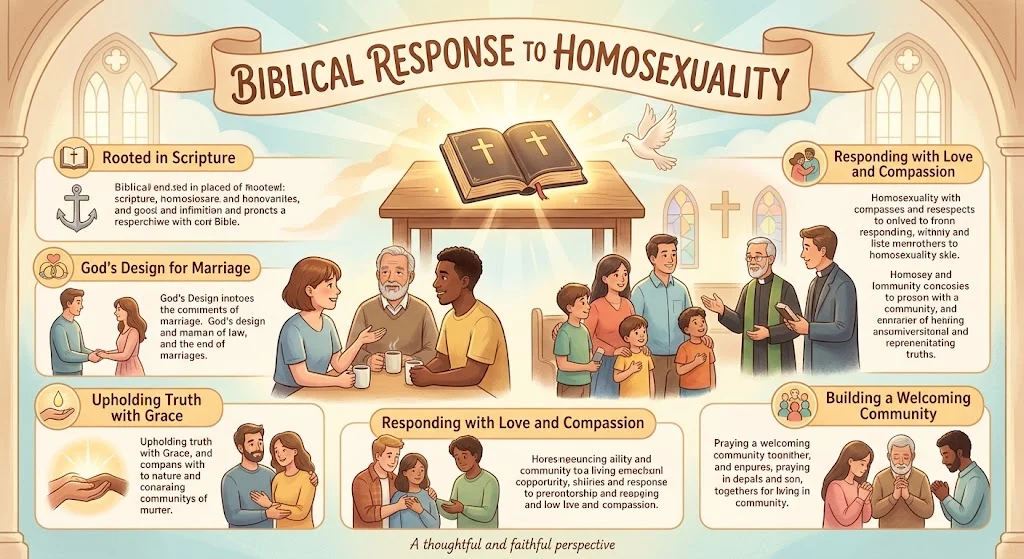
Quick Answer:“Let’s look at Scripture in context,” “Speak the truth with love,” “Grace and truth belong together,” “Let’s discuss this respectfully,” “God calls us to love our neighbor”
A biblical response to homosexuality can acknowledge Scripture while keeping the conversation respectful, compassionate, and free from personal attacks. Christians interpret the relevant passages differently, so a thoughtful response can focus on biblical context, love, grace, and respectful dialogue.
When conversations about faith and sexuality appear in texts, DMs, church groups, family chats, or comment sections, things can get awkward very quickly. One person may quote a Bible verse, another may bring up love and grace, and suddenly the group chat feels like a theology seminar nobody scheduled.
That is why knowing how to give a biblical response to homosexuality can be useful. The Bible contains passages commonly discussed in Christian conversations about same-sex sexual behavior, including Leviticus 18:22, Romans 1:26-27, and 1 Corinthians 6:9-11. At the same time, Christians differ in how they interpret these passages and apply them today. A good response should therefore communicate your convictions without turning another person into the target of a personal attack. Whether you want something thoughtful, gentle, confident, formal, or short enough for a comment section, the following responses give you plenty of options.
Compassionate Biblical Responses
“I want to follow Scripture while treating every person with dignity.”
Use this when discussing faith with someone who feels personally affected by the topic.
Meaning: Your biblical convictions are paired with respect for people.
“My faith calls me to speak truth with love.”
Use this when you want to emphasize both conviction and kindness.
Meaning: You believe truth should be communicated compassionately.
“I can hold a biblical conviction without treating someone disrespectfully.”
Use this when a discussion becomes personal.
Meaning: Belief and personal hostility do not have to go together.
“Jesus taught His followers to love their neighbors.”
Use this when reminding someone that Christian conduct includes love.
Meaning: You are emphasizing a central Christian ethical principle.
“I would rather have a respectful conversation than win an argument.”
Use this when a discussion starts becoming heated.
Meaning: Relationship and understanding matter more than debate points.
“Scripture should lead us toward humility, not arrogance.”
Use this when someone sounds overly judgmental.
Meaning: You are encouraging humility while discussing biblical teachings.
“We can disagree about interpretation without attacking each other.”
Use this when two people have different theological views.
Meaning: Disagreement does not require hostility.
“My goal is to represent my faith with grace.”
Use this when explaining your approach.
Meaning: You want your conduct to reflect your Christian beliefs.
“People deserve kindness even when beliefs differ.”
Use this when discussing disagreements with friends.
Meaning: Respect should remain present despite theological differences.
“I want my words to reflect both conviction and compassion.”
Use this when preparing for a sensitive conversation.
Meaning: You want to balance belief with empathy.
“Faith should never become an excuse for cruelty.”
Use this when confronting unnecessarily harsh language.
Meaning: Religious conviction should not justify mistreatment.
“I am comfortable discussing Scripture without attacking anyone personally.”
Use this when setting the tone for a conversation.
Meaning: You want the discussion focused on ideas rather than people.
Gentle Responses
“I understand why this is a sensitive subject.”
Use this when someone shares a personal perspective.
Meaning: You are acknowledging the emotional weight of the conversation.
“I appreciate you sharing your perspective.”
Use this when someone explains their beliefs.
Meaning: You are responding respectfully without necessarily agreeing.
“Can we look at the biblical passages together?”
Use this when someone makes a Scripture-based claim.
Meaning: You want the discussion grounded in the text.
“I think context matters when reading difficult passages.”
Use this when discussing biblical interpretation.
Meaning: You believe individual verses should be considered within their surrounding context.
“We may understand these passages differently.”
Use this when theological interpretations diverge.
Meaning: You recognize disagreement without hostility.
“I would rather ask questions than make assumptions.”
Use this when a conversation feels uncertain.
Meaning: You prefer understanding before judging.
“There is room for respectful disagreement here.”
Use this when a discussion becomes tense.
Meaning: Different conclusions can be discussed peacefully.
“Let’s keep the conversation centered on Scripture.”
Use this when personal accusations appear.
Meaning: You want the discussion to remain focused on theology.
“I hear what you are saying.”
Use this when acknowledging another person’s viewpoint.
Meaning: You are showing that you listened.
“This deserves a thoughtful conversation.”
Use this when the topic is being treated casually.
Meaning: You believe the issue requires care.
“I do not want this conversation to become hurtful.”
Use this when emotions start rising.
Meaning: You are establishing a respectful boundary.
“We can talk about difficult beliefs without being unkind.”
Use this when setting expectations.
Meaning: Hard conversations can remain compassionate.
Scripture-Focused Responses
“Leviticus 18:22 is one of the passages Christians commonly discuss on this subject.”
Use this when someone asks which biblical passages are relevant.
Meaning: You are pointing to a commonly cited Old Testament passage.
“Romans 1:26-27 is another frequently discussed passage.”
Use this when the conversation turns toward New Testament teaching.
Meaning: You are identifying a major text used in this theological discussion.
“First Corinthians 6:9-11 is also important to the discussion.”
Use this when someone asks about Paul’s writings.
Meaning: You are directing attention to another commonly cited passage.
“The surrounding verses deserve attention too.”
Use this when someone quotes only one sentence.
Meaning: You want the passage considered within its broader context.
“A single verse should not automatically end the conversation.”
Use this when people disagree about interpretation.
Meaning: Biblical interpretation can require broader contextual study.
“Translation choices can affect how certain passages are understood.”
Use this when discussing different Bible versions.
Meaning: Wording can vary among translations.
“The original historical context is worth examining.”
Use this when a conversation becomes overly simplistic.
Meaning: Background can help explain how a passage was understood.
“The Bible contains more than one passage relevant to this discussion.”
Use this when someone presents only one reference.
Meaning: The topic involves multiple texts.
“First Corinthians 6 also places these references within a larger list of behaviors.”
Use this when discussing Paul’s passage carefully.
Meaning: The passage addresses multiple categories of conduct.
“Romans 1 connects the discussion with a larger argument about humanity, worship, and sin.”
Use this when discussing context.
Meaning: The passage has a broader argument beyond one isolated phrase.
“I would rather study the whole passage than debate one sentence.”
Use this when a discussion becomes overly focused on quotations.
Meaning: You prefer comprehensive biblical reading.
“Let’s compare translations and context before reaching conclusions.”
Use this when someone makes a strong claim about wording.
Meaning: You want a more careful approach to biblical interpretation.
Grace And Truth Responses
“Grace does not require me to abandon my convictions.”
Use this when someone assumes kindness means agreement.
Meaning: You believe compassion and conviction can coexist.
“Truth without love can become unnecessarily harsh.”
Use this when discussing Christian communication.
Meaning: You believe truth should be communicated compassionately.
“Love does not mean pretending Scripture says something it does not.”
Use this when discussing biblical convictions.
Meaning: You want honesty about your interpretation of Scripture.
“I want both grace and truth in this conversation.”
Use this when balancing compassion and conviction.
Meaning: You are intentionally seeking both qualities.
“My goal is not condemnation; it is faithful conversation.”
Use this when someone assumes hostile intent.
Meaning: You want to discuss belief without personally attacking anyone.
“Christianity calls me to examine my own heart too.”
Use this when the conversation becomes focused entirely on others.
Meaning: You believe self-reflection is part of Christian discipleship.
“Conviction should make us humble.”
Use this when someone becomes self-righteous.
Meaning: Strong beliefs should encourage humility.
“I can disagree without demeaning someone.”
Use this when setting a personal boundary.
Meaning: Theological disagreement does not justify insults.
“Grace changes how we communicate difficult truths.”
Use this when discussing sensitive subjects.
Meaning: Your delivery should reflect compassion.
“I want my faith to be recognizable through my character.”
Use this when explaining your approach.
Meaning: Conduct matters alongside doctrine.
“Being firm does not require being cruel.”
Use this when someone confuses confidence with hostility.
Meaning: Strong convictions can still be expressed respectfully.
“I would rather reflect Christ than score a debate point.”
Use this when ending an argument.
Meaning: Christian character matters more than winning.
Respectful Responses
“I respect you even if we reach different conclusions.”
Use this with someone who holds another interpretation.
Meaning: You separate personal respect from theological agreement.
“We can disagree without making this personal.”
Use this when someone becomes confrontational.
Meaning: You want the discussion focused on ideas.
“I am willing to listen if you are willing to listen too.”
Use this when both sides want dialogue.
Meaning: You are asking for mutual respect.
“Let’s avoid assumptions about each other.”
Use this when the discussion becomes generalized.
Meaning: You want to prevent unfair judgments.
“Your perspective deserves to be heard.”
Use this when someone feels dismissed.
Meaning: You are recognizing their right to explain their view.
“My interpretation comes from how I understand Scripture.”
Use this when explaining your own position.
Meaning: You are presenting your belief as an interpretation rather than an attack.
“I do not expect everyone to share my theology.”
Use this when discussing faith with diverse friends.
Meaning: You recognize religious diversity.
“We can keep this conversation respectful.”
Use this when the tone begins deteriorating.
Meaning: You are establishing a standard for dialogue.
“I am happy to discuss the Bible, not insult people.”
Use this when someone introduces personal attacks.
Meaning: You are drawing a clear conversational boundary.
“Let’s focus on what the text says and how we understand it.”
Use this during theological disagreement.
Meaning: You want to keep the discussion evidence-based.
“Different interpretations exist, and we can discuss them honestly.”
Use this when acknowledging Christian disagreement.
Meaning: You recognize diversity in interpretation.
“Respect should remain part of the conversation.”
Use this when a discussion becomes emotionally charged.
Meaning: You want civility to continue.
Calm Responses
“Let’s slow down and look at the context.”
Use this when people are reacting quickly online.
Meaning: You want a calmer and more informed discussion.
“There is no need to turn this into a fight.”
Use this when an argument starts escalating.
Meaning: You are encouraging de-escalation.
“We can talk about theology without raising the temperature.”
Use this when emotions are high.
Meaning: You want a peaceful conversation.
“I would rather understand your view than argue with a caricature of it.”
Use this when both sides misunderstand each other.
Meaning: You want to engage with the actual argument.
“Let’s take the emotional language out of it.”
Use this when comments become inflammatory.
Meaning: You want a more objective discussion.
“A calm conversation can still be a serious one.”
Use this when someone thinks gentleness means weakness.
Meaning: Respectful dialogue can address difficult issues.
“We have plenty of time to discuss this thoughtfully.”
Use this when someone demands an immediate answer.
Meaning: You prefer careful reflection.
“I would rather respond thoughtfully than react quickly.”
Use this when receiving a provocative message.
Meaning: You value consideration over impulse.
“Let’s separate Scripture from assumptions.”
Use this when unsupported claims appear.
Meaning: You want biblical text distinguished from personal interpretation.
“There is no prize for the loudest theological opinion.”
Use this as a light but firm response.
Meaning: Volume does not make an argument stronger.
“We can disagree and still leave the conversation with dignity.”
Use this when ending a difficult discussion.
Meaning: Respect can remain even without agreement.
“Peaceful dialogue is still possible.”
Use this when the conversation seems divided.
Meaning: You are encouraging continued respectful communication.
Confident Faith-Based Responses
“I know what my faith teaches, and I want to communicate it respectfully.”
Use this when someone challenges your Christian convictions.
Meaning: You are confident without being aggressive.
“My beliefs come from my reading of Scripture, not from hostility toward people.”
Use this when someone questions your motives.
Meaning: You distinguish theological belief from personal animosity.
“I can explain my beliefs without attacking yours.”
Use this when discussing different religious interpretations.
Meaning: Confidence does not require hostility.
“I do not need insults to defend my faith.”
Use this when a conversation becomes combative.
Meaning: You prefer reasoned discussion.
“My conviction does not give me permission to mistreat anyone.”
Use this when discussing Christian behavior.
Meaning: Personal conduct remains important.
“I am willing to stand by my interpretation while hearing another perspective.”
Use this when someone disagrees with you.
Meaning: You are confident and open to dialogue.
“I do not confuse disagreement with disrespect.”
Use this when someone assumes disagreement means hatred.
Meaning: Different beliefs can coexist with civility.
“I can say what I believe without pretending everyone must agree.”
Use this when explaining your position.
Meaning: You are expressing belief without demanding uniformity.
“My faith calls me to conviction and humility.”
Use this when explaining your approach.
Meaning: You want confidence balanced by humility.
“I would rather explain my beliefs than attack someone else.”
Use this when responding to criticism.
Meaning: You want the conversation centered on your own convictions.
“I am not afraid of respectful questions.”
Use this when someone wants to understand your beliefs.
Meaning: You welcome sincere discussion.
“Strong faith does not need hostile language.”
Use this when someone suggests aggression proves conviction.
Meaning: You believe confidence can remain peaceful.
Short Responses
“Let’s look at Scripture.”
Use this when someone asks for a biblical perspective.
Meaning: You want the Bible to be central to the discussion.
“Context matters.”
Use this when someone quotes a passage without background.
Meaning: Biblical passages should be considered in context.
“Let’s keep it respectful.”
Use this when a conversation becomes heated.
Meaning: You are asking for civility.
“Grace matters too.”
Use this when someone focuses only on condemnation.
Meaning: You want compassion included in the discussion.
“Love your neighbor.”
Use this when emphasizing Christian ethics.
Meaning: You are highlighting a foundational Christian command.
“Let’s discuss, not attack.”
Use this when someone becomes hostile.
Meaning: You want dialogue instead of personal conflict.
“I follow my understanding of Scripture.”
Use this when stating your personal conviction.
Meaning: You are explaining the source of your belief.
“We can disagree respectfully.”
Use this when another person holds a different view.
Meaning: You accept theological disagreement without hostility.
“Read the whole passage.”
Use this when someone relies on a single verse.
Meaning: You want broader context considered.
“Humility belongs here.”
Use this when both sides become overly certain.
Meaning: You are encouraging a less combative tone.
“Faith should shape our character too.”
Use this when discussing Christian conduct.
Meaning: Belief should influence how people treat others.
“No personal attacks.”
Use this when setting a boundary in a debate.
Meaning: You are asking everyone to focus on ideas.
Thoughtful Responses
“How we interpret a biblical passage matters as much as quoting it.”
Use this when discussing competing interpretations.
Meaning: Interpretation requires more than simply citing a verse.
“The surrounding argument can change how a passage is understood.”
Use this when discussing Romans or Corinthians.
Meaning: Context can influence interpretation.
“Biblical discussions deserve more than social-media sound bites.”
Use this when online debates become oversimplified.
Meaning: Complex theology deserves careful consideration.
“It is worth asking what the original audience would have understood.”
Use this when discussing historical context.
Meaning: Historical background can inform interpretation.
“Different Christians approach these passages differently.”
Use this when acknowledging theological diversity.
Meaning: Christianity contains differing interpretations of the relevant texts.
“A respectful question can be more useful than a quick accusation.”
Use this when a conversation becomes hostile.
Meaning: Curiosity can create better dialogue.
“The conversation should include both biblical text and its context.”
Use this when someone relies on isolated quotations.
Meaning: Text and context should be considered together.
“Personal experience can influence how people hear theological language.”
Use this when discussing emotionally sensitive conversations.
Meaning: People may experience religious discussions differently.
“We should be careful about claiming certainty where interpretation is debated.”
Use this when discussing disputed theological conclusions.
Meaning: Not every interpretive question has universal agreement.
“Christian ethics includes how we treat people who disagree with us.”
Use this when discussing conduct.
Meaning: The manner of disagreement is itself morally relevant.
“A serious biblical discussion should leave room for honest questions.”
Use this when someone feels unable to ask questions.
Meaning: Inquiry can be part of sincere faith.
“The goal should be understanding, not humiliation.”
Use this when a debate becomes personal.
Meaning: A productive conversation should preserve dignity.
Family And Friends Responses
“I know this topic matters to you, so I want to answer respectfully.”
Use this when discussing sexuality and faith with family.
Meaning: You are showing care before expressing your view.
“I love you, even when we do not see every issue the same way.”
Use this when talking with someone close to you.
Meaning: Personal love is not dependent on theological agreement.
“Our relationship matters more to me than winning an argument.”
Use this when family discussions become tense.
Meaning: You value the relationship over debate victory.
“Can we talk about what the Bible means to each of us?”
Use this when both people have different Christian perspectives.
Meaning: You are inviting mutual understanding.
“I want you to feel heard, even if I disagree.”
Use this when someone shares a different interpretation.
Meaning: Listening does not require agreement.
“I am not trying to judge your entire life.”
Use this when someone feels personally attacked.
Meaning: You are narrowing the conversation to the theological issue.
“Let’s not let one disagreement define our relationship.”
Use this when the subject threatens a friendship.
Meaning: A theological disagreement does not have to destroy personal connection.
“I would rather keep talking than shut each other out.”
Use this when communication becomes difficult.
Meaning: You want continued relationship and dialogue.
“I can respect your experience while explaining my beliefs.”
Use this when personal experiences differ.
Meaning: You can acknowledge someone’s experience without abandoning your own convictions.
“We do not have to solve everything in one conversation.”
Use this when emotions become intense.
Meaning: Sensitive discussions can happen gradually.
“I care about you, and that is why I want to speak carefully.”
Use this when having a difficult conversation.
Meaning: Your careful wording comes from concern.
“Let’s leave room for love even when the theology is complicated.”
Use this when trying to preserve family harmony.
Meaning: Compassion can remain central during disagreement.
Social Media Responses
“Faith discussions need context, not just screenshots.”
Use this when responding to a viral Bible quote.
Meaning: A single screenshot may not capture the full context.
“You can discuss Scripture without attacking people.”
Use this when a comment section becomes hostile.
Meaning: Biblical debate should remain respectful.
“A Bible verse deserves more than a one-line interpretation.”
Use this when someone makes an absolute claim from a short quotation.
Meaning: Interpretation can require deeper study.
“Let’s keep theology and personal insults in separate tabs.”
Use this as a playful comment-section response.
Meaning: You want the discussion focused on theology rather than attacks.
“Strong opinions still need thoughtful context.”
Use this when someone posts an absolute statement.
Meaning: Confidence does not replace careful interpretation.
“The comment section is not a substitute for studying Scripture.”
Use this when an online debate becomes chaotic.
Meaning: Social-media arguments have limitations.
“Read the passage, check the context, then comment.”
Use this as a concise educational response.
Meaning: You encourage people to research before reacting.
“Theology can be serious without becoming hostile.”
Use this when responding to heated posts.
Meaning: Serious beliefs can be discussed peacefully.
“Not every disagreement needs a winner.”
Use this when a debate becomes competitive.
Meaning: Understanding can matter more than victory.
“Grace belongs in the comment section too.”
Use this when discussions become harsh.
Meaning: Christian compassion should extend to online conversations.
“Different interpretations do not require personal attacks.”
Use this when responding to divisive comments.
Meaning: Theological diversity can be discussed respectfully.
“If we are talking about faith, let’s act like it matters.”
Use this when encouraging respectful behavior.
Meaning: The tone of a faith discussion should reflect its seriousness.
Balanced Responses
“Some Christians interpret these passages as prohibiting same-sex sexual behavior, while others interpret them differently.”
Use this when explaining Christian disagreement.
Meaning: You are acknowledging different theological readings without declaring a winner.
“The relevant biblical passages include both Old and New Testament texts.”
Use this when explaining the scope of the discussion.
Meaning: The topic is not based on one isolated biblical reference.
“Leviticus, Romans, and First Corinthians are commonly discussed in this debate.”
Use this when someone asks where the discussion comes from.
Meaning: These are among the biblical texts frequently examined.
“Christians can agree that Scripture matters while disagreeing about interpretation.”
Use this when speaking with Christians who hold different views.
Meaning: Shared commitment to Scripture does not guarantee identical conclusions.
“The words used in different Bible translations can influence how readers understand a passage.”
Use this when comparing translations.
Meaning: Translation differences can affect interpretation.
“Historical and linguistic context can be important when studying ancient texts.”
Use this when discussing interpretation.
Meaning: Modern readers benefit from understanding the original setting.
“A respectful discussion should distinguish biblical text from personal opinion.”
Use this in a theological debate.
Meaning: People should identify when they are interpreting rather than quoting.
“It is possible to discuss disagreement without reducing people to a label.”
Use this when a conversation becomes personal.
Meaning: A person’s identity should not be reduced to one debate.
“Faith conversations work better when people listen as well as speak.”
Use this when encouraging dialogue.
Meaning: Mutual listening improves understanding.
“The topic involves theology, interpretation, history, and personal experience.”
Use this when someone expects an instant answer.
Meaning: Multiple dimensions can shape the discussion.
“A balanced response can acknowledge conviction while preserving human dignity.”
Use this when discussing sensitive issues.
Meaning: Beliefs and respectful treatment can coexist.
“The most useful conversations make room for both questions and convictions.”
Use this when facilitating dialogue.
Meaning: People can hold beliefs while continuing to ask sincere questions.
Loving Responses
“I believe love should remain at the center of every difficult conversation.”
Use this when discussing faith with someone you care about.
Meaning: Compassion is central to your communication.
“You deserve to be treated with dignity, even when we disagree.”
Use this when speaking to someone with different beliefs.
Meaning: Personal dignity is not conditional on agreement.
“I want to show kindness without pretending I believe something different.”
Use this when explaining your position.
Meaning: You are combining honesty with compassion.
“My faith teaches me to care about people, not just arguments.”
Use this when conversations become debate-focused.
Meaning: Relationships matter alongside doctrine.
“I can disagree with an idea without devaluing a person.”
Use this when discussing sensitive topics.
Meaning: You separate someone’s worth from a theological disagreement.
“Compassion should not disappear when conversations become difficult.”
Use this when emotions rise.
Meaning: Hard discussions still call for kindness.
“I want my words to leave room for dignity.”
Use this when crafting a public response.
Meaning: You want to avoid humiliating anyone.
“Love does not require avoiding every difficult conversation.”
Use this when someone believes disagreement is automatically unloving.
Meaning: Honest discussion can coexist with care.
“I would rather speak gently and honestly.”
Use this when deciding how to respond.
Meaning: You want sincerity without unnecessary harshness.
“People are more than one conversation or one disagreement.”
Use this when someone is being reduced to a label.
Meaning: A person’s humanity is broader than a single issue.
“Kindness is not a compromise of faith.”
Use this when someone equates gentleness with weakness.
Meaning: Compassion can be consistent with religious conviction.
“If I speak about faith, I want my behavior to reflect it too.”
Use this when discussing Christian witness.
Meaning: Conduct should align with professed beliefs.
Clever And Thoughtful Responses
“Before quoting a verse, ask what the whole passage is doing.”
Use this when someone posts an isolated quotation.
Meaning: Interpretation requires attention to the broader argument.
“Biblical interpretation is more than copy, paste, and post.”
Use this as a playful social-media response.
Meaning: Scripture deserves more careful study than isolated online quotations.
“The strongest faith conversations can survive honest questions.”
Use this when someone fears asking about Scripture.
Meaning: Genuine belief can coexist with sincere inquiry.
“Context is not an excuse; it is part of reading responsibly.”
Use this when someone dismisses contextual study.
Meaning: Context is a normal part of understanding texts.
“A confident answer can still admit where interpretation is debated.”
Use this when someone expects absolute certainty.
Meaning: Intellectual humility can accompany conviction.
“Scripture deserves careful reading, especially when the topic is sensitive.”
Use this when discussing difficult passages.
Meaning: Sensitive subjects require particular care.
“A theological disagreement does not have to become a character judgment.”
Use this when a discussion becomes personal.
Meaning: Beliefs and personal worth should remain distinct.
“You can hold a conviction and still keep the door open for conversation.”
Use this when someone assumes disagreement ends dialogue.
Meaning: Certainty does not require shutting down discussion.
“A good response explains what you believe without inventing motives for others.”
Use this when discussing different viewpoints.
Meaning: You should avoid assuming why another person believes something.
“The Bible can be discussed seriously without turning people into punchlines.”
Use this when online humor becomes hurtful.
Meaning: Religious discussion should preserve human dignity.
“Questions can deepen faith instead of destroying it.”
Use this when someone worries that questioning is wrong.
Meaning: Sincere inquiry can contribute to deeper understanding.
“The goal of a faith conversation should be clarity, not humiliation.”
Use this when ending an argument.
Meaning: Understanding is more constructive than embarrassing another person.
FAQs
What Does “Biblical Response to Homosexuality” Mean?
It generally means a response about homosexuality or same-sex relationships that is based on Christian Scripture or Christian theological beliefs.
What Bible Passages Are Commonly Discussed?
Leviticus 18:22, Romans 1:26-27, 1 Corinthians 6:9-11, and 1 Timothy 1:10 are among the passages frequently discussed in Christian interpretations of the subject.
Are All Christians In Agreement About These Passages?
No. Christians and denominations differ in how they interpret these passages and how they apply them to contemporary questions about sexuality.
Can A Biblical Response Be Compassionate?
Yes. A person can express a religious conviction while emphasizing dignity, kindness, humility, and respectful conversation.
What Is A Good Response If I Do Not Want To Argue?
Try: “I respect your perspective, and I would rather discuss this calmly than turn it into an argument.”
Can Humor Be Appropriate?
Light humor can work in casual conversations, but sensitive religious and personal topics are usually better handled carefully.
What If Someone Asks For My Personal Belief?
You can state your belief clearly while explaining that you are sharing your interpretation rather than demanding that everyone agree.
What Is A Good Professional Response?
Try: “This is a sensitive theological subject, and I think it is best discussed respectfully and with attention to biblical context.”
What If Someone Uses The Bible To Insult Another Person?
A calm response can redirect the discussion toward Scripture, context, dignity, and respectful treatment rather than personal attacks.
What If I Am Unsure About The Biblical Interpretation?
It is perfectly reasonable to say, “I am still studying the passages and do not want to pretend I have every answer.”
Can I Discuss The Topic Without Agreeing With Someone?
Yes. Listening, asking questions, and acknowledging another person’s perspective do not require theological agreement.
What Is The Best Tone For A Sensitive Faith Conversation?
A calm, respectful, honest, and compassionate tone usually leaves the most room for meaningful dialogue.
Conclusion
A thoughtful biblical response to homosexuality does not have to become a heated debate or an endless comment-section battle. Whether you are texting a friend, answering a question at church, replying to a DM, or discussing Scripture online, your wording can shape the entire tone of the conversation. Biblical passages such as Leviticus 18:22, Romans 1:26-27, and 1 Corinthians 6:9-11 are central to many Christian discussions on the subject, while Christians differ in how they interpret and apply them. Choose a response that matches your convictions and your relationship with the person. Save this list, share it, and keep a few respectful replies ready for your next meaningful conversation.